Quick answer: Aircraft holds and cabins run very dry, winter transit is drier still, and destination climates can sit 40 RH points from home. The travel protocol: hard case with a two-way 49% pack and indicator card, case stays closed through every climate handoff, and after any big temperature change the instrument warms or cools inside the closed case for ~30 minutes before you open the lid.
A touring instrument lives a brutal humidity life: a heated apartment, a freezing curbside, a dry aircraft, a humid arrival city and an over-air-conditioned venue — sometimes inside 24 hours. None of those single exposures ruins an instrument. What does the damage is speed: wood that expands or contracts too quickly, or unevenly, is wood that cracks, and condensation from cold-to-warm transitions adds a soaking on top.
Before the trip
Fly the hard case. Cabin or hold, the case is your climate armor — a quality hard shell exchanges air slowly enough that a two-way pack can hold the interior steady through a long-haul flight. A gig bag cannot.
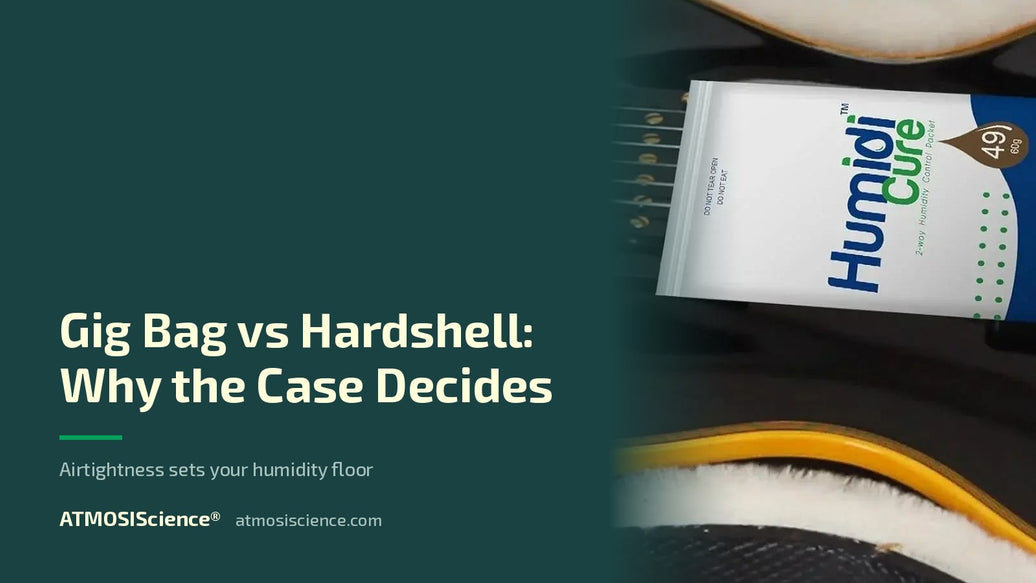
Load the system a day early. One 60 g Humidi-Cure® 49% pack (two for cello cases), indicator card at the headstock, lid closed overnight — you leave home with the case already stabilised at 49% and a baseline reading to compare on arrival. Fresh pack for a long tour: a well-sealed case gives about 3 months of service, and airline pressure changes do not bother a solid fiber pack — no liquid or gel means nothing to burst, weep or stain at altitude, and nothing for security to question.
Detune half a step if checking the instrument. Not a humidity measure — it eases stress on a neck riding through temperature swings in the hold.
In transit: the one rule that prevents most damage
After any large temperature change — winter curbside, hot tarmac, cold baggage hall — do not open the case for about 30 minutes. A cold instrument meeting warm indoor air fogs like eyeglasses; condensation on a freezing finish is how checking starts. The closed case forces the transition to happen slowly, which is the entire game. It is the same acclimation rule luthiers apply to instruments arriving by courier.

On arrival: read, do not guess
Open the case (after its 30 minutes), read the card, compare to your home baseline. Tropical arrival — Singapore, Bangkok, Miami in August: the pack switches to absorbing; keep the case closed except when playing, and expect the card to hold near 50% even as the hotel room runs 75%+ (the full tropical playbook is in the Singapore guide). Dry arrival — Denver, Phoenix, any heated northern city: the pack switches to releasing; same case discipline, same card checks (the US winter plan covers the heating-season end).
Shipping an instrument
Selling, sending to a luthier, or drop-shipping stock: the courier box is a case with worse seals riding through unheated trucks and depots for days. Protocol: pack and card inside the case, case inside the box, transit-time matched to pack life (a fresh pack covers any surface route), and a photographed card reading on both ends — sellers who ship this way convert “arrived safe” into a documented fact. Retailers and online sellers: per-shipment packs are a wholesale line item — wholesale programs or info@atmosiscience.com.

For players: one 60 g pack per guitar or violin case, two for cello cases and cabinets. Tour-ready: the 60 g Humidi-Cure® 49% pack →
Buying for a shop, school or fleet of cases? Wholesale tiers and custom RH programs are available — see wholesale programs or write to info@atmosiscience.com.
FAQ
Cabin or hold — which is safer for humidity?
Both run dry; the hold adds cold and rougher handling. Humidity-wise the sealed case + pack handles either; take the cabin when you can for the handling, not the humidity.
Will security flag the pack?
It is a solid-state pouch — no liquid, no gel, no powder loose in the case — and prints its purpose on the wrapper. It travels like a shoe-box desiccant, in carry-on or checked.
Fly-in gig, 90 minutes on the ground — is the 30-minute rule negotiable?
Shorten it only as far as the temperature gap allows: room-temp van to room-temp club, open away. Freezing curb to heated stage, the 30 minutes is cheaper than a finish-check repair.
Does a pack stabilise a wood instrument bought abroad and carried home?
Yes — that is the classic use. New purchase goes into a controlled case immediately, then acclimates to its new home country at the pack’s pace instead of the airport’s.
Get the printable pre-flight checklist
The full checklist — night-before loading, transit rules, arrival reads, shipping variant — formatted to tape inside a case lid. Tell the team where you tour and what you carry.
Prefer email? Write to info@atmosiscience.com — a specialist replies within one business day.