Quick answer: Most DIY humidity hacks fail in the same way: they are one-way and uncontrolled. A damp sponge or wet cloth only adds moisture (and can over-shoot into mold and swelling); rice and silica only remove it (and never stop at a safe level). Wooden instruments want a setpoint — 45–55% RH, held from both directions — which is exactly what a two-way pack does and a DIY hack cannot.
Every guitar forum has the thread: “just put a damp sponge in a soap dish,” “throw a bag of rice in the case,” “a glass of water near the guitar does it.” The instinct is right — humidity matters — but the physics of these hacks is wrong in a way that can cost you a top. Let’s take them one at a time, honestly.
The hacks, and why each falls short
| DIY hack | What it actually does | The problem |
|---|---|---|
| Damp sponge / wet cloth in the case | Adds moisture, fast and uncontrolled | One-way: no upper limit. Over-humidifies into swelling & mold; can drip and stain the finish |
| Bag of rice in the case | Absorbs a little moisture | One-way and weak: dries the case with no setpoint; sheds dust; useless in a dry winter (wrong direction entirely) |
| Loose silica gel packs | Absorbs moisture | One-way: keeps drying past the safe zone, then saturates silently — can push a case too dry |
| Glass of water near the guitar | Evaporates into the room | Affects the whole room barely at all; does nothing inside a case where it matters |
| Fruit peel / potato (yes, really) | Releases a little moisture, then rots | Uncontrolled, mold and pest risk against your instrument — never do this |
The common thread: none of them have a target. Wood does not want “more moisture” or “less moisture” — it wants to sit at 45–55% and stay there, as the sweet-spot guide explains. A one-way hack, even when it pushes the right direction today, keeps pushing until it over-shoots. That is how a well-meant damp sponge ends in a bellied top and a musty case.

What a two-way pack does instead
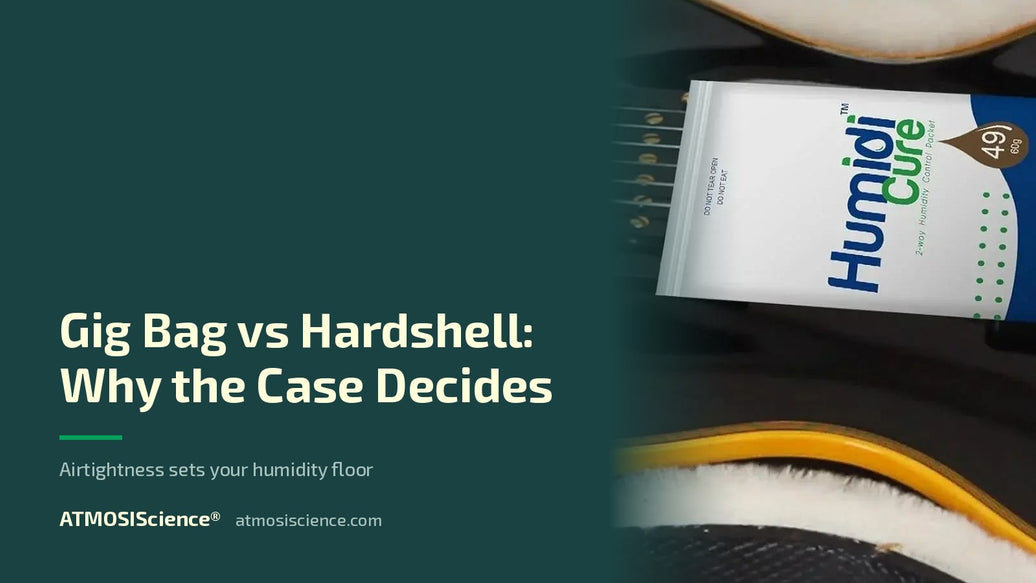
A two-way humidity pack is engineered around a setpoint. Below 49% RH it releases moisture; above it, it absorbs — and it stops at 49% ±2% in both directions. Drop one 60 g Humidi-Cure® 49% pack in a sealed case and the case simply settles at the safe number and holds, through a dry heating winter and a humid summer, with no daily fiddling, no refills, and no liquid or gel to drip on the wood. Why the fiber pack out-performs even the salt-solution packets some players graduate to is covered, with lab numbers, in the how-it-works article.

The one “DIY” step worth doing
Measure. The single most useful cheap thing you can add is an RH indicator card or hygrometer in the case, so you actually know what your instrument is living in instead of guessing. Pair it with a two-way pack and you have the whole system for the price of a set of strings — reading routine in the card guide.
For players: one 60 g pack per guitar or violin case, two for cello cases and cabinets. Skip the hacks: 60 g Humidi-Cure® 49% pack + card →
Buying for a shop, school or fleet of cases? Wholesale tiers and custom RH programs are available — see wholesale programs or write to info@atmosiscience.com.
FAQ
Can I not just re-wet a sponge carefully and watch it?
You can, and diligent players do — but it only humidifies, needs daily attention, and one forgotten week (or one spill) undoes it. A set-and-forget setpoint pack is safer for exactly the days you are busy.
Is rice genuinely useless?
For a dry winter case, yes — it dries, which is the wrong direction, weakly and without a stop. It is a moisture-absorber solving a moisture-loss problem.
What about DIY with a proper two-way pack in a food jar?
That is not a hack — that is the right tool in a good container. A sealed jar or a well-sealed case both work; the pack is what makes it controlled.
My climate is humid, not dry — do I still avoid the sponge?
Especially then. In a humid climate you need absorption with a floor, not added moisture — a two-way pack pulls down to 49% and stops; a sponge makes it worse.
Not sure what your instrument actually needs? Ask first
Tell the team your climate and how you store the instrument, and they will tell you honestly whether you need to add or remove moisture — and the simplest way to hold the setpoint.
Prefer email? Write to info@atmosiscience.com — a specialist replies within one business day.