Quick answer: Never leave a wooden instrument in a parked car if you can avoid it. On a 38°C day a closed cabin averages 47°C within an hour and the dashboard reaches 69°C — past the point where instrument glue joints begin to soften. Winter is just as harsh: a frozen car followed by a heated room swings relative humidity violently. If a car stop is unavoidable, keep the instrument in a closed hard case away from glass, park in shade, keep it under 30 minutes, keep a two-way Humidi-Cure® 49% pack inside the case, and let the case acclimate 30–60 minutes before opening.
Every touring player, weekend gigger and music parent eventually faces the same question: can the guitar stay in the car while I run in? The honest answer is that a parked car is one of the most hostile environments a wooden instrument ever meets — more extreme than any climate it will see indoors, whether you live in Texas, Queensland or Seoul. This guide covers the real numbers, what they do to wood and glue, and the field rules professionals use.
What a parked car actually does in one hour
Researchers at Arizona State University measured vehicles parked on 38°C (100°F) summer days. After a single hour in the sun, the average cabin air temperature reached 47°C (116°F), dashboards averaged 69°C (157°F), and seats 51°C (123°F). Even parked in the shade, cabins settled near 38°C (100°F). A car is a greenhouse: glass lets shortwave sunlight in and traps the re-radiated heat.

Why heat is a structural threat, not just a comfort issue
Instruments are assembled with heat-reversible adhesives. Traditional hide glue and most modern wood glues begin to soften and creep around 60°C (140°F) — a temperature the upper cabin and anything near glass can exceed. That is how bridges slide, braces let go and neck joints shift. Heat also softens finishes, which is why a case interior can print its plush pattern into lacquer on a hot day.
Heat attacks moisture too. Warming air without adding water collapses its relative humidity — roughly halving RH for every 10–11°C of warming. Case air that started at a healthy 49% RH can behave like desert air once the cabin soars, pulling moisture out of the top and fingerboard exactly when the glue holding them is at its weakest. The result after a bad afternoon: sunken top, sharp fret ends, open seams — the same drying damage covered in our 45–52% RH sweet-spot guide.
Winter: the swing in the other direction
A car parked overnight at −5°C chills the instrument to its core. Cold alone rarely cracks wood, but two things that follow it do. First, rapid rewarming: carrying a frozen guitar straight into a heated living room can craze brittle lacquer (cold checking) and, because heated indoor air is often desperately dry, the wood then sheds moisture fast. Second, condensation: warm room air meeting a cold instrument can film it with water. Players in ondol-heated apartments in Korea and forced-air homes in the northern US see this every January. The rule is simple: bring the case in, leave it shut for 30–60 minutes, then open it.
The risk table
| Scenario | Cabin conditions | Main risk |
|---|---|---|
| 38°C day, sun, 1 hour | ≈47°C air, 69°C dashboard | Glue creep, finish damage, rapid drying |
| 30°C day, shade, 1 hour | ≈38°C air | Drying, setup drift |
| Winter night, −5°C | Cabin tracks outdoor cold | Cold-checked finish, condensation on rewarm |
| Mild day, 20°C, closed case | Benign | Low — still lock it out of sight |
The six field rules
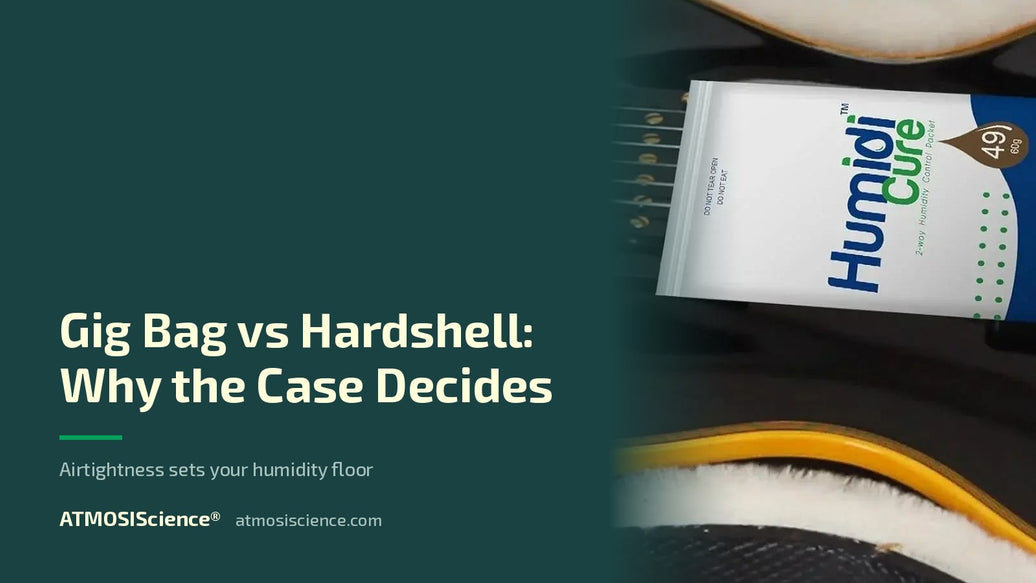
1. Shade beats sun; a shaded footwell or covered trunk area beats anywhere near glass. 2. Hard case shut — a flight-style case buffers swings far longer than a gig bag (see our case airtightness comparison). 3. Thirty minutes is the working limit in summer heat or hard frost. 4. Keep a two-way Humidi-Cure® 49% pack in the case year-round; it releases moisture as hot air dries the case and absorbs it back as things cool, holding ±2% of its setpoint. 5. After temperature extremes, let the closed case acclimate indoors before opening. 6. Flying instead of driving? Read the flying and touring humidity guide — the pressures differ but the logic is the same.

FAQ
How long can a guitar safely stay in a car?
In mild weather (15–25°C), a closed case in a shaded car is reasonably safe for a few hours. In summer sun or sub-zero cold, treat 30 minutes as the limit — and remember cabin heat keeps climbing for 2–3 hours.
Is the trunk safer than the cabin?
In sun, usually yes — no direct radiation. In winter they are equally cold. Either way the case, not the location, does most of the protecting.
Does loosening strings help in a hot car?
Slightly, for tension-related warping, but it does nothing about glue softening or drying. Prevention beats detuning.
My instrument already baked in a car — what now?
Bring it indoors in its closed case, let it acclimate an hour, then inspect: check action, seams, bridge edges and finish. Restore case RH with a fresh two-way pack and re-check over a week. Sudden buzzing or a lifted bridge means a luthier visit. Our humidity vs temperature guide explains which symptoms point where.
Travel-proof your case: Humidi-Cure® 49% Humidity Pack — 4-pack, $8.99 — two-way control at ±2% RH, no liquid or gel to leak in a hot car, food-contact-safe US-patented plant fiber, works for about 3 months per pack. See the full instrument collection.
Touring company, backline provider or store? Wholesale and case-insert programs: atmosiscience.com/pages/wholesale · info@atmosiscience.com
Ask us about transport humidity
Tell us how you move your instruments and we will recommend a pack setup. Or email info@atmosiscience.com.