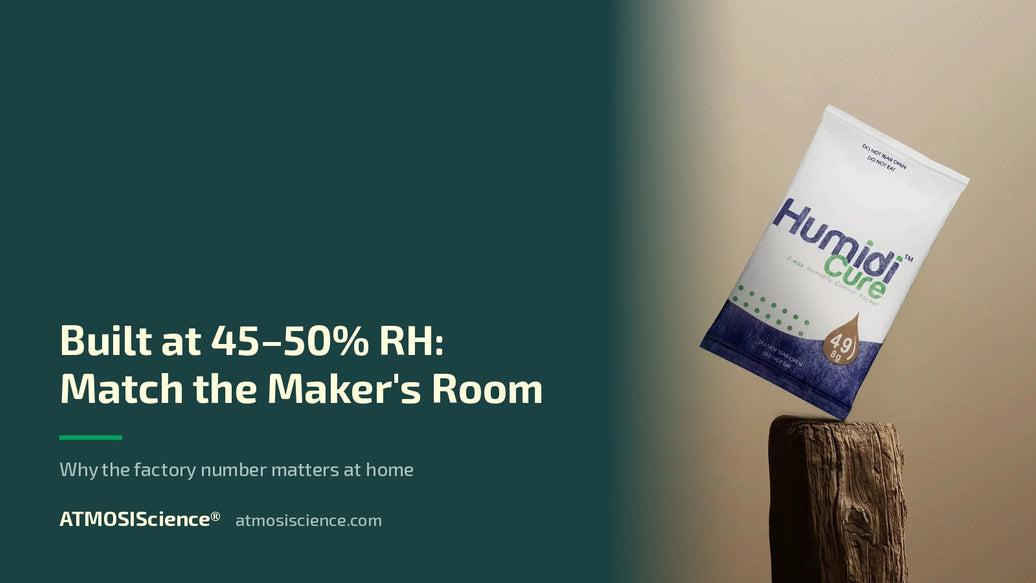
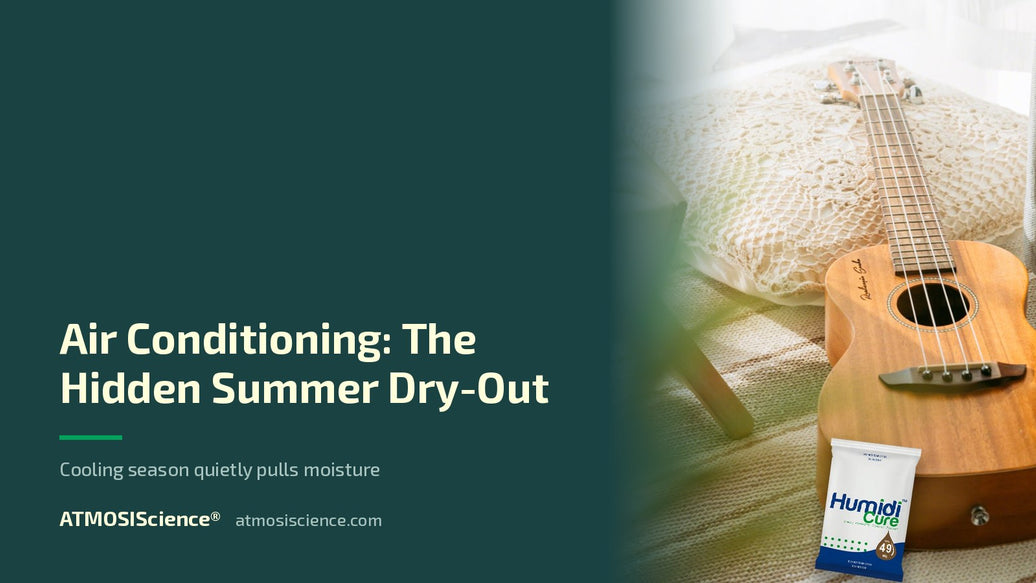
Quick answer: Everything in a woodwind case — grenadilla body, leather and felt pads, cork joints, cane reeds — is happiest in the same moderate band: roughly 45–55% RH, away from the mold zone above ~70% and the crack zone below ~40%. One Humidi-Cure® 49% two-way pack in the closed case holds 49% ±2% for about 3 months, adding moisture in dry rooms and absorbing it in humid ones.
Woodwind players usually fight humidity on three separate fronts: a humidifier tube for the instrument, a special box for reeds, silica gel somewhere for the mold smell. But the case you already close every day is a microclimate waiting to be set — and every component in it fails toward the same two extremes. Here is what too dry and too damp do to each part, and how to run the whole case at one setpoint.

One case, four failure modes
| Component | Too dry (heating season, aircon) | Too damp (tropics, monsoon) |
|---|---|---|
| Grenadilla / rosewood body | Bore shrinks around a wet interior — the classic crack scenario | Swollen tenons, tight rings, sluggish response |
| Pads (leather, felt, skin) | Dry, curl and lose seal — mystery leaks | Sticky pads, mildew spots |
| Cork joints & case lining | Cork shrinks, joints wobble | Musty case smell, mold in the plush |
| Cane reeds (backups in the case) | Brittle tips, dead response | Warping and visible mold above ~70% sustained |
The wet-bore problem — and what the case can fix
A wooden clarinet or oboe cracks for a specific reason: you blow warm, saturated air down the bore while the outside of the instrument sits in dry room air. The inside swells, the outside shrinks, and the stress has to go somewhere. The case cannot change what happens while you play — that is swabbing discipline and sensible warm-ups (our crack-prevention guide covers the full routine). What the case does control is the other 22 hours a day. An instrument that rests at 49% between sessions starts each day without accumulated shrinkage stress, pads keep their shape, and the bore-to-exterior gradient you create while playing starts from a safer baseline.
For reed players there is a second win. Backup reeds stored in the instrument case ride the same microclimate: stable enough that flat-sanded reeds stay flat, dry enough that mold never gets started. Players in Singapore and in Korea's jangma weeks tell the same story — the enemy is not dryness but weeks above 70% RH, where cane and pad leather grow spots. A two-way pack absorbs in that direction too; there is no liquid or gel involved, just a US-patented plant fiber sheet that is food-contact safe and compostable when spent.
Setting up the case
Place one Humidi-Cure® 49% pack in the largest free compartment (or flat under the neck strap area), clip an RH indicator card where you can read it at a glance, and close the case properly after every session — latches, not just the lid. Expect about 3 months per pack; a tight modern case runs longer, a battered school case shorter, because case airtightness is the number-one variable in pack life. Double reeds in a separate small reed case? Tuck it inside the main case so it shares the microclimate.


Protect it today: Humidi-Cure® 49% Humidity Pack — 4-pack, $8.99 · All instrument humidity control
Band program, hagwon or repair shop? B2B & wholesale: wholesale program · info@atmosiscience.com
FAQ
Is 49% the right humidity for reeds?
It is the right humidity for storing reeds alongside a wooden instrument: flat, stable and mold-free. Reeds you are actively playing get wet at every session anyway; what stored cane needs is freedom from the warp-and-mold cycling that big RH swings cause.
Does a plastic clarinet need this?
The body shrugs off humidity, but pads, cork and stored reeds behave exactly the same as on a wooden instrument. One pack still saves pads and reeds — it is simply less critical.
Can the pack touch the keywork?
Yes. There is no liquid or gel, so there is nothing to leak or corrode — keeping RH moderate actually protects plating and springs from the humid extreme.
My case smells musty already. Now what?
Empty it, wipe it, air it in sunlight for an afternoon, then run a fresh pack — the absorb direction keeps the lining below mold territory. Our mold & mildew guide has the full protocol.
Get a free case-setup plan
Or email info@atmosiscience.com.