Quick answer: A 12-string top carries roughly 40 to 50 percent more string pull than a 6-string, so humidity damage shows up sooner and costs more. Keep the case in the 45–55% RH zone with a Humidi-Cure® 49% pack (two for jumbo cases), check a hygrometer monthly, and treat any change in action height as an early warning rather than a setup quirk.
Twelve-string players usually meet humidity the hard way. The guitar that sounded huge in June starts buzzing in January, the action creeps up in a muggy August, and one day a business card slides under the back edge of the bridge. None of that is bad luck. It is physics working on a top that was already doing twice the work.
Why a 12-string lives under more stress
String maker tension charts put a light-gauge 12-string set at roughly 230 to 260 pounds of pull, compared with about 160 to 180 pounds for a comparable 6-string set. All of that extra load runs through the same few square inches of glue: the bridge, the bridge plate and the braces. The strings also anchor behind the saddle, so they are constantly trying to rotate the bridge forward and peel its back edge off the top.
A healthy top handles this for decades. A top that has been pushed out of the 45–52% RH sweet spot is a different story, because wood that is swelling or shrinking is already under internal stress before the strings add theirs.
The dry path: sunken top, low action, stressed glue lines
Taylor Guitars tells owners to keep guitars in a comfortable range of 45 to 55 percent relative humidity, and its dry-guitar symptom list reads like a 12-string owner's winter diary: a sunken top between the bridge and fingerboard, low action that turns into fret buzz, sharp fret ends and a hump where the neck meets the body. The movement is not small. By Taylor's own example, a 16-inch-wide spruce top shrinks almost 1/8 inch when RH falls from 47% to 30%.
As the top sinks, the geometry around the bridge changes and the glue line takes shear it was never meant to carry. On a 6-string that may stay invisible for years. Under 12-string tension, a tiny glue-line failure grows into a visible lift much faster.

The damp path: belly, rotation and a rising action
Above roughly 60% RH the top absorbs moisture and swells. Since the edges are glued down, the extra material has nowhere to go but up, and the top bellies behind the bridge. The bridge rotates forward with it, the saddle leans, action rises, and the back edge of the bridge starts to lift. High humidity also softens glue joints over time, which is exactly what a joint under 250 pounds of load does not need.
Read the symptom, find the direction
| What you notice | Likely direction | First move |
|---|---|---|
| Action dropped, new buzzing, sharp fret ends | Too dry | Case the guitar with a fresh 49% pack and let it rehydrate for a week before judging the setup |
| Action rose, visible belly behind the bridge | Too humid | Same pack, opposite job: two-way fiber absorbs the excess and settles the top back down |
| A card slides under the back edge of the bridge | Either, made worse by tension | Drop tuning a whole step, stabilize at 49%, book a luthier before it grows |
| Finish cracks near the bridge or fingerboard extension | Repeated swings | Stop the cycling first, then repair. See our repair cost math |
A case routine that holds 49%
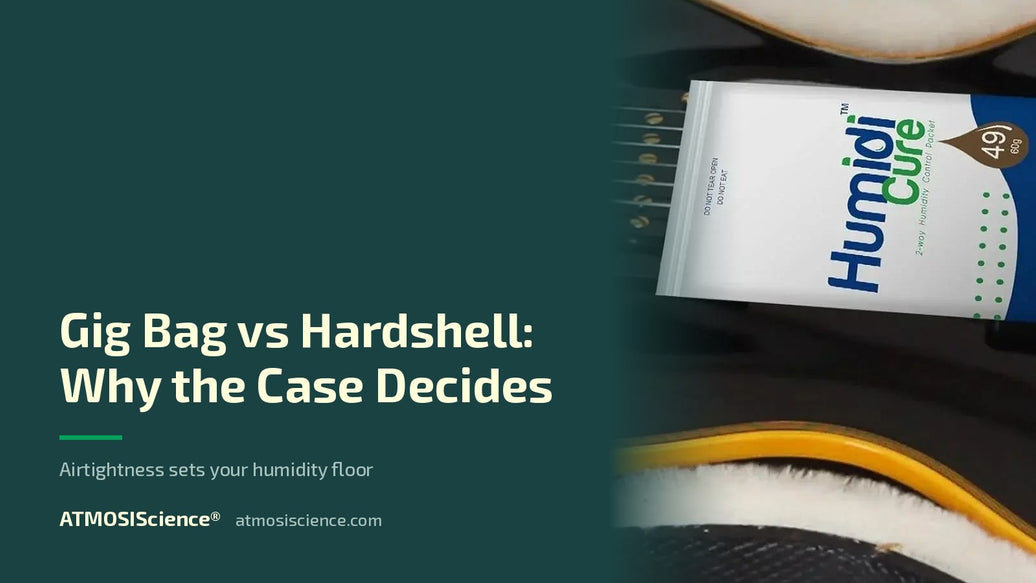
Because a 12-string punishes both directions, one-way humidifiers that only add moisture solve half the problem. A two-way pack regulates in both directions: Humidi-Cure® 49% holds the case at 49% RH within about 2 points, adding moisture in a dry winter and absorbing it in a sticky summer, with no liquid or gel anywhere near your finish. The fill is a US-patented plant fiber that is food-contact safe and compostable when spent.
Most 12-strings live in dreadnought or jumbo cases, which usually want two 60 g packs. Expect about 3 months of service per pack, and remember that case airtightness is the number one variable: a gappy vintage case works the packs harder than a modern sealed one. Our dosing guide covers the edge cases.

Where you live sets the schedule. Heating season in the US Midwest and Northeast can pull a music room below 20% RH, and ondol-heated apartments in Korea do the same. Inland Australia adds dry heat in summer, while Singapore sits humid all year, which means the same pack simply spends more of its life absorbing. The routine does not change, only the direction of the work.
FAQ
Should I detune a 12-string for storage?
For storage longer than a month, easing every string down a half step to a whole step takes a meaningful load off the top while keeping the neck under some tension. For day-to-day playing, tuned to pitch inside a 45–55% case is exactly what the guitar was built for.
Is bridge lift always a repair job?
A true gap under the bridge needs a luthier, but caught early it is usually a routine reglue rather than a rebuild. The expensive cases are the ones that kept playing for months while the gap grew.
How many packs does my case need?
One 60 g pack for parlor and concert cases, two for dreadnought and jumbo cases, which covers most 12-strings.
I live somewhere humid. Do I still need this?
Yes, and arguably more. Humid climates push tops toward belly and bridge rotation, and air-conditioned rooms overdry them. A two-way pack handles both without you thinking about it.
Protect the twelve: Humidi-Cure® 49% Humidity Pack, 4-pack of 60 g packs, $8.99, or browse the full instrument humidity collection.
Music stores, studios and schools: see the wholesale program or write to info@atmosiscience.com.
Ask us about your 12-string
Tell us your model, your case and your city, and we will suggest a dosing and check schedule for it.