Quick answer: A guitar on a wall hanger is fully exposed to room air — it will track whatever your room does, hour by hour, season by season. If the room reliably sits at 45–55% RH, wall display is fine. If it does not — heated winters, air-conditioned summers, tropical humidity — the case wins: as Taylor Guitars puts it, you are 'better off stashing it in the case, especially if the air is dry.' A closed case with a two-way Humidi-Cure® 49% pack holds ±2% regardless of what the room is doing. The practical answer for most players is a rotation: daily player on the wall, everything else cased and controlled.
The wall of guitars is the dream — instruments as furniture, always within reach, always saying 'pick me up.' Accessibility genuinely means more playing. But the humidity question decides whether that wall is a display or a slow-motion drying rack, and the answer depends entirely on the room behind it.
The physics of hanging in open air
Inside a closed case, the microclimate changes slowly and a humidity source can maintain it. On the wall there is no buffer at all: every radiator cycle, every air-conditioning run, every weather front passes straight over the wood. In a US or Korean heating-season room that can mean 20–25% RH for months — the range where spruce tops shed roughly 1/8 inch of width (47%→30%), fret ends emerge and cracks start. In a tropical apartment it means 70%+ and the swollen, dull-sounding guitar of our symptom checker. The wood does not care that it looks great up there.

When the wall is actually fine
Wall display works when the room is controlled: a dedicated music room with a humidifier/dehumidifier holding 45–55%, a hygrometer you actually read, and instruments hung away from exterior walls, windows, radiators and vents. Home-studio owners often already run this setup — our studio humidity guide covers it. Two placement rules save most wall casualties: never above or beside a heat source, and never on an exterior wall that goes cold in winter (the guitar bridges the temperature gap and collects condensation risk).

Wall vs case, honestly scored
| Factor | Wall hanger | Case + 49% two-way pack |
|---|---|---|
| Humidity stability | Tracks the room, swing for swing | Held at 49% ±2% year-round |
| Play frequency | Excellent — instant access | One latch away |
| Dust, UV, finish fade | Constant exposure | Protected |
| Cost to make safe | Whole-room climate control | $8.99 per 4-pack |
The rotation routine
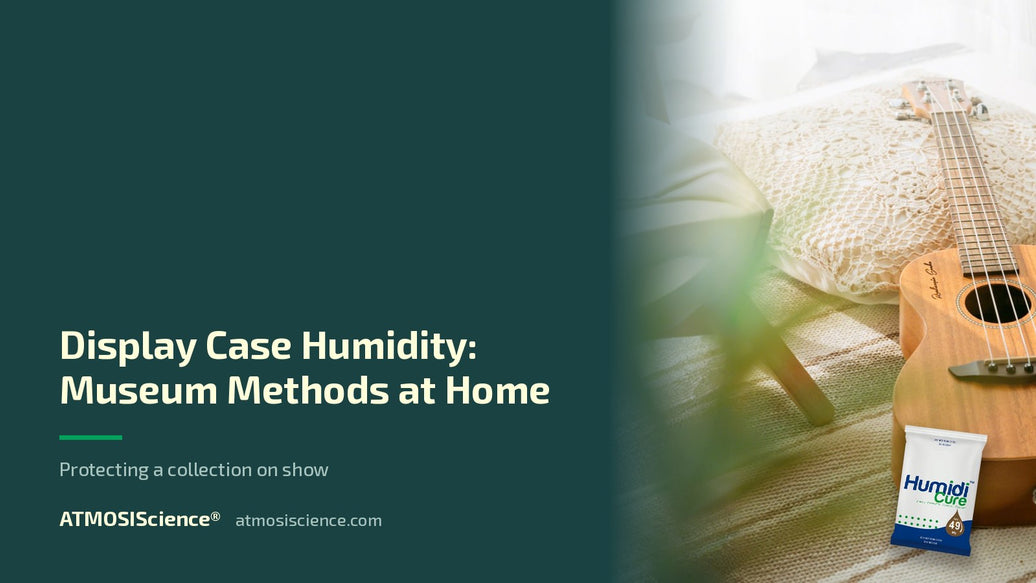
Serious multi-guitar owners usually land on the same compromise. The one or two instruments in heavy rotation live on the wall (interior wall, away from vents) where they get played daily — frequent playing also means frequent inspection. Everything else lives latched in cases, each with a two-way pack quietly holding 49% — no liquid or gel near the finish, about 3 months per pack, and the case's airtightness makes the biggest difference to pack life (gig bags leak; see the case airtightness comparison). Swap which guitar hangs as your playing changes. For glass display cabinets — the third option — see our display case guide, which behaves much more like a case than a wall.
FAQ
Does hanging by the headstock hurt the neck?
No — a guitar's own weight in a proper yoke is trivial next to string tension. The humidity of the air around it is the real exposure, and it is the room's humidity, not gravity, that does damage.
Can I humidify a hung guitar?
Only by humidifying the room. Soundhole devices work in a closed case; in open air their output vanishes into the room. Room humidifiers work but need refilling, cleaning and electricity — the wall guitar's care bill is the room's care bill.
What about a guitar on a floor stand?
Identical exposure to the wall, plus knock-over risk. Same rules: fine in a controlled room, risky elsewhere.
How fast does a hung guitar dry out in winter?
Surface layers start within hours; measurable setup change within days to a week; structural risk builds over weeks at 20–30% RH. It follows the room to the edge of the safe zone and keeps going.
Case-side of the rotation, sorted: Humidi-Cure® 49% Humidity Pack — 4-pack, $8.99 — one pack per cased guitar, ±2% two-way control. Full collection here.
Outfitting a showroom wall? Ask about display + case programs: wholesale · info@atmosiscience.com
Planning a guitar wall?
Tell us your room and climate — we will tell you what is safe to hang. Or email info@atmosiscience.com.