Quick answer: Singapore averages roughly 80% relative humidity year-round — nearly 30 points above the 45–55% window wooden instruments need. The realistic strategy is not humidifying (there is already too much water in the air) but controlled absorption inside the case: a sealed hard case plus a two-way 49% pack that drinks the excess and stops at the setpoint, so the instrument never over-dries the way it can in a dry cabinet.
Guitarists and string players in Singapore, Kuala Lumpur, Bangkok and Manila fight the opposite battle from players in Boston or Seoul: ambient air sits at 70–90% RH every month of the year. Wood answers with the full high-humidity symptom set — a bellied top behind the bridge, action creeping upward, glue joints softening, strings and frets oxidising faster, and in bad cases mold blooming on the case lining. None of it is cosmetic: a swollen soundboard changes the neck angle, and a softened glue joint is structural.
Local players know the traditional answers: air-conditioning, dehumidifier rooms, and electric dry cabinets. Each works — and each has a catch.
The three local fixes, and where they fall short
| Approach | What it does well | The catch |
|---|---|---|
| Air-conditioning the room | Drops both temperature and absolute moisture while running | RH rebounds within hours of switching off; nobody air-cons an empty room 24/7 |
| Electric dry cabinet | Reliable low humidity for storage | Most are tuned for cameras (35–45%); a guitar parked at 38% for months develops dry symptoms — and the cabinet stays home when you gig |
| Silica packs in the case | Cheap, absorbs moisture | One-way: keeps absorbing past the safe zone, then saturates silently; no setpoint, no signal to replace |
The gap in all three: no setpoint. Wooden instruments do not want “as dry as possible” — they want 45–55% and stability, as the sweet-spot guide explains. That is exactly what a two-way system is for.
The case-level protocol for tropical climates
1. Hard case, kept closed. A decent hard case is a slow-exchange micro-climate; a gig bag is not a moisture barrier. In 80% ambient air, an open stand is a swelling programme.
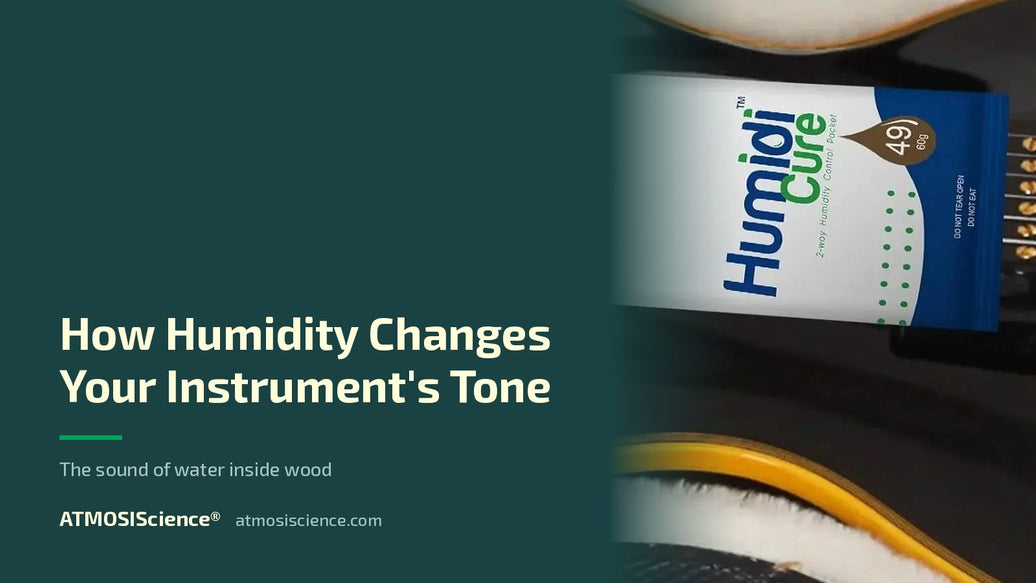
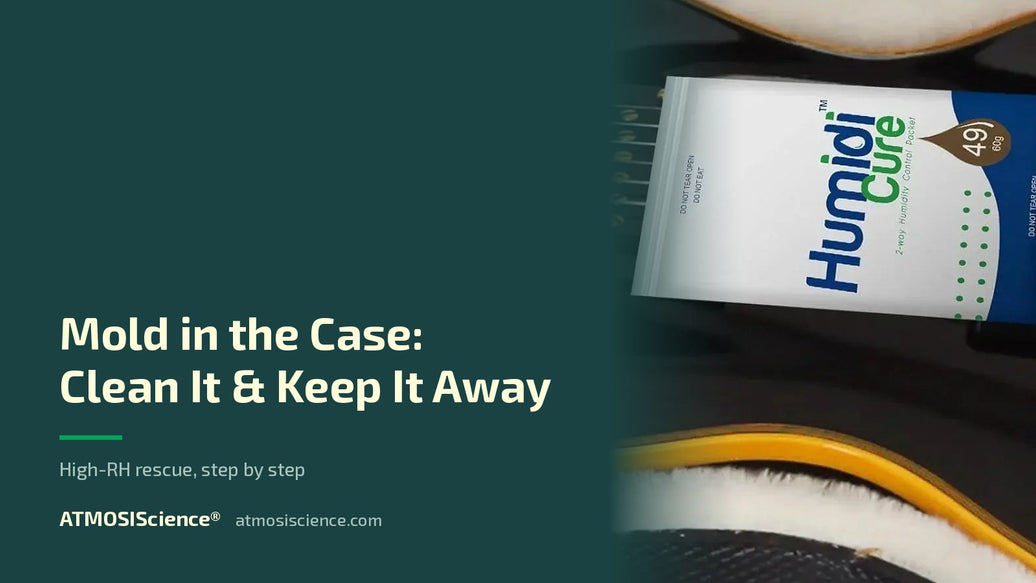
2. One 60 g Humidi-Cure® 49% pack inside. In Singapore conditions the pack spends most of its life absorbing — pulling the case down toward 49% and stopping there, ±2%. Because it is a plant-fiber pack with no liquid or gel, tropical heat cannot make it leak, sweat or stain varnish; it can rest directly on the instrument.
3. An RH indicator card at the headstock. First read after 24 hours; healthy is around 50%. In tropical use, watch the wet side: if the card reads 60% or higher for more than a day, the case is leaking air faster than the pack can absorb — check the seal, or step up to two packs for oversized or frequently-opened cases.


How long does a pack last at 80% ambient?
Pack life depends on one variable above all: how airtight the case is and how often it opens. In a well-sealed hard case opened for normal daily practice, expect about 3 months of service; in a leaky case, a humid rehearsal studio, or a case opened many times daily, it can be significantly shorter. The pack tells you when it is done: it turns firm and stiff to the touch once saturated (the touch test), and the indicator card stops returning to the healthy band. Full detail in the card-reading guide.
Travelling out of the tropics
Flying Singapore → Seoul or Singapore → Sydney swaps one extreme for another within hours. The same pack works in both directions — it releases moisture in dry air instead of absorbing — which is why touring players standardise on one system rather than swapping tools by destination. See the touring survival guide.
For players: one 60 g pack per guitar or violin case, two for cello cases and cabinets. Get the 60 g Humidi-Cure® 49% pack →
Buying for a shop, school or fleet of cases? Wholesale tiers and custom RH programs are available — see wholesale programs or write to info@atmosiscience.com.
FAQ
Do I still need this if my studio is air-conditioned all day?
Aircon helps while it runs, but RH rebounds after hours and on weekends — and condensation cycles as rooms warm back up add their own moisture swings. The pack rides through both.
Will the pack fight my dry cabinet?
Use one system per space. Inside a cabinet set to 45–50%, no pack is needed; inside the case you gig with, the pack is the cabinet you carry.
Can mold grow on the pack itself?
The fiber material is engineered for repeated moisture cycling and is food-contact safe. Replace it when saturated rather than sun-drying it — regeneration attempts change its calibration.
My room hits 90% during monsoon season. Two packs?
For standard guitar and violin cases one 60 g pack remains the dose; two packs suit cello cases, cabinets and cases with tired seals. If the card still reads ≥60% after 48 hours with the case closed, the seal — not the dose — is the problem.
Get the tropical-case protocol as a one-page PDF
Tell the team what you play and how you store it. You will get the Singapore/SEA case protocol sheet — dose, card placement, replacement signals — plus a sample-kit option for schools and shops.
Prefer email? Write to info@atmosiscience.com — a specialist replies within one business day.