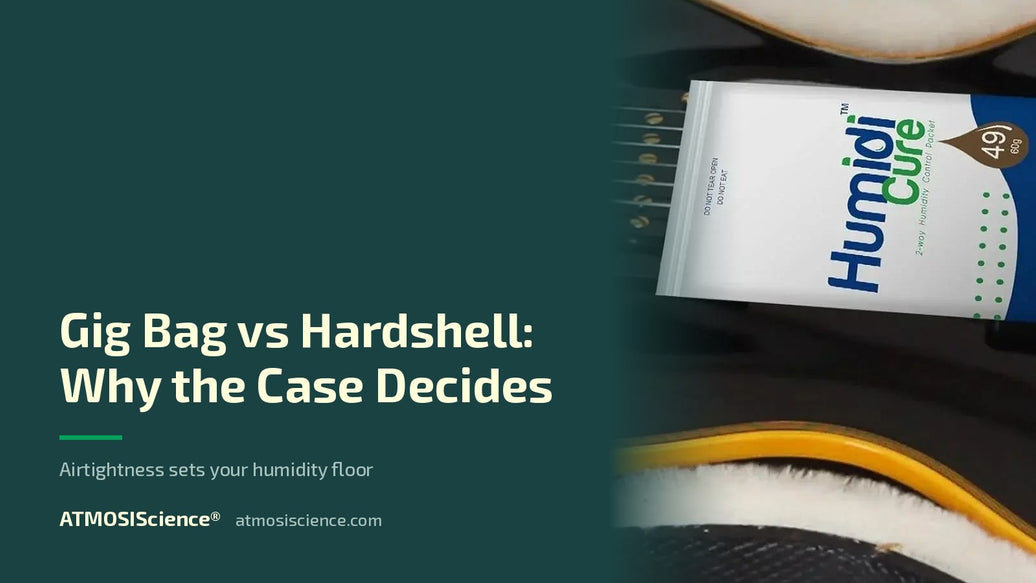
Quick answer: Yes — electric guitars and basses need humidity control too. The solid body tolerates more than a hollow acoustic, but the fingerboard is wood on every electric, and fret sprout (sharp fret ends from a shrinking board) is one of the most common winter repairs on Strats, Les Pauls and basses. A two-way 49% pack in the case holds the neck at a stable 45–55% and keeps those fret ends where they belong.
“It’s a slab of maple and alder — it doesn’t care about humidity.” Every guitar tech has heard it, usually from someone holding a guitar with fret ends you could file a nail on. Solid-body electrics are more forgiving than a thin-topped acoustic — there is no braced soundboard to sink or crack — but forgiving is not immune, and the one part that always reacts is the one your hand is on.
Fret sprout: the electric player’s winter tax
A fingerboard — rosewood, maple, ebony, pau ferro — is a strip of wood glued across the neck grain. When the room dries out, the board shrinks across its width while the metal frets, which do not shrink, stay put. The result is fret ends that poke past the edge of the board and catch your fretting hand: fret sprout. It is not a fret problem; it is a humidity problem wearing a fret costume, and dressing the ends without fixing the air just means it returns next winter. The whole dry/humid symptom set for necks is mapped in the 12-point symptom checker.

What else moves on an electric
| Part | Too dry (below ~40%) | Too humid (above ~60%) |
|---|---|---|
| Fingerboard | Fret sprout, sharp edges; board can hairline-check | Board swells, frets feel low; sluggish feel |
| Neck relief / setup | Back-bow tendency; buzzing; action drops | Forward bow; action rises; intonation drifts |
| Bound edges & finish | Binding can shrink and crack away from the wood | Finish clouding on nitro; sticky feel |
| Hardware & strings | — | Faster fret and string oxidation; rust on unplated steel |
| Set-neck joints (glued) | Glue lines can stress as woods contract unevenly | Glue creep in extreme, prolonged damp |
Semi-hollow and hollowbody electrics (335-style, jazz boxes) sit in the middle: they have real tops and f-holes, so they behave more like acoustics and deserve full acoustic-grade care.
The setup argument every player understands
Even if you never crack a thing, humidity swings wreck your setup. A neck that back-bows in January dry air and forward-bows in July damp is a neck you are constantly chasing with truss-rod and saddle tweaks. Hold the case at a steady 49% RH ±2% with a two-way pack and the neck stops moving — one setup lasts, instead of two visits to the tech a year. One 60 g Humidi-Cure® 49% pack per case, about 3 months per pack, no liquid or gel to leak onto pickups or hardware.

Touring and gigging electrics
Trunk to stage, cold curb to hot club — the same swings that check an acoustic’s finish fog an electric’s and stress the neck. Let a cold guitar warm up in the closed case ~30 minutes before opening, and keep the pack in for transit; the full routine is in the touring guide.
For players: one 60 g pack per guitar or violin case, two for cello cases and cabinets. Get the 60 g Humidi-Cure® 49% pack for your case →
Buying for a shop, school or fleet of cases? Wholesale tiers and custom RH programs are available — see wholesale programs or write to info@atmosiscience.com.
FAQ
My guitar is maple-necked with a maple board. Still?
Yes — finished maple boards resist a little better, but fret sprout on maple-necks is still a standard winter ticket. The neck wood moves under the finish.
Do I need this for a cheap beginner electric?
Fret sprout does not check the price tag — and sharp fret ends turn a beginner off practising. A pack is cheaper than a fret dress.
What about the electronics — can the pack cause corrosion?
The opposite. It holds the case at a moderate 49%, away from the high-humidity zone where pots crackle and hardware rusts. Solid fiber, no liquid, nothing to drip on a pickup.
I keep my electric on a stand in a climate-controlled room.
If the room truly holds 45–55% year-round, a stand is fine. Most rooms swing with the seasons and overnight; the cased pack is the failsafe — and the only protection once the guitar leaves the room.
Chasing your setup every season? Fix the neck's climate
Tell the team what you play and where. You will get the electric-specific routine (dose, card placement, setup notes) — and bulk options if you are covering a band, studio or backline.
Prefer email? Write to info@atmosiscience.com — a specialist replies within one business day.