Quick answer: The moment forced-air heating switches on, indoor RH in northern US homes falls off a cliff — heated winter rooms can sink into the teens or lower, while wooden instruments need 45–55%. The seasonal plan: case closed from the first furnace day, one two-way 49% pack inside releasing moisture all winter, indicator card checked weekly, and a 30-minute warm-up in the case after any cold transit.
Every winter, repair benches across the northern US fill with the same three jobs: sharp fret ends, hairline top cracks, and action gone low and buzzy. The cause is not the cold — it is the heating. Cold outdoor air holds very little water; warm it to 70°F and its relative humidity collapses, which is why guitar makers describe heated winter homes sinking toward single-digit RH. A spruce top can lose close to 1/8 inch of width between 47% and 30% RH. Between November and March, an uncontrolled case is simply a slow press for that experiment.

The month-by-month plan
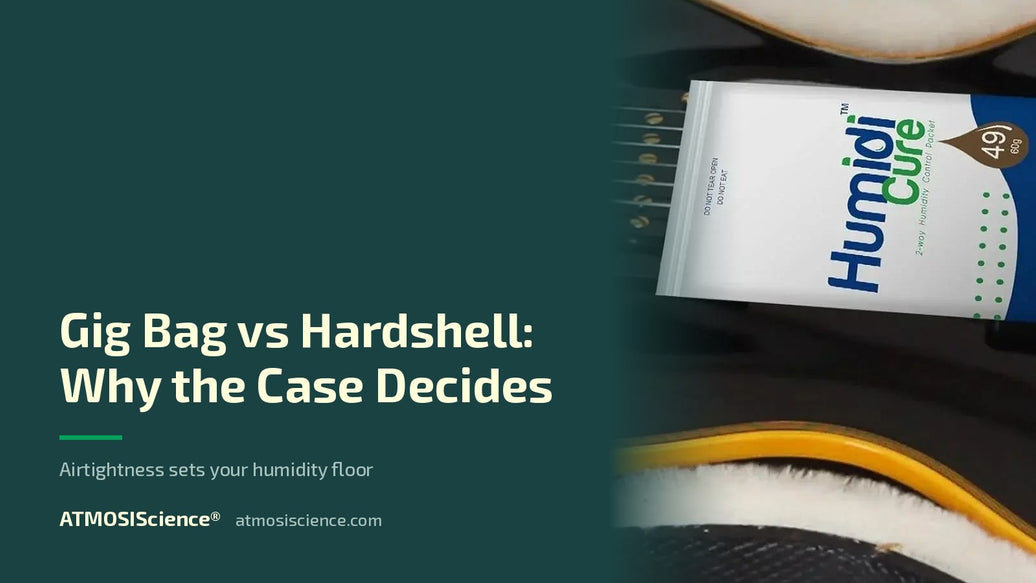
October — before first heat. Fit a fresh RH indicator card in every case (first accurate read after 24 hours). Put a 60 g two-way pack in each case now; activation takes 2–3 hours and the case stabilises within a day, so protection is in place before the furnace strips the room.
November–February — deep heating season. Cases stay closed and latched between sessions; every hour open on a stand undoes hours of the pack’s work. Keep cases away from vents, radiators and fireplaces, and off outside walls. Check cards weekly: healthy reads ~50%; a card stuck ≤40% for more than a day means the case is leaking faster than the pack can supply — check seals, or the pack has reached end of life (it turns light and stiff when spent — the touch test).
Gig nights. A guitar that rode in a 20°F trunk must warm up inside the closed case for about 30 minutes indoors before the latches open. Opening cold risks finish checking and condensation on the wood.
March–April — the rebound. As heating tapers, watch the card drift up. Spring in much of the US swings humid fast; the same two-way pack simply switches from releasing to absorbing — no gear change, unlike sponge humidifiers that must come out before the wet season or they push the case past 60%. The full product-class comparison is in packets vs sponges vs gels.

Why 49% and not a soundhole humidifier?
Sponge-and-tube humidifiers add moisture only — the right direction in January and the wrong one by May — and their output falls as they dry, so the case rides a sawtooth between refills. A two-way 49% pack holds 49% ±2% continuously: it releases exactly as fast as the case loses moisture, then stops. No refills, no drips (plant fiber, no liquid or gel — nothing to leak through a soundhole onto braces), about 3 months of service per pack in a well-sealed case. The dose: one 60 g pack per guitar or violin case, two for cello cases and storage cabinets. Why the setpoint sits at 49% is covered in the 45–52% sweet-spot guide.
Whole-collection and studio notes
Room humidifiers are a fine complement for a dedicated music room — but they need daily water, die over vacation weeks, and fight every ceiling vent in the house. The resilient pattern used by collectors and teaching studios: room humidifier as the coarse control, a pack in each case as the fine control and the failsafe. Teaching studios and stores running dozens of cases: the fleet programme is in the music-store guide, and wholesale tiers are at wholesale programs.
For players: one 60 g pack per guitar or violin case, two for cello cases and cabinets. Get winter-ready: the 60 g Humidi-Cure® 49% pack →
Buying for a shop, school or fleet of cases? Wholesale tiers and custom RH programs are available — see wholesale programs or write to info@atmosiscience.com.
FAQ
My house hygrometer says 35% — is that really an emergency?
At 35% damage is a matter of weeks, not hours — but heating cycles overnight can be pulling the room far lower than the daytime reading. The card inside the case tells the truth that matters.
Radiator humidifiers, stovetop kettles, houseplants — do they help?
Marginally and unreliably. None of them move a whole-house forced-air system more than a few points. Case-level control is the only lever a player fully owns.
Do electric guitars need this too?
Solid bodies tolerate more, but fret sprout is a fingerboard phenomenon — and fingerboards are wood on every guitar. Winter fret sprout on electrics is a standard February repair ticket.
When exactly do I replace the pack?
When it goes stiff to the touch or the card stops returning to ~50% — typically around 3 months into heavy heating-season duty. The card guide shows both signals.
Winter-proof your cases: get the checklist + a bulk option
Tell the team how many instruments you are protecting this winter. You will get the October checklist as a printable sheet — and multi-case pricing if you are covering a studio, band or classroom.
Prefer email? Write to info@atmosiscience.com — a specialist replies within one business day.