Quick answer: Any hygrometer you actually look at beats a perfect one you ignore. Consumer digital units typically read within ±2–5% out of the box (professional handhelds spec around ±3%), analog dials drift and need regular recalibration, and every one of them can be sanity-checked at home with the 75% salt test. Put the sensor inside the case at instrument height, read it weekly — and remember a hygrometer only reports the problem; a two-way Humidi-Cure® 49% pack is what fixes it.
Musicians buy hygrometers the way people buy bathroom scales: once, cheaply, and with total faith in the number. But an uncalibrated hygrometer that reads 8 points high will happily tell you your case is "fine" at a true 38% RH while your top sinks. This guide covers the three sensor types worth considering, what accuracy claims really mean, the salt calibration test, and where the sensor should live.
The three types worth buying (and one that isn't)
| Type | Typical accuracy | Strengths | Watch out for |
|---|---|---|---|
| Analog dial (hair/spring) | ±5–10% and drifts | No battery, looks great on a shelf | Needs recalibration every few months; slow to respond |
| Digital (sensor + LCD) | ±2–5% typical | Cheap, compact, fits in a case pocket | Quality varies wildly at the same price; verify with salt test |
| Bluetooth / app logger | ±2–3% typical | History graphs — see what happened overnight or on tour | Battery and app dependency; overkill for one case |
| RH indicator card | Zone-level (colour bands) | No battery ever, instant glance, costs almost nothing | Shows zones not decimals — perfect companion, not a lab meter |
The type not worth buying: a phone weather app. It reports the airport's humidity, not your case's. The two environments routinely differ by 20 points or more.

The salt test: calibrate anything in one evening
Physics gives us a free calibration standard: air above a saturated solution of ordinary table salt stabilises at 75% RH (75.3% at 25 °C — a textbook constant used by calibration labs). The procedure:
1. Put a spoonful of table salt in a bottle cap and dampen it with a few drops of water — wet sand texture, no standing water.
2. Seal cap and hygrometer together in an airtight container or zip bag with as little extra air as possible.
3. Wait at least 8 hours (overnight is ideal) at stable room temperature, away from sun and vents.
4. Read without opening. A perfect sensor shows 75%. Whatever yours shows, the difference is its offset — a unit reading 70% runs 5 points low, so a case reading of "44%" from that unit is really about 49%.
Write the offset on a sticker on the back, re-test every 6–12 months, and retire any unit that's more than 8–10 points out or gives different answers on consecutive tests.
Placement: measure where the wood lives
Put the sensor inside the case, in the accessory compartment or beside the upper bout — not clipped outside, not in a lid pocket pressed against the shell's outer wall, and not on a bookshelf across the room. Room and case are different climates; the case is the one your instrument inhabits 20+ hours a day. If you monitor one thing, monitor the case; if you monitor two, add the room where the case is stored. Sudden disagreements between the two tell you the case seal or your humidity pack needs attention — the diagnostic flow is in the symptom checker.
A monitor reports. A two-way pack governs.
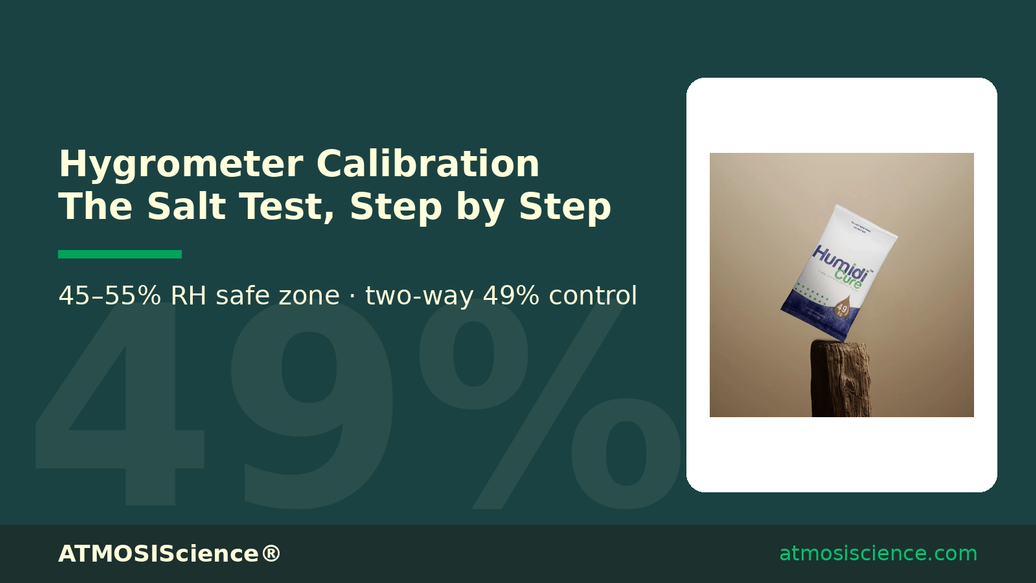
The hygrometer's job ends at the number. Holding the number is the job of a controller: a Humidi-Cure® 49% pack releases moisture when the case runs dry and absorbs it when the case runs damp, holding 49% RH with ±2% accuracy — tighter than most consumer hygrometers can even measure. No liquid or gel, food-contact-safe plant fiber, about 3 months per pack with case airtightness the number-one variable. Monitor weekly, refresh quarterly, and the graph goes flat — which is exactly what our sealed-box lab data shows.

FAQ
My new digital hygrometer and my old dial disagree by 12 points. Which is lying?
Possibly both. Salt-test each one and apply the offsets; the disagreement usually collapses to a couple of points. Trust whichever unit repeats its salt-test result consistently.
How often should I recalibrate?
Every 6–12 months for digitals, more often for analog dials, and any time a reading surprises you. Sensors age, especially cheap capacitive ones.
The case reads 40% even with a fresh pack inside. Is the pack weak?
First salt-test the hygrometer. If it's honest, your case is leaking — worn gasket, warped lid or a case left open daily. Airtightness is the number-one variable in both pack life and holding power; the sealed-case method shows how far a tight case can go.
Do I need a logger, or is a card enough?
For one instrument at home: an indicator card plus an occasional digital check is plenty. For touring, collections or a store floor, a logger's history graph earns its price the first time you find out what Sunday night did to the shop.
Close the loop: Humidi-Cure® 49% Humidity Pack — 4-pack, $8.99 · All instrument humidity control
Outfitting a store or studio with monitors and packs? Wholesale · info@atmosiscience.com.
Ask a measurement question
Next: what the numbers should be and why, in the 45–52% RH sweet spot.