Quick answer: For a vintage or antique instrument, stable humidity is not maintenance — it is value protection. Old hide glue, thin aged wood, French polish and shellac all move with the air, and a single dry winter can open a seam or check a finish that knocks real money off an appraisal. Keep it cased at a steady 45–55% with a two-way 49% pack, and the wood that has survived decades keeps surviving.
A collector once described the moment perfectly: a pre-war archtop that had been fine for 80 years developed a top crack in the three weeks a new forced-air furnace ran in a dry apartment. Nothing hit it. The air did. Age does not make an instrument tougher against humidity — in many ways it makes it more delicate, because everything holding it together is old too.
What’s different about old instruments
Hide glue joints. Traditional animal hide glue — used on violins, old archtops, fine acoustics — is itself hygroscopic. In damp it can soften and creep; in dry swings the joints it holds are stressed as plates shrink. Seams that open are common on antiques for exactly this reason (a violin’s open seam is often, by design, the glue letting go before the wood cracks).
Thin, aged wood. Decades of playing and drying leave old tops lighter and often thinner than modern equivalents, with less reserve against a dry spell.
Period finishes. French polish, shellac and thin nitro move with the wood and show it — finish checking (fine crazing) is a classic dry-cold signature, and on a collectible it is a value question, not just cosmetics.
Provenance and originality. The whole premium on a vintage instrument is that it is original. A crack repair, a re-glued seam, a refinish — each is a note on the appraisal. Preventing the damage preserves the value that repairs can only partly restore.

The conservation-grade routine
This is the same principle museums use for wooden artifacts, applied at case scale: hold a stable micro-climate and let the object stop reacting to the weather.
Original case, sealed and stable. If the vintage case still seals, use it; if its lining is degrading, a modern hard case protects better. Either way, keep it closed.
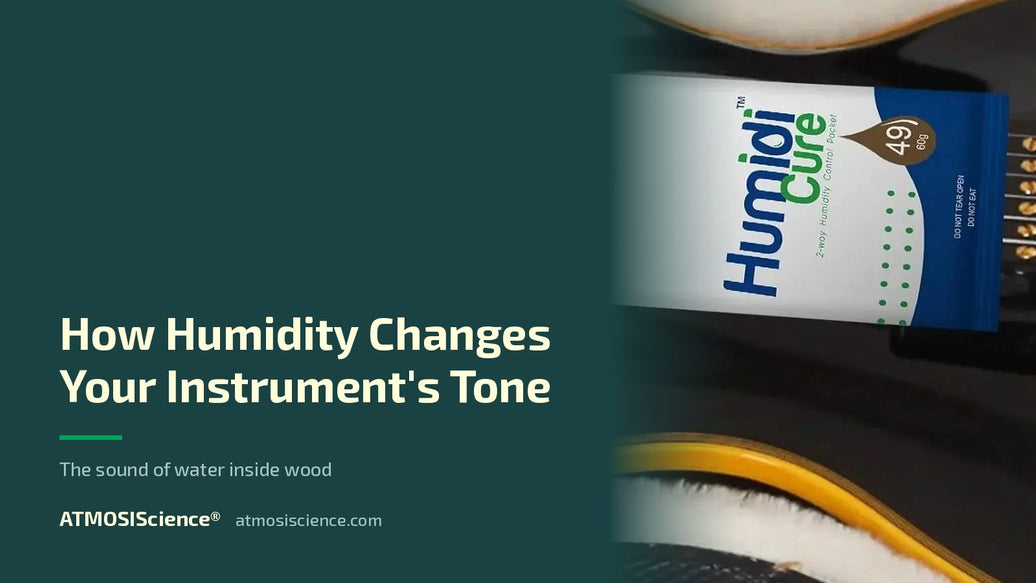
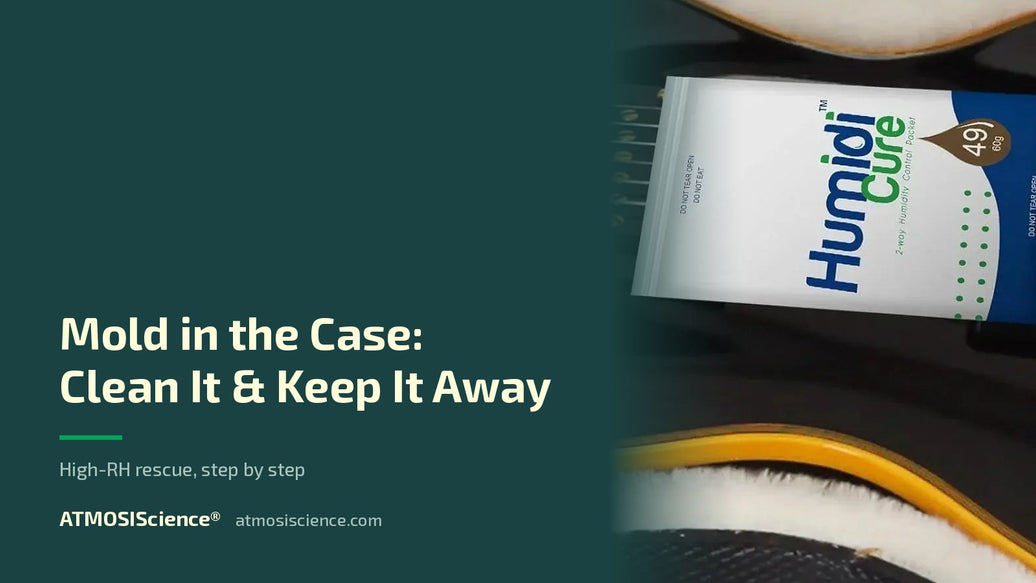
One 60 g Humidi-Cure® 49% pack (two for a large archtop, cello or cabinet). It holds 49% RH ±2%, releasing in dry heat and absorbing in damp. Critically for an antique, it is a solid plant-fiber pack with no liquid or gel — there is nothing to leak onto a French-polished top or corrode old hardware, so it can sit safely near irreplaceable finishes. About 3 months per pack; trust the card, not the calendar.
An indicator card, checked and logged. A monthly reading logged on a card is also a provenance record — documented, stable storage is exactly what a serious buyer or insurer wants to see. Reading routine in the card guide; long-away storage in the sealed-case method.

Before you buy, sell or ship one
Acclimate slowly. A vintage instrument arriving from a different climate should warm to room temperature inside its closed case and equalise over a day or two before it is opened, tuned to pitch or played hard — cold, dry-shipped old wood meeting a warm humid room is where transit cracks happen. Shipping tips are in the travel & shipping guide.
For players: one 60 g pack per guitar or violin case, two for cello cases and cabinets. Protect the value: 60 g Humidi-Cure® 49% pack →
Buying for a shop, school or fleet of cases? Wholesale tiers and custom RH programs are available — see wholesale programs or write to info@atmosiscience.com.
FAQ
Will a humidity pack devalue my instrument or leave residue?
No — it is inert solid fiber with no liquid, gel or off-gassing to touch the finish. It is the wet sponge and gel humidifiers that carry a spill risk near a collectible.
My antique violin’s seams keep opening. Is that the humidity?
Very often yes — open seams are hide glue releasing under humidity swings. Stabilise the case first; then a luthier re-glues seams that stay open, and they hold far longer at steady RH.
Is 49% right, or should a vintage piece be drier?
45–55% is the conservation band for aged wood; 49% sits safely in the middle. Drier is not safer — below 40% is where old tops check and crack.
Does stable storage really matter for insurance or resale?
It matters for the wood and it reads well on paper. A logged, stable-RH history is the opposite of “stored in a dry attic,” and originality is the whole vintage premium.
Protecting a collectible? Get the conservation routine
Tell the team what you have and how it is stored. You will get the conservation-grade routine and card-logging sheet — and dosing for archtops, cellos and cabinets.
Prefer email? Write to info@atmosiscience.com — a specialist replies within one business day.