Quick answer: Teams packaging moisture-sensitive diagnostic and medical products often ask for a humidity-control layer laminated into the pouch film so the sachet disappears. Before committing, settle two things. First, the job: does the product need to be kept as dry as possible, or held at a set humidity? Those are different technologies. Second, the format: a laminated film fixes the dose in the material for every pack made from that roll, while a thin die-cut card keeps the dose adjustable per product and its capacity easy to document. A Fiber Desiccant Card is 0.7 mm or 1.0 mm thick and sits flat in a pouch; the 1.0 mm card holds about twice as much water as silica gel across 20 to 40% RH at 25 °C.
Removing the sachet from a sealed diagnostic pouch is an attractive idea. It deletes a loose component, a line step and a question from the user who opens the pack. That is why packaging engineers increasingly ask converters for an active film with the moisture control built into the laminate. Sometimes that is the right answer. Often a flat card placed in the pouch gets the same benefit with far less redesign. This guide helps you decide.
Step 1: name the job before the format
| The product needs | What does that | What to ask any supplier |
|---|---|---|
| As dry as possible | A one-way desiccant, which keeps pulling humidity down | Capacity at your target humidity, not only at 90% RH |
| Held at a set humidity | Two-way humidity control, which adds or removes moisture to hold a set point | The measured humidity curve at your set point, and how far it drifts |
The two are easy to confuse because they can look the same in a pouch. The risk is real: a desiccant in a product that needs a set humidity will over-dry it, and a two-way pack in a product that needs to stay dry will leave it too humid. Some reagents and membranes are sensitive in both directions. If yours is, ask for curves, not claims.
Step 2: compare film and card on the points that matter
| Question | Laminated film | Die-cut card in the pouch |
|---|---|---|
| How is the dose set? | By sorbent loading in the film and the pouch area. Same for every pack from that roll | By card size. Changed per product without touching the film |
| What if the product changes? | A new film may mean a new laminate qualification | Resize the card and confirm with a storage test |
| How is capacity documented? | Per square metre of film at a stated condition, if published | Per gram of card at stated humidity and temperature |
| What happens before packing? | The sorbent is working while film sits on rolls, so roll storage needs controlling | Cards stay sealed until placement, with written open-bag limits |
| Effect on the pouch build | Adds a layer to the laminate, which can change seal and barrier behaviour | Leaves the existing laminate as it is |
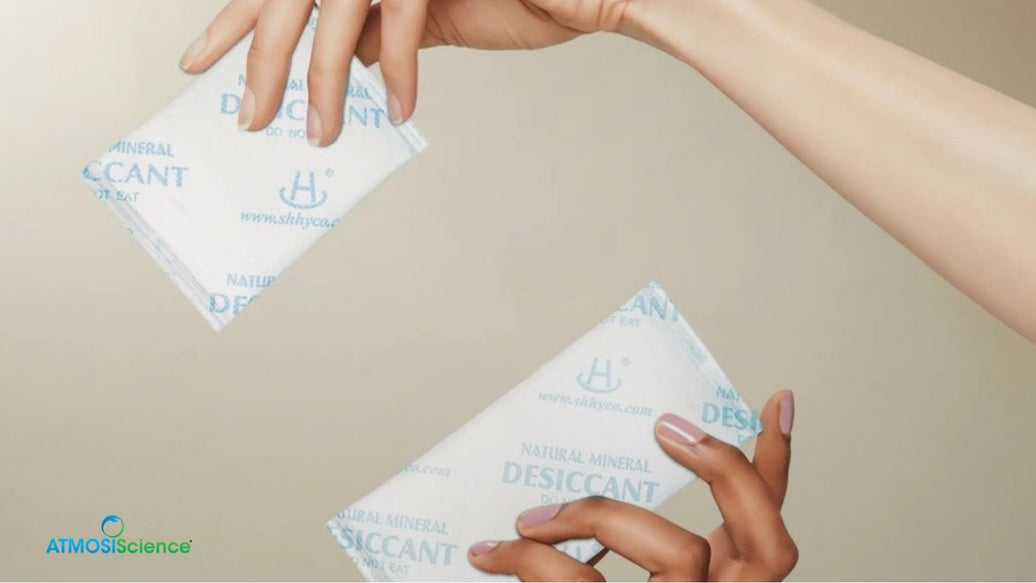
| User experience | Nothing loose in the pack | A thin flat card, not a puffy sachet, and it can carry a printed logo |
For a broader set of questions on active films, see desiccant film vs desiccant insert.

What the card brings when the job is keeping it dry
If the job is keeping the product dry, the low-humidity band is what matters, because that is where the desiccant has to keep working. Suitability for any medical or diagnostic use is not claimed here: qualification of the finished pack sits with the device maker.
| Fiber Desiccant Card | Value |
|---|---|
| Minimum adsorption, 25 °C | More than 10% of own weight at 20% RH, more than 35% at 50% RH, more than 70% at 90% RH |
| Against silica gel | The 1.0 mm card holds about twice the water of silica gel across 20 to 40% RH, and three times at 25 °C and 90% RH |
| Format | 0.7 mm or 1.0 mm card, die-cut to shape, logo printing available |
| Shelf life | 12 months from manufacturing date, unopened |
We supply the fiber as die-cut cards and sheets cut to shape, not as a laminated film. If your design calls for a laminated layer, send us the pouch structure and the humidity the product needs. We will tell you plainly whether a card can do the job instead, or whether your project needs a different route.
What to validate, whichever format you choose
- The finished pouch, not the material. Test humidity inside sealed, filled pouches across the shelf life you claim.
- Your real conditions. Include the warmest storage and shipping condition the product will see.
- Every process step. If the sealed pouch goes through any treatment after packing, test the moisture control through that same step.
- After opening. If the user opens the pouch and leaves it, decide how long the product must stay protected and test that too.
Our desiccant sizing calculator gives a first estimate from the pouch barrier, area and shelf life, and the sample evaluation protocol shows how to set up the confirming test.
Frequently asked questions
Is a laminated humidity-control film better than a desiccant card?
Not by default. A film removes a loose component but fixes the dose in the material. A card keeps the dose adjustable per product and leaves the existing laminate unchanged. Which is better depends on how many products share the pouch and how often they change.
What is the difference between a desiccant and two-way humidity control?
A desiccant keeps pulling humidity down. Two-way humidity control adds or removes moisture to hold a set point. A product that needs a set humidity can be over-dried by a desiccant.
How thin is a fiber desiccant card?
0.7 mm for compact packs or 1.0 mm for larger formats. It can be die-cut to shape and carry a printed logo.
Do you supply fiber desiccant as film for lamination?
No. We supply die-cut cards and sheets cut to shape. Send the pouch structure and target humidity and we will say whether a card can replace the laminated layer.
Check if a card can replace the film
Tell us what the product needs and how the pouch is built. We reply with a recommendation, a card size if it fits, and samples to test.
Prefer email? info@atmosiscience.com · More on our fiber desiccant: fiber desiccant for B2B
Figures from ATMOSIScience Fiber Desiccant Card product documentation and the measured adsorption curve at 25 °C.