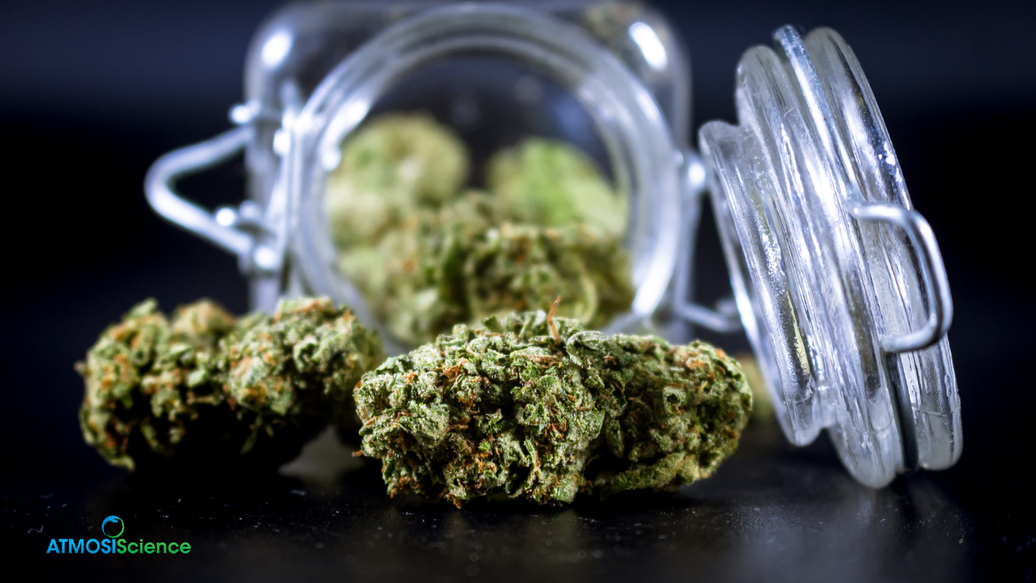
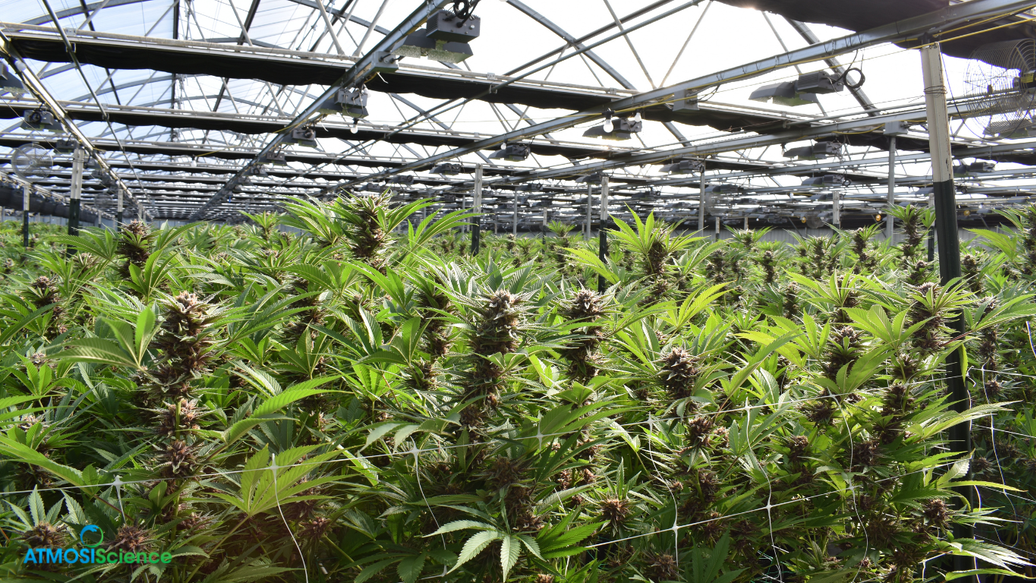
Commercial cannabis loses money in silence. A cultivator can harvest beautifully, dry on schedule, and hit every THC mark at lab — then watch 6–8% of that same batch evaporate in the curing room over sixty days because the bulk storage was off by four relative-humidity points. That's not a theoretical loss. A 500 lb/month cultivator at $1,200/lb wholesale who loses 6% of a batch to over-drying is handing $36,000 back to physics every thirty days.
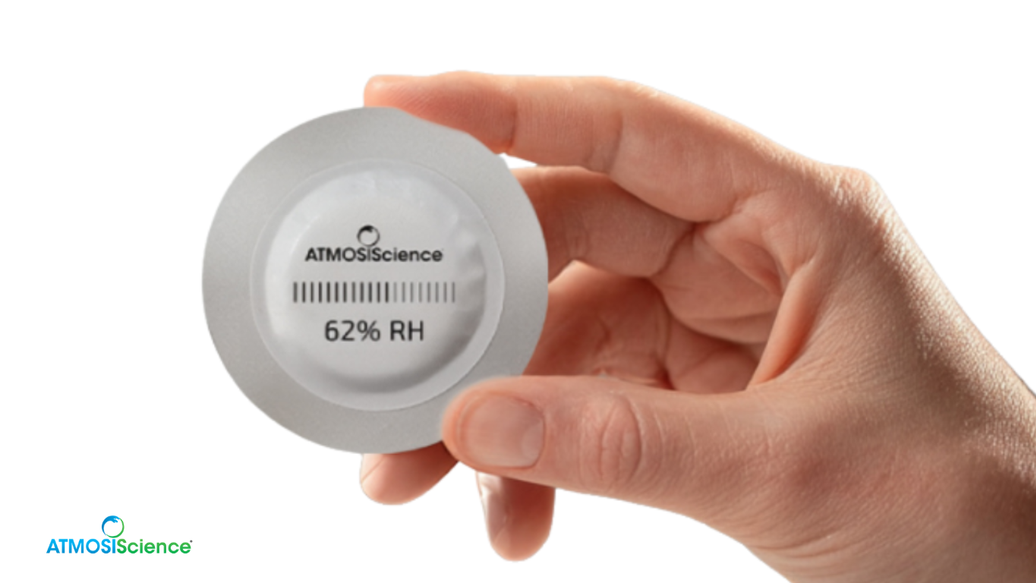
This is why 62% RH has become the reference standard for commercial bulk cannabis storage. Not 55%. Not "somewhere around 60." A narrow, defended, two-way-controlled 62% RH window inside the container itself.
This article walks through why the number landed where it did, what happens at every RH point above and below, and what a cultivator should actually look for in a bulk storage bag used for 1 lb and half-pound holding.
What happens to cannabis at each RH point
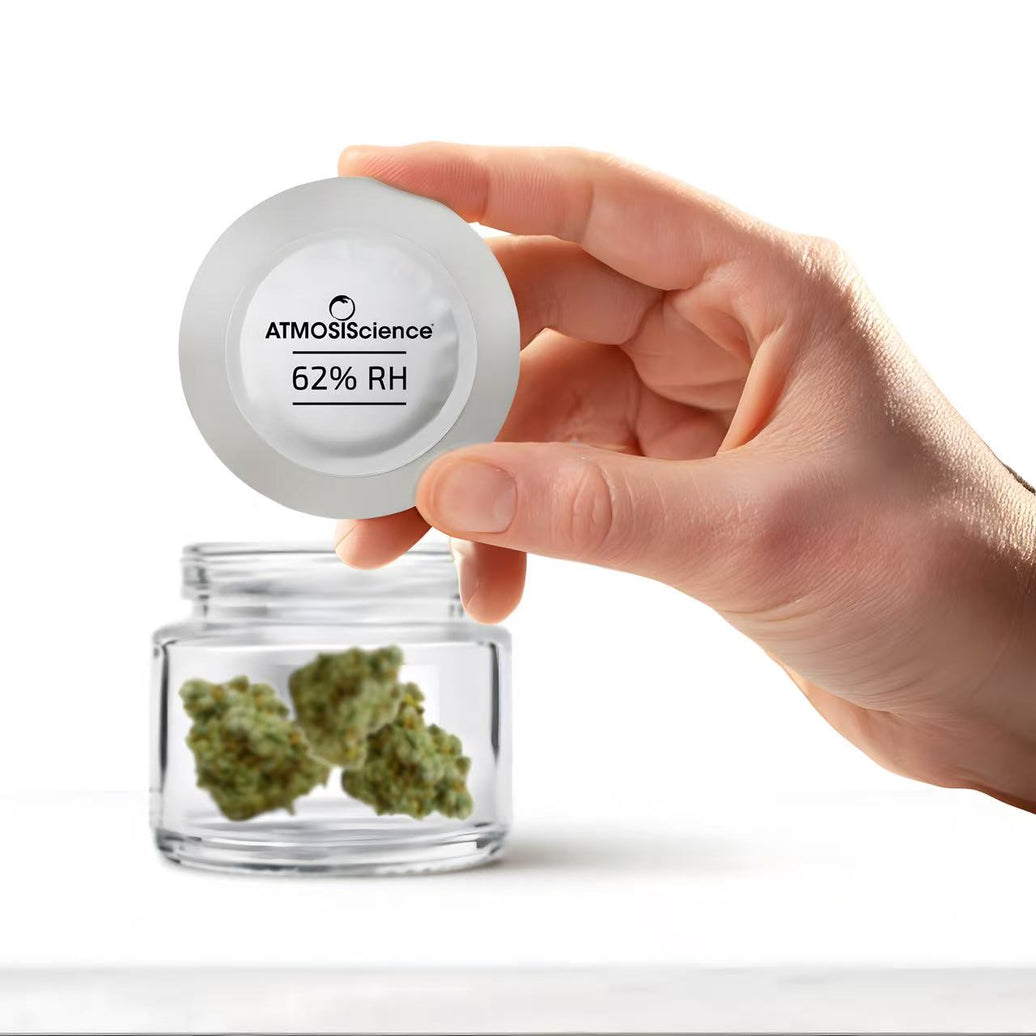
Relative humidity is the percentage of water vapor the air is holding versus what it could hold at that temperature. Cannabis flower is hygroscopic — it will give water to dry air and pull water from wet air until the two reach equilibrium. The only way to stop that drift is to put the flower inside a container with a medium that matches the target RH and refuses to move off it.
The team at ATMOSIScience has tested flower at every RH band in sealed commercial containers. The findings cluster neatly:
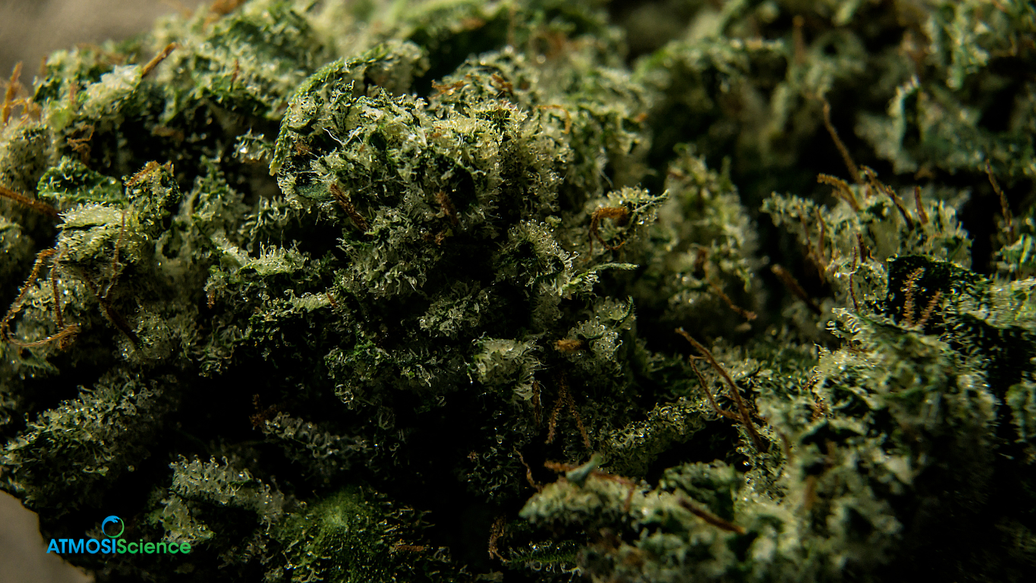
Below 55% RH — over-drying territory. Trichomes become brittle. Terpenes volatilize from the plant material faster than at any other RH range because monoterpenes like myrcene and limonene have low vapor pressure and prefer to exit dry matrices. Flower weight drops 4–9% over 30 days. Smoke gets harsher. Lab-measured terpene counts fall by 15–30% depending on strain.
55–58% RH — the "dry side" danger zone. Still over-drying, just slower. Many cultivators default here because older desiccant products settled to ~55%. The problem is cumulative: a pound sitting at 56% for 90 days loses more weight and more nose than a pound sitting at 62% for the same period.
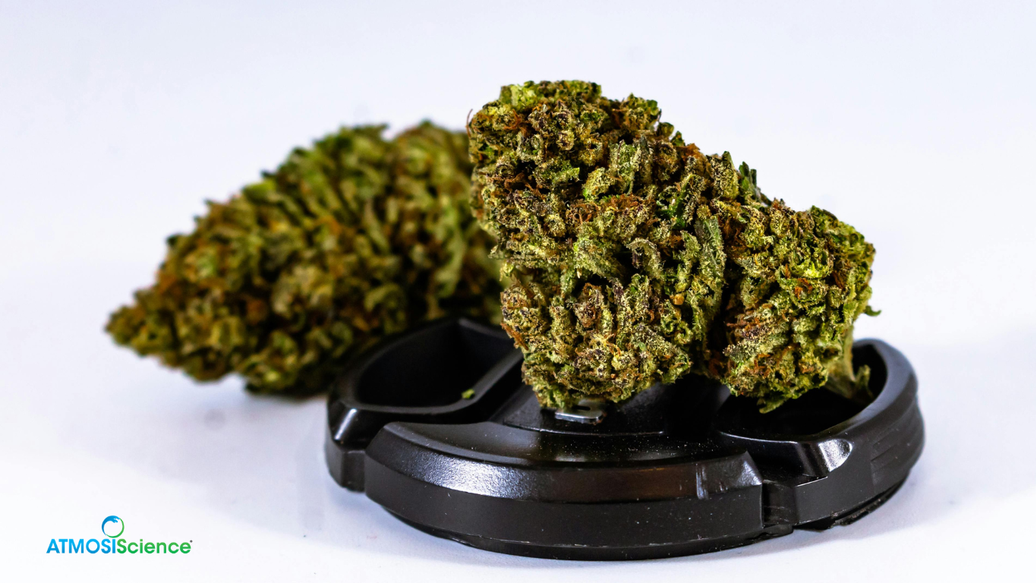
59–64% RH — the stability band. Trichomes stay glandular. Terpenes hold. Flower snaps rather than crumbles. This is the range where commercial cultivators who track lab retests see the flattest terpene decay curves.
65–68% RH — the wet side. Smoke is smoother but combustion gets uneven. Weight looks good but density feels spongy.
Above 68% RH — mold risk. Aspergillus, Botrytis, and Penicillium spores all germinate readily above 70% water activity in plant matter. Sealed containers at 70%+ RH over two weeks create measurable mold risk even on properly-cured flower. Regulators in CA, CO, NV, and MA all cite mold as the single largest reason for post-harvest lot failures.
62% RH is the center of the stability band. It leaves a safety margin on both sides: two points of buffer before over-dry, three points before the wet-side density issue, and six points before mold risk becomes real. That is why it became the standard.
Why one-way desiccants fail commercial storage
A lot of bulk flower still ships in bags with silica gel packets or mineral desiccants. Those are one-way — they pull moisture from the air until they are saturated, then they sit there. They cannot release moisture back into flower that has over-dried.
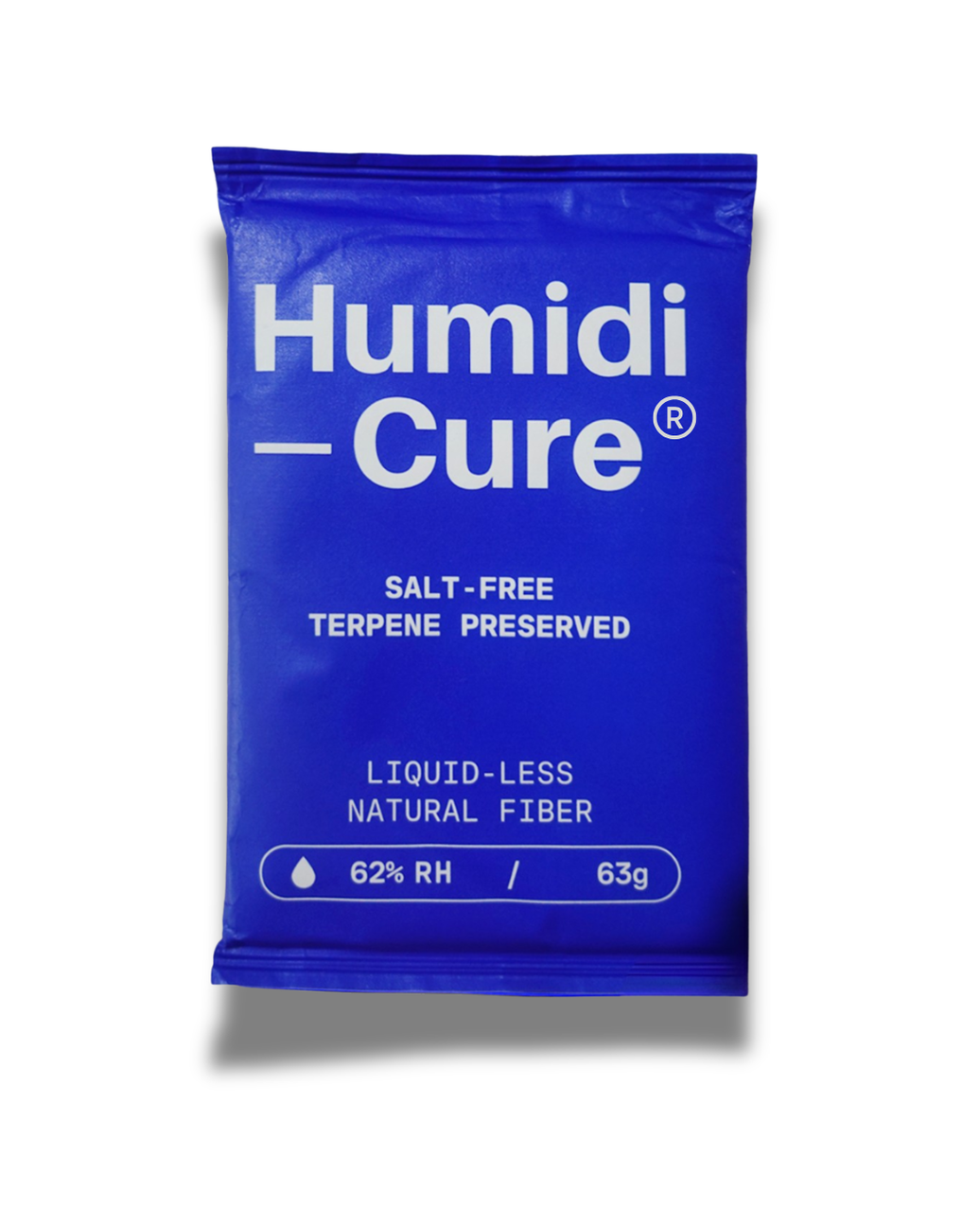
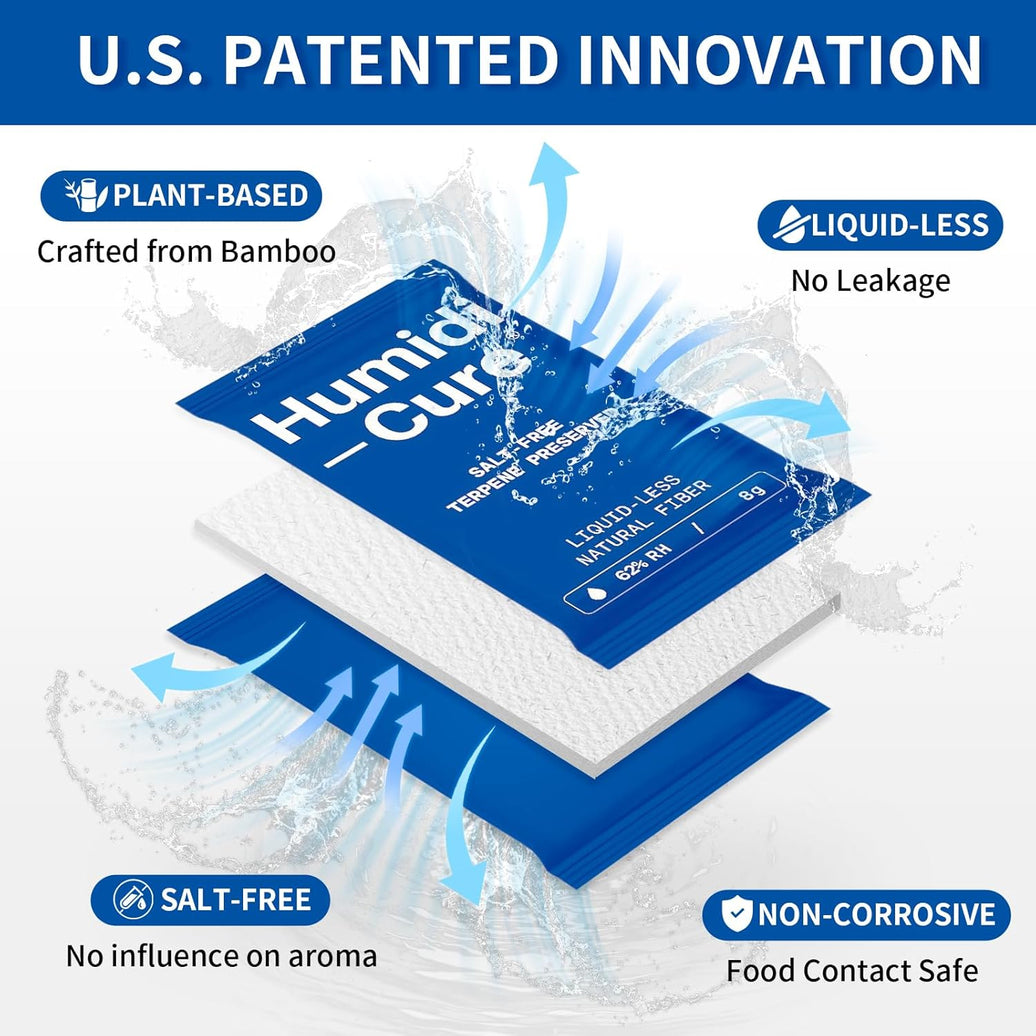
What a commercial cultivator actually needs is a two-way humidity control medium: something that both absorbs excess moisture and releases moisture back to the flower when the headspace RH drops below target. Two-way media hold the set point for the life of the container.
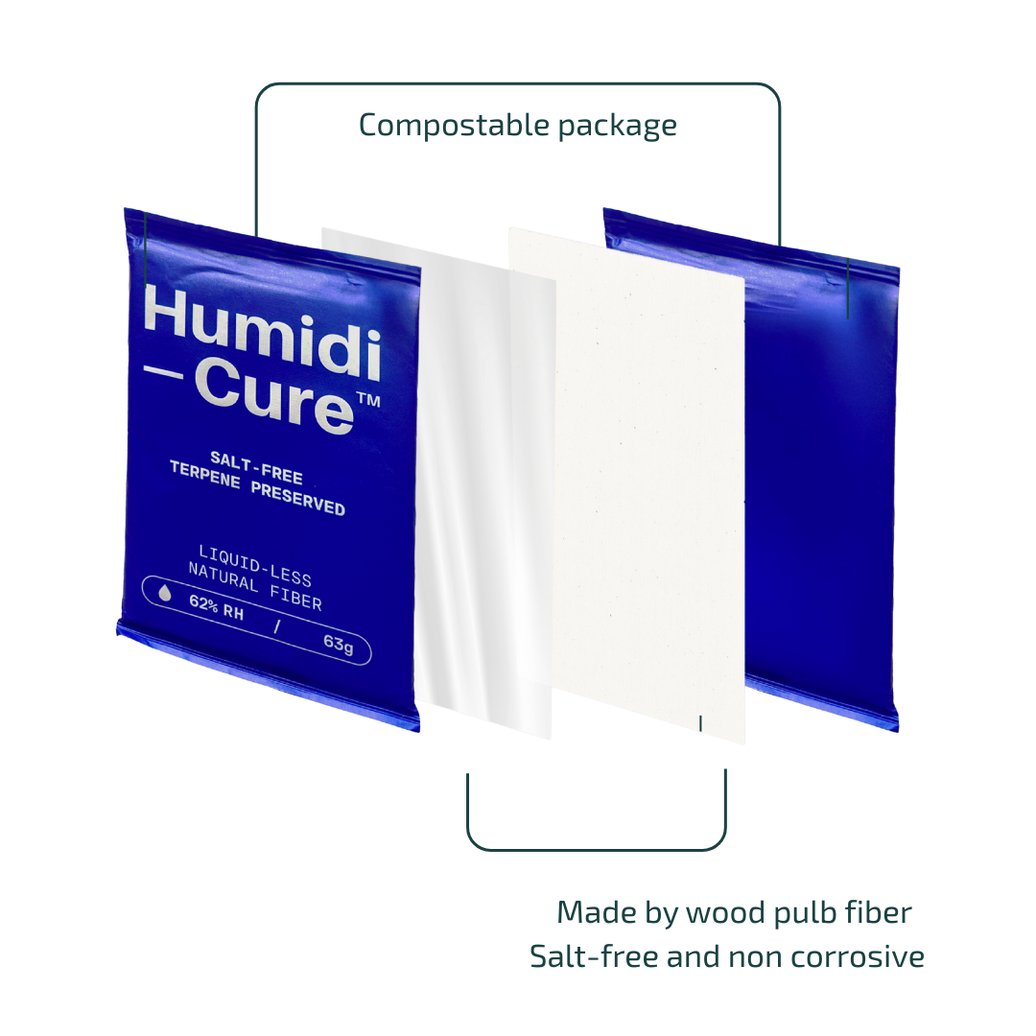
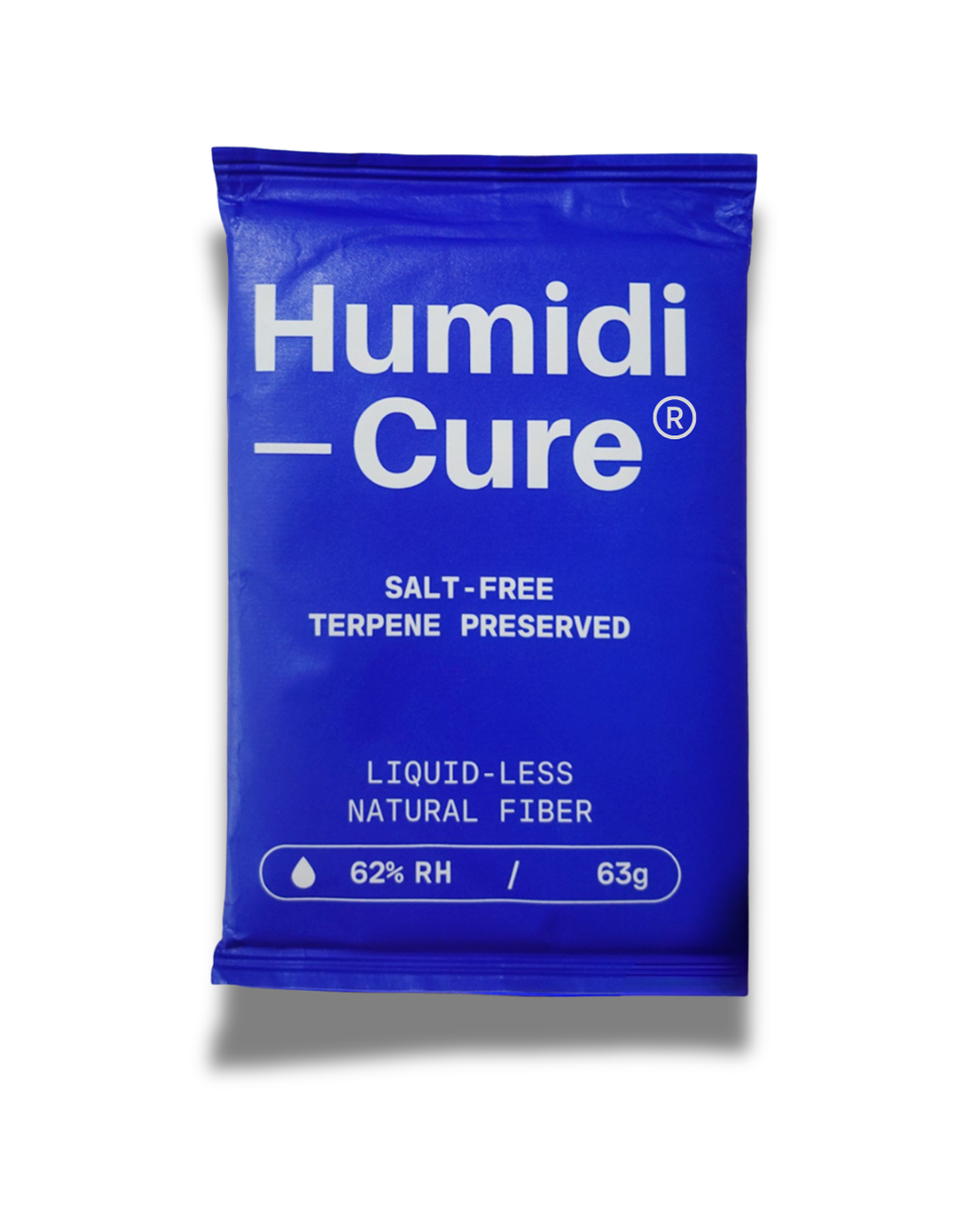
At ATMOSIScience, the two-way medium used inside the ruksak pouch is a bamboo-fiber matrix tuned to a fixed RH set point. The fiber is compostable, food-contact safe, and engineered to hold 62% RH within a ±1% tolerance across a 40°F–90°F ambient range. That means one pouch of flower behaves the same in an unconditioned warehouse in Humboldt in February as it does in an air-conditioned backroom in Denver in August.
What to look for in a commercial bulk storage bag
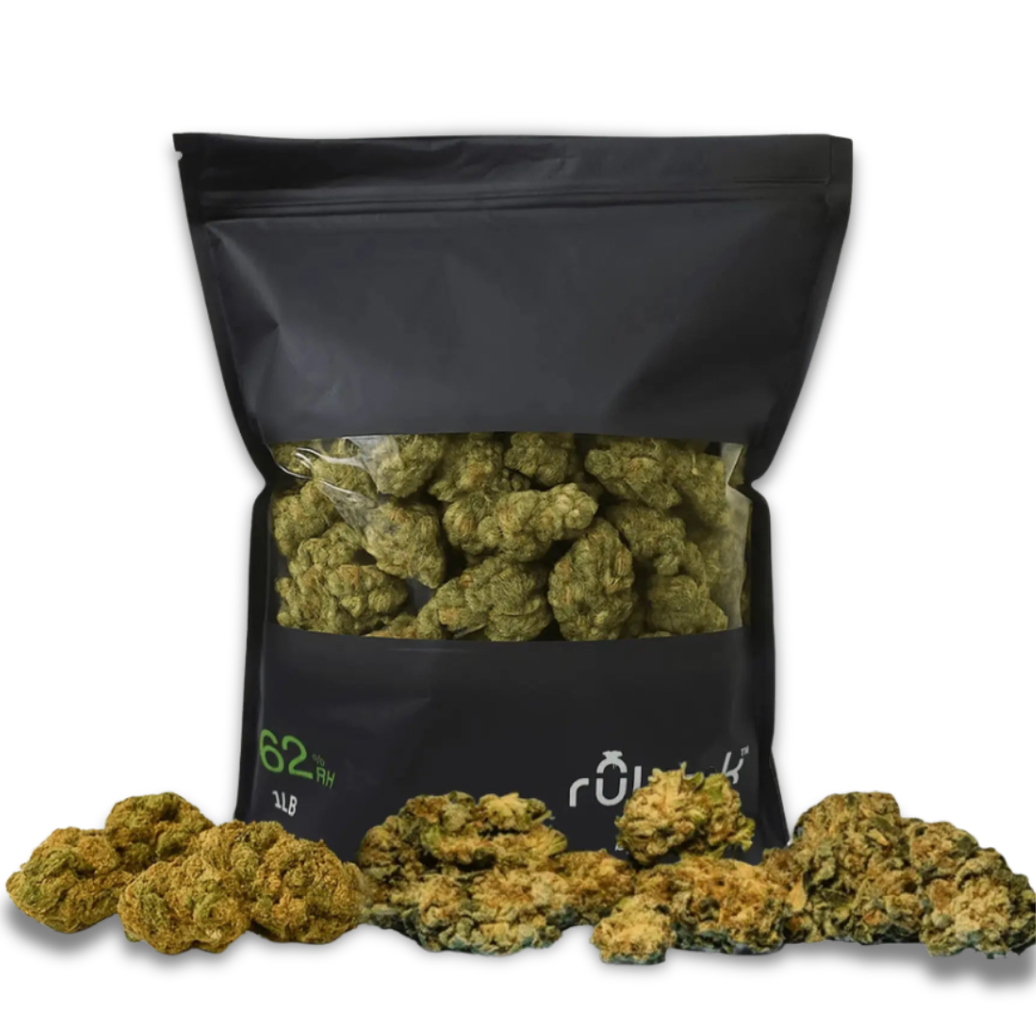
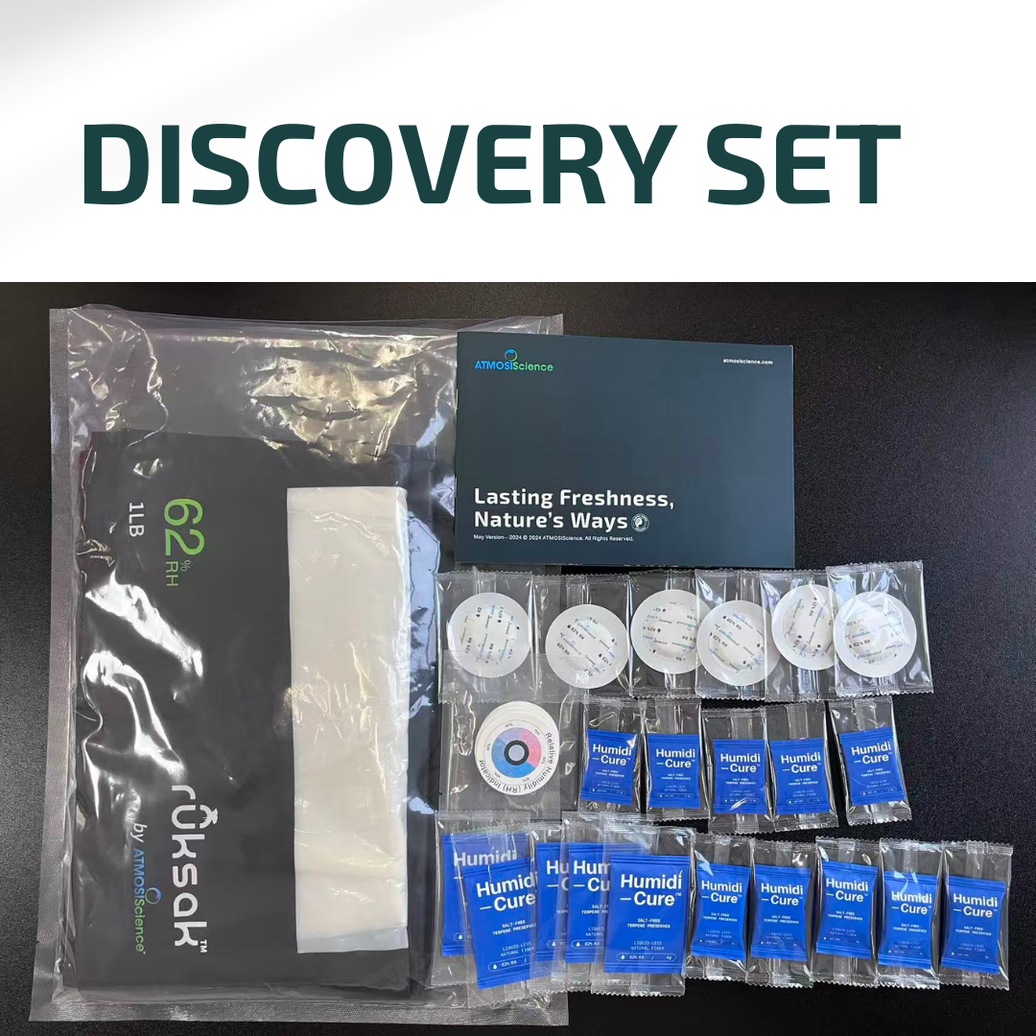
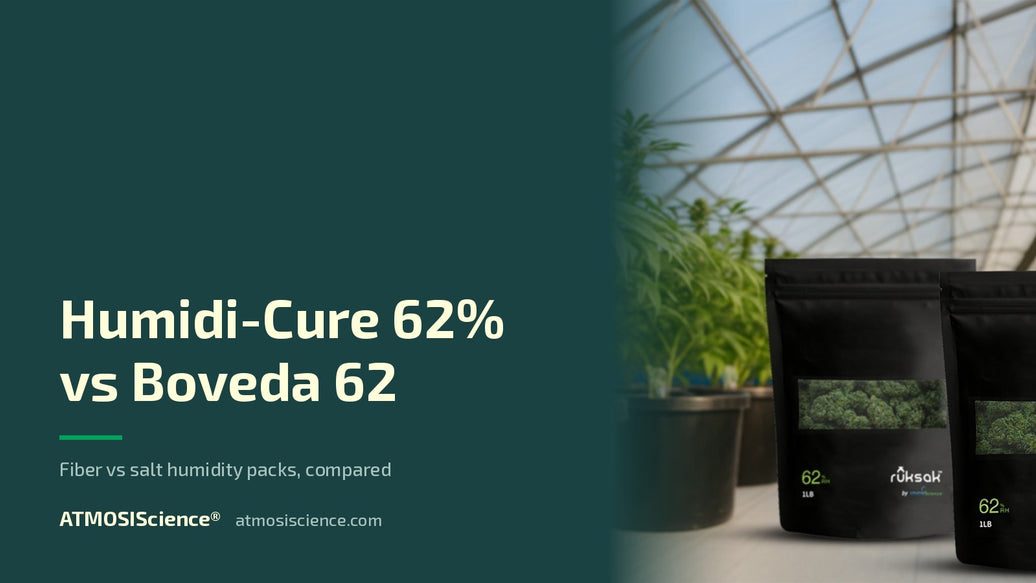
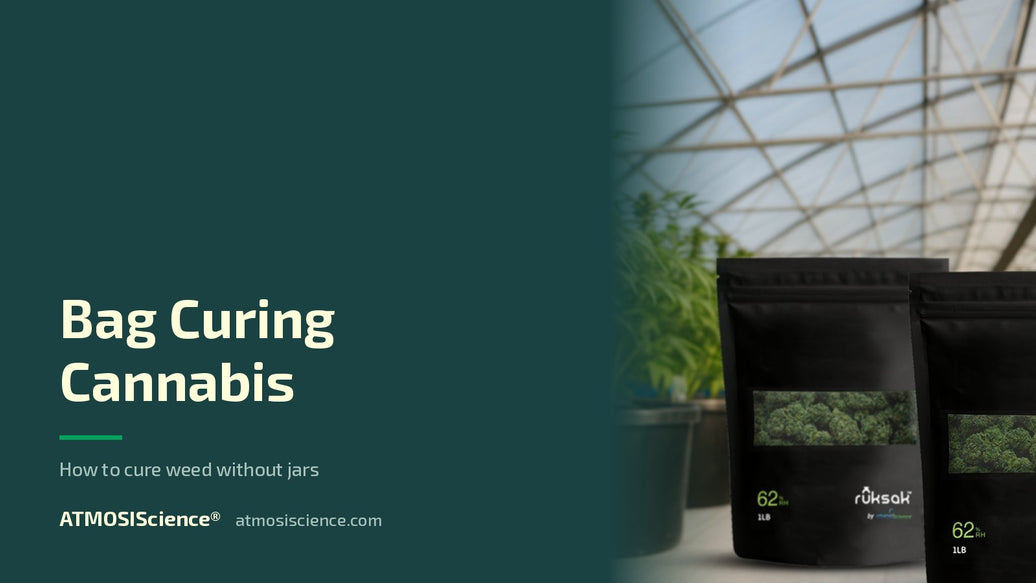
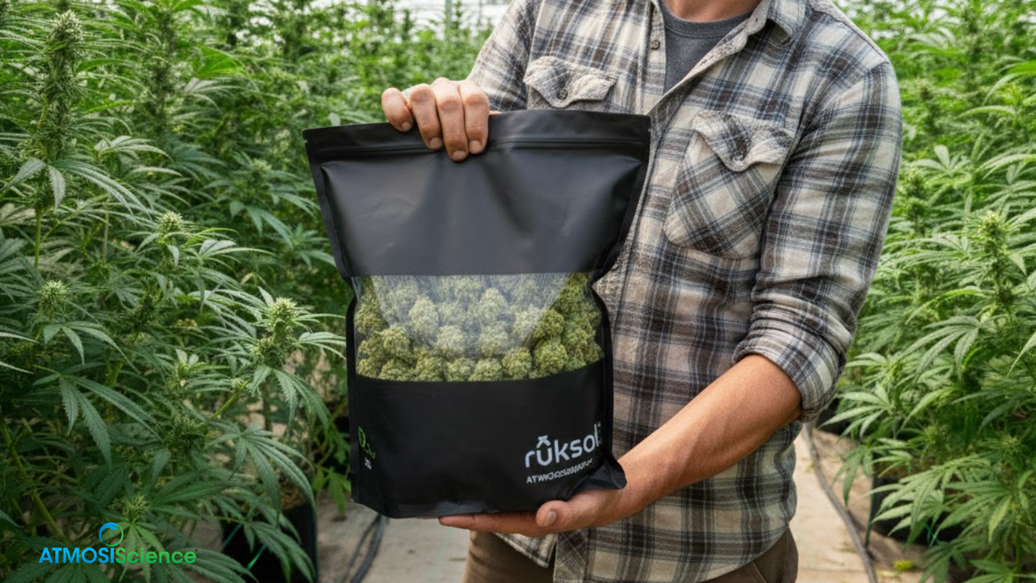
The ruksak pouch from ATMOSIScience was built specifically against the commercial cultivator spec sheet. The anatomy matters, because each layer is doing a job:

-
Child-resistant zipper top. Required in every regulated US cannabis market. A bulk bag without CR closure cannot move through a compliant supply chain.
-
Opaque proprietary outer film. Light, specifically UV-A and UV-B, degrades THC into CBN on the timescale of weeks. The matte-black outer layer blocks nearly all incident light while still looking clean on a shelf.
-
Breathable inner film. The inner layer is engineered to pass water vapor to and from the control medium but block oxygen and trap volatile terpenes.
-
Two-way humidity control fiber. The bamboo-fiber matrix locks the internal RH at 62% (or custom set points for specific strains and buyers).
-
Clear front window. Cultivators and buyers can inspect bud structure, color, and density without opening the seal and disturbing equilibrium.
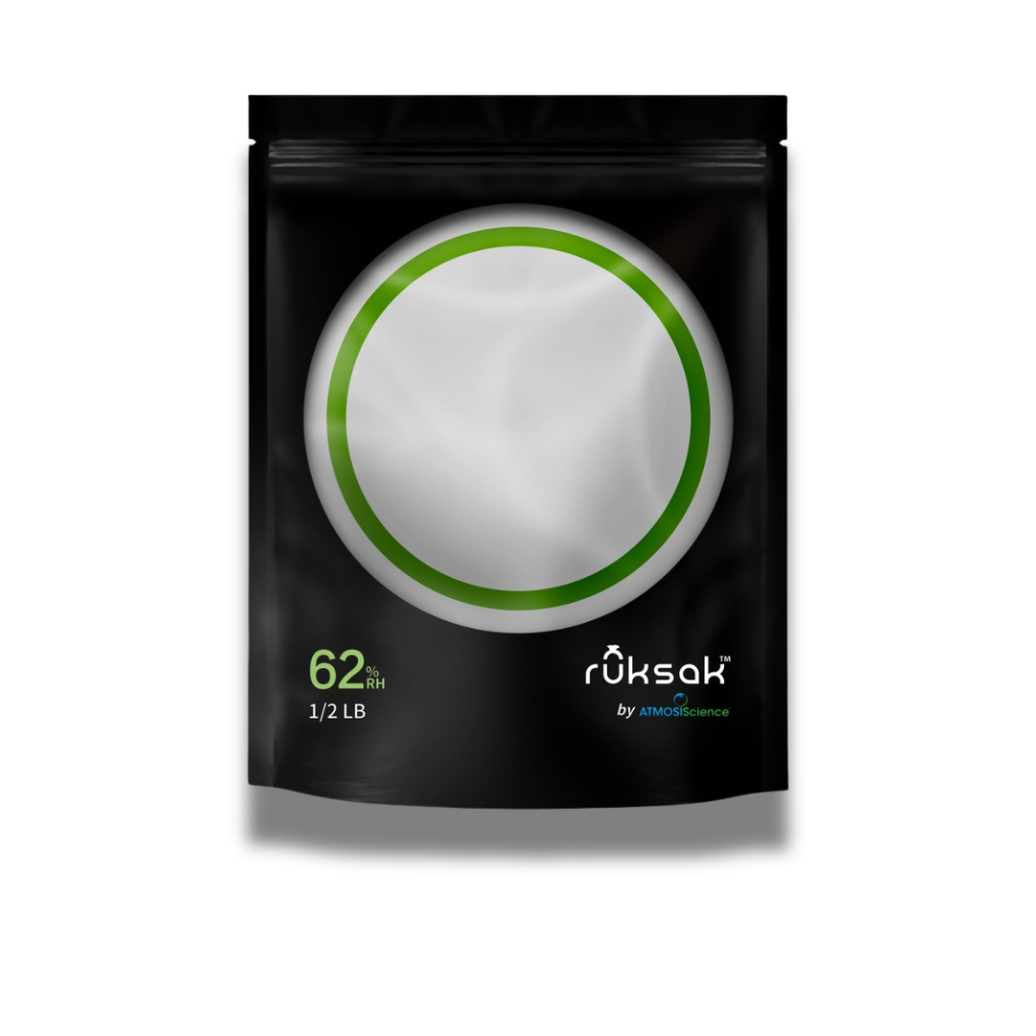
For bulk handling, the ruksak 1 lb pouch is the standard commercial unit. The half-pound variant is used by cultivators who split batches by strain or by buyer allocation.
Switching cost vs. the math of not switching
Most cultivators resist switching bulk storage because change feels disruptive. The math usually collapses that resistance in one afternoon.
A simple spreadsheet: take one month of wholesale volume, multiply by observed weight-loss percent in current storage, multiply by per-pound wholesale price. Then do the same math for the delta at 62% RH. A 500 lb/month operation losing 6% to over-drying at ~56% RH versus 1.5% in a 62% RH sealed container is looking at $27,000/month in recovered sellable weight — before any conversation about terpene retention, which lab testers are measuring more explicitly every quarter and which buyers are starting to pay up for.
The short version
Cannabis is a moisture-sensitive commodity that loses weight and aroma when stored dry and fails lab tests when stored wet. 62% RH is the center of the stable band. Two-way humidity control holds that number for the life of the container. One-way desiccants do not. A compliant bulk bag needs a CR zipper, an opaque film, a breathable inner film, a two-way control medium, and a window for inspection. ATMOSIScience builds ruksak against exactly that spec.
ATMOSIScience builds humidity-control storage for commercial cannabis operators. Explore the ruksak here.