If you’re a grower or post-harvest lead, February can feel like a trap.
Cold air plus HVAC dries everything out. Then you get one warmer, wetter day and the whole building shifts again. Your flower might be finished and jarred, but your jars still “feel” the season through real life: storage rooms, shipping, retail shelves, and the constant open-close cycle.
That’s when teams start asking the same question:
“Why does flower feel harsher a few weeks after jarring… even when the cure was good?”
The answer is usually not one dramatic mistake. It’s something quieter:
The microclimate inside the jar is drifting.
A sealed jar isn’t a stable jar
A jar seals air inside, but it doesn’t freeze time.
Inside every closed jar there’s a small atmosphere: air + moisture in the headspace + moisture in the flower. Over time, that system tries to balance itself. Then the outside world pushes it again:
-
The room gets drier (HVAC season).
-
The jar gets moved to a different space.
-
The jar gets opened for QC, sampling, or retail handling.
-
The jar gets closed again and the system re-balances.
In February, this happens more aggressively because environmental swings are sharper and more frequent. So the jar microclimate keeps “re-adjusting,” and flower pays the price.

Why cannabis shows damage fast
Cannabis is unusually sensitive to humidity drift because of three practical realities:
1) Cannabis is sold by weight
When the jar runs dry over time, moisture loss becomes weight loss. And it’s rarely obvious in week one. It shows up across the hold window.
2) Aroma is the first thing you lose
When the microclimate isn’t stable, it speeds up the slow loss of the compounds responsible for aroma and “freshness.” The jar can look fine while the nose tells you something changed.
3) “Close to 62%” isn’t the same as stable
Most people talk about 62% RH like it’s a magic number. The truth is simpler:
Stability matters more than perfection.
A jar that bounces around
58 → 60 → 64 → 60 → 62
can cause more quality drift than a jar that stays steady at a slightly different point.
Those ups and downs drive moisture migration. And over weeks, moisture migration shows up as harsher smoke, flatter aroma, and inconsistent jar-to-jar experience.
Why “throwing something into the jar” isn’t ideal
Traditional humidity control in jars usually means adding a loose component inside. Even if the chemistry works, growers and brands run into workflow and product-handling problems:
-
Direct contact with flower is unwanted (and in many brands, unacceptable).
-
Friction and movement increase with every open-close cycle (more disturbance inside the jar).
-
Static becomes a bigger issue in dry season, and anything that increases movement and friction inside the jar makes it worse.
-
It adds an operational step, which invites inconsistency across SKUs and lines.
So the question becomes:
Can you stabilize the jar without adding anything loose to the flower space?
The ATMOSIScience answer: put humidity control in the lid
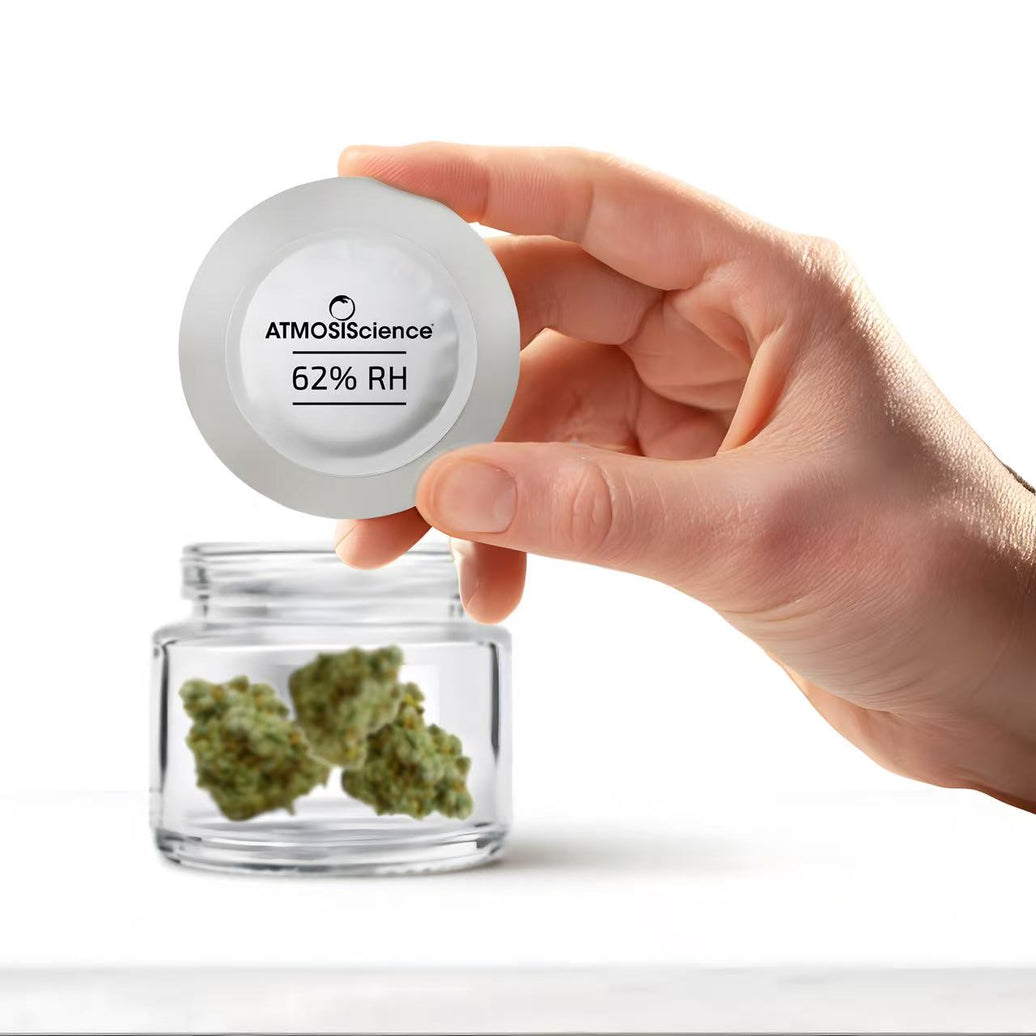
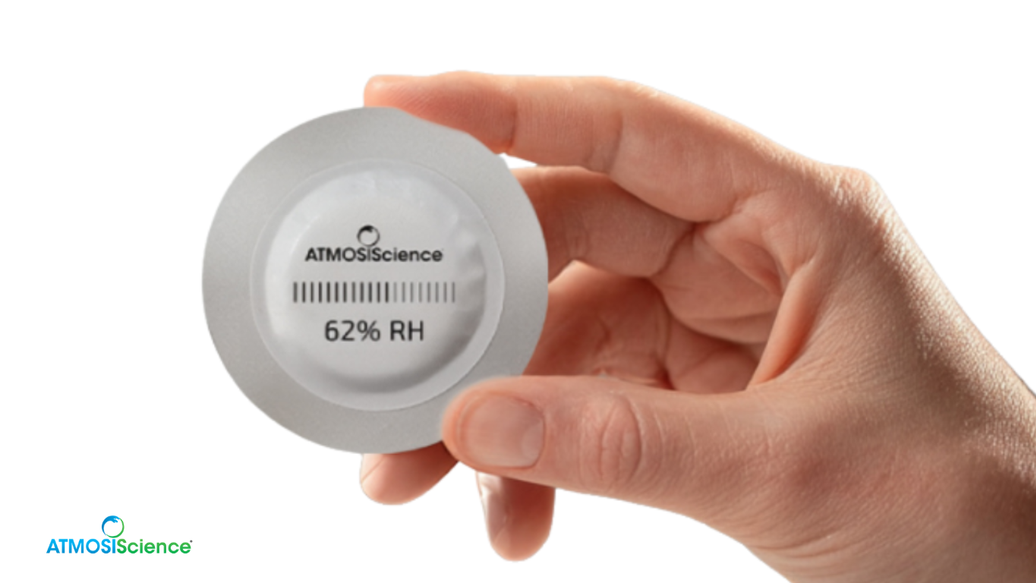
ATMOSIScience designed a Humidity-Control Liner that integrates under the cap.
Instead of dropping a packet into the jar, the lid itself becomes the control point.
What it is
A plant-based fiber liner (bamboo + wood fiber) that sits under the cap and regulates the jar’s microclimate after sealing.
What it does
Once the jar is closed, it automatically:
-
absorbs moisture when it’s too humid
-
releases moisture when it’s too dry
The intent is simple: keep the jar environment steady around the target zone (commonly 62% RH for flower storage) with tight control (±2% RH accuracy is the design goal), so the flower isn’t constantly being pushed and pulled by seasonal swings.
What it avoids
-
No loose packs
-
No salt
-
No liquid
-
No direct contact with flower
That “no contact” detail is not cosmetic. It changes how jar storage behaves over weeks.

Why lid-integrated makes storage more predictable
Here’s the practical reason the lid location matters:
Less disturbance, slower degradation
Because the liner sits on top, there’s less friction and less movement inside the jar when it’s opened and closed. In real workflows, that reduces the little mechanical and electrostatic stressors that quietly accelerate quality loss.
Lower static risk when RH stays in a healthy zone
Static risk drops significantly when RH stays above a healthier threshold (above ~55% is a useful operational reference). The liner’s job is to keep the jar from spending time in the “too dry” zone during HVAC season.
Works in harsh environments
Humidity control exists for extremes. This liner is designed to keep functioning in very dry or very humid conditions—and it remains effective even in freezing temperatures (tested to work down to -14°C).
Two formats depending on how long you hold inventory
Growers don’t all hold product the same way, so the liner comes in two formats:
-
Heat-sealed liner: designed for longer storage windows (up to ~1 year)
-
Friction-fit liner: designed for shorter cycles (around ~3 months, depending on conditions and how often jars are opened)
If you commonly hold inventory 3–6 weeks or longer, you’re in the window where drift becomes visible and expensive.

How it’s used (and why teams adopt it fast)
One of the biggest barriers to any packaging upgrade is “one more step.”
So ATMOSIScience supports a workflow that’s built for production reality:
-
Liners arrive sealed in airtight packaging
-
The humidity control function activates only when you open the bag
-
You can install them normally—or choose pre-insert under the cap
Pre-insert option
For teams that want zero extra work, ATMOSIScience can work with jar manufacturing partners to pre-insert the liner under the cap at no additional cost. Your caps arrive ready to use, with consistent placement across units.
This is how you get humidity stability without slowing the line.
The simplest way to decide if you need this in February
You’re a strong fit for a lid-integrated liner if any of these are true:
-
your facility is running HVAC and dry rooms are unavoidable
-
your jars go through multiple handoffs (warehouse, shipping, retail)
-
jars get opened regularly (QC, sampling, retail handling)
-
you hold inventory long enough for drift to show up (3+ weeks, especially 3–6+ weeks)
-
you care about consistent shelf experience jar-to-jar, not just “good cure day one”
The takeaway
February doesn’t just make rooms dry. It makes conditions unstable.
And in cannabis storage, instability is what turns “great cure” into “why is this harsher now?” a few weeks later.
ATMOSIScience built the Humidity-Control Liner to solve the real problem at the cleanest point in the jar:
the lid controls humidity, quietly, without touching the flower.