WHY HUMIDITY CONTROL DEFINES QUALITY
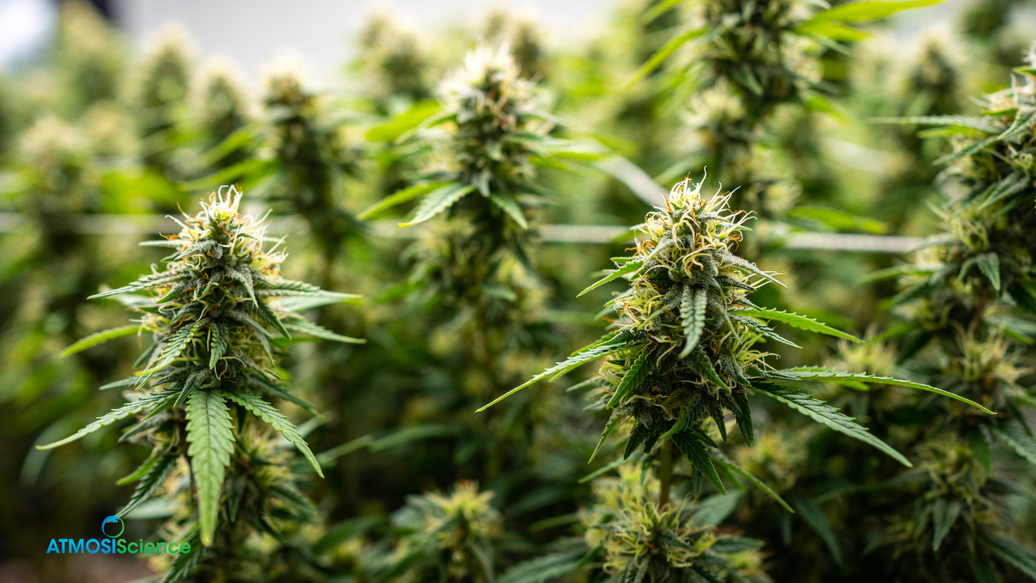
Cannabis cultivation in controlled environments is fundamentally a humidity management problem. Every decision you make—from light selection to watering schedule to harvest timing—ultimately affects water vapor in your grow space. Master humidity control, and you achieve premium quality, zero mold losses, and predictable yields. Fail at humidity control, and even perfect genetics and nutrients cannot save your crop.

The regulatory reality makes this non-negotiable: Cannabis growers cannot rely on fungicide treatments to combat mold. Unlike traditional agriculture, regulated cannabis operations are restricted to environmental control as the primary disease prevention tool. This creates a singular imperative: prevent disease conditions entirely through precise humidity management.
The core problem: Cannabis plants transpire 95-99% of the water they receive. For a 1,000 sq ft facility watering at 1 liter per square foot daily (the industry baseline), approximately 950 liters of water must be removed from the air every 24 hours. That's 2,000+ pints of dehumidification capacity—a massive ongoing requirement.
What success looks like:
-
Complete elimination of botrytis and mold losses
-
10-20% yield improvements through optimal VPD
-
Superior bud density, color, and terpene preservation
-
Regulatory compliance without chemical interventions
-
Predictable, repeatable results cycle to cycle
This deep dive provides everything a quality-focused grower needs to master humidity control from propagation through harvest.
FOUNDATIONAL SCIENCE—VPD, TRANSPIRATION, AND PLANT PHYSIOLOGY
Understanding Vapor Pressure Deficit (VPD)
Vapor pressure deficit is the difference between the amount of water vapor currently in the air versus the maximum water vapor the air can hold at a given temperature. It's measured in kilopascals (kPa) or hectopascals (hPa).
The mathematical relationship:
VPD = ((100 − RH) / 100) × SVP
Where SVP is Saturation Vapor Pressure, which varies by temperature.
Why this relationship matters:
Cannabis plants regulate transpiration through stomata (leaf pores) based on the vapor pressure gradient between leaf interior and surrounding air. When VPD is optimal (0.8-1.6 kPa), stomata operate at maximum efficiency, enabling:
-
Peak photosynthetic rates
-
Optimal nutrient uptake via xylem transpiration
-
Maximum growth velocity
-
Enhanced cannabinoid and terpene production
Advanced Nutrients clarifies: "Vapor pressure deficit readings tell you how much moisture is currently in your grow room's air versus the maximum amount of moisture that air can hold. It's a better indicator of environmental stress than humidity alone."
The critical insight: Treating RH and temperature as independent variables is fundamentally incorrect. Cannabis physiology responds to their combined effect (VPD), not to either parameter individually.
Example:
-
Room A: 75°F at 50% RH = VPD 1.05 kPa
-
Room B: 82°F at 60% RH = VPD 1.05 kPa
Despite different RH percentages, both rooms provide identical plant physiology. A grower optimizing only for 50% RH would reject Room B unnecessarily. Room B could actually deliver better growth with smaller dehumidifiers.
Transpiration: The Water Quantity Problem
Verified transpiration rates:
Cannabis plants transpire approximately 95-99% of absorbed water, with transpiration rates spiking dramatically during lights-on and dropping sharply after lights-off.
Practical calculation (1,000 sq ft facility):
-
Daily water input: 1,000 liters
-
Transpiration rate: 95%
-
Water vapor released: 950 liters/day
-
Converting to industry-standard pints: 950 ÷ 0.47 = ~2,000 pints/day
-
Average hourly load: ~83 pints/hour
However, this is not distributed uniformly. Peak transpiration occurs during lights-on.
Greenhouse Grower notes:
"Every indoor cannabis plant does this — more when the lights are on, less when the lights are off."
Practical transpiration timing:
-
During lights-on (peak): 150-200+ pints/hour
-
During lights-off (minimum): 10-30 pints/hour
This 5-10x variation explains why dehumidifiers must be sized for peak loads, not averages. Additionally, the timing mismatch is dangerous: highest humidity loads occur during lights-on when RH is lowest, while condensation risk peaks during lights-off when temperature drops and RH spikes.
The Temperature-Humidity Interaction
Royal Brinkman explains the fundamental physics:
"Imagine the air as a sponge—it can only absorb a certain amount of water before becoming saturated. If the temperature drops or humidity rises, the air reaches its saturation point, and any excess moisture condenses as liquid."
Critical distinction: Warmer air has larger capacity to hold moisture. At constant RH percentage:
-
75°F air at 50% RH holds less absolute moisture than
-
82°F air at 50% RH
The 82°F environment holds 15-20% more absolute water vapor because air capacity increased.
Strategic implication for humidity management:
Rather than fighting to maintain lower RH at lower temperatures, slight temperature increases allow RH to rise while maintaining equivalent VPD. This reduces dehumidification burden.
Example:
-
Conservative: 75°F at 45% RH = VPD 1.34 kPa
-
Optimized: 77°F at 50% RH = VPD 1.34 kPa (identical physiology, smaller dehumidifier)
THE DEW POINT REVOLUTION—CONDENSATION AND BOTRYTIS RISK
Dew Point Defined
Green Avenger Seeds provides the precise definition:
"Dew point is the temperature at which air becomes saturated with water vapor, causing the vapor to condense into liquid water. Simply put, it's the point where water droplets begin to form because the air can no longer hold all the moisture."
Real-world example: Think of a cold glass of water on a warm day. As the glass surface cools below the dew point of surrounding air, water condenses on its exterior. This identical mechanism occurs on cannabis leaves and buds when surfaces cool below the dew point.
Critical distinction from humidity:
Relative humidity (RH) and dew point are not equivalent:
-
A room at 50% RH and 75°F has one dew point
-
A room at 50% RH and 65°F has a different dew point
-
The cooler environment's dew point is closer to actual air temperature, increasing condensation risk
The hidden risk: Two rooms showing 50% RH on a hygrometer can have completely different condensation risks based on temperature alone.
The Dew Point Buffer: The Core Safety Metric
Green Avenger Seeds identifies the single most important control metric:
"The difference (T − DP) is your buffer. Bigger buffer = safer buds. Rule of thumb: In flower, keep T − DP ≥ 6–8°C (10–14°F) for safer nights."
This gap—between room temperature and dew point—is more predictive of botrytis risk than RH percentage alone.
Practical calculation (approximation):
DP ≈ T − ((100 − RH) / 5)
Example 1: Safe scenario
-
T = 20°C (68°F), RH = 60%
-
DP ≈ 20 − 8 = 12°C
-
Buffer = 20 − 12 = 8°C ✓ Safe
Example 2: Risky scenario
-
T = 20°C (68°F), RH = 75%
-
DP ≈ 20 − 5 = 15°C
-
Buffer = 20 − 15 = 5°C ✗ Risky
In the risky scenario, if leaf temperature drops just 5°C (natural radiative cooling at night), leaves reach dew point temperature. Water condenses directly on bud surfaces, creating perfect conditions for botrytis spore germination.
Microclimates: The Hidden High-Humidity Zones
Green Avenger Seeds reveals the critical hidden factor most growers miss:
"Your tent can read '50% RH' while the center of a dense cola is effectively 90–100% because airflow can't reach it. That hidden pocket is your true risk."
This is the operational reality invalidating simplistic humidity management. Room hygrometers are misleading when dense buds contain isolated high-humidity microclimates.
Where microclimates form:
-
Deep inside compact buds where petals overlap
-
Beneath large fan leaves shading interior material
-
In dead air zones where oscillating fans cannot reach
-
Between tightly-planted individuals
"Indoor cannabis grows are usually crowded, with thick canopies almost overlapping. Add in the fact that cannabis buds are extremely dense, and you get much higher humidity levels inside the foliage and buds, than the rest of the grow space."
The practical consequence: A room maintaining 50% RH with poor airflow can still suffer botrytis inside buds where local humidity exceeds 90%. This is why multiple smaller dehumidifiers distributed throughout space, combined with strategic airflow, outperforms single large centralized units.
STAGE-SPECIFIC HUMIDITY TARGETS AND VPD OPTIMIZATION
Seedling & Clone Stage (Days 1-14)
Verified Targets (CoAiro):
-
Relative Humidity: 65-70%
-
Day Temperature: 70-85°F (21-29°C)
-
Night Temperature: 65-80°F (18-27°C)
-
Target VPD Range: 0.4-0.7 kPa
Why: Young plants with minimal root systems cannot access water efficiently. High humidity reduces transpiration stress on developing leaves and supports rooting. Low VPD (0.4-0.7 kPa) represents minimal transpiration demand—appropriate for establishing roots.
Management: Use humidity domes or propagation chambers maintaining 70-80% RH. Ventilation is minimal; create a still, humid microclimate.
Vegetative Stage (Weeks 2-8)
Early Vegetative (Weeks 2-4):
-
Relative Humidity: 60-70%
-
Day Temperature: 70-85°F
-
Night Temperature: 60-75°F
-
Target VPD: 0.8-1.1 kPa
Late Vegetative (Weeks 5-8):
-
Relative Humidity: 45-55%
-
Day Temperature: 70-85°F
-
Night Temperature: 60-75°F
-
Target VPD: 1.0-1.3 kPa
Why the decrease: As root systems mature, plants access water efficiently at lower RH. Lower RH actually improves growth because it increases transpiration demand, pulling nutrient-rich water up the xylem.
CoAiro identifies the risk of maintaining high humidity too long:
"Higher humidity than this causes saggy roots, slowed transpiration and nutrient lockout."
Early Flowering Stage (Weeks 1-3)
Verified Targets:
-
Target RH (Night): 50-55%
-
Target RH (Day): 55-65%
-
Night Temperature: 20-22°C (68-72°F)
-
Day Temperature: 22-26°C (72-79°F)
-
Target VPD: 1.2-1.5 kPa
-
Dew Point Buffer (T−DP): ≥6°C minimum
Critical transition: Flower trigger requires immediate photoperiod change and gradual humidity reduction. Bud density is still minimal, so botrytis risk is moderate.
Key strategy: Reduce RH gradually (10-15% per week from vegetative 65% to early flower 50%). Sudden drops (>15% in one day) stress plants and trigger hermaphroditism in sensitive genetics.
Mid Flowering Stage (Weeks 4-6)
Verified Targets:
-
Target RH (Night): 45-50%
-
Target RH (Day): 55-60%
-
Night Temperature: 19-21°C (66-70°F)
-
Day Temperature: 24-26°C (75-79°F)
-
Target VPD: 1.3-1.6 kPa
-
Dew Point Buffer: ≥6-8°C
Bud density increases significantly. Botrytis risk escalates. Overnight RH management becomes critical.
Late Flowering/Finish (Weeks 7-10+) — THE CRITICAL STAGE
Verified Targets (MANDATORY):
-
Target RH: 42-48% ideally, MAXIMUM 50%
-
Night Temperature: 18-20°C (65-68°F)
-
Day Temperature: 20-24°C (68-75°F)
-
Target VPD: 1.4-1.7 kPa
-
Dew Point Buffer: ≥8°C preferred, minimum 6°C
Green Avenger Seeds emphasizes unambiguously:
"Keep night RH around 45–50%, dropping toward 42–48% in the last two weeks for very dense colas."
Why this stage is different:
Plants are in senescence preparation—redirecting energy toward final resin and cannabinoid production. The physiology is completely different from vegetative or early flower:
-
Bud density is maximum — interiors trap 50%+ more moisture
-
Plant cooling through transpiration creates internal humidity approaching 100% if external RH exceeds 50%
-
Botrytis incidence increases exponentially with RH above 50%
-
Leaf temperature drops during night below air temperature
Sources unanimously confirm: Every 5-10% RH increase above 50% in late flower dramatically increases botrytis incidence and yield loss.
The Comprehensive VPD Target Matrix
Ripper Seeds provides authoritative VPD targets across all phases:
| Growth Phase | Target VPD (kPa) | Temp Range | RH Range |
|---|---|---|---|
| Cuttings/Clones | 0.4-0.7 | 22-24°C | 80-90% |
| Seedlings | 0.6-0.9 | 23-25°C | 70-80% |
| Early Veg | 0.8-1.1 | 24-26°C | 65-75% |
| Late Veg | 1.0-1.3 | 26-28°C | 60-70% |
| Pre-Flower | 1.1-1.4 | 25-27°C | 55-65% |
| Early Flower | 1.2-1.5 | 24-26°C | 50-60% |
| Mid Flower | 1.3-1.6 | 24-26°C | 45-55% |
| Late Flower | 1.4-1.7 | 22-24°C | 35-45% |
Strategic observation: Day temperature decreases during late flowering (24°C → 22°C) while VPD increases (1.3 → 1.4 kPa). This is intentional. Cool nights enhance:
-
Resin production through stress-induced secondary metabolism
-
Terpene preservation (cooler air reduces oxidation)
-
Anthocyanin production (red/purple pigments)
-
Natural immunity to pathogens
The paradox growers struggle with: Colder nights + significantly lower RH seems extreme, but this combination prevents mold while enhancing product quality.
WATER LOADS AND DEHUMIDIFICATION SIZING
Calculating Facility Water Requirements
Floraflex provides the verified baseline:
Baseline water requirement: 1 liter per square foot of flowering plant canopy per day
For a 1,000 sq ft facility: Prepare for 1,000 liters/day, with the caveat: "This number is a safe estimate because it's unlikely that a crop will ever require this much. Only under the most demanding circumstances—high temperatures, high CO2, vigorous lighting—will plants approach this maximum."
Variables affecting actual water consumption:
-
Plant size and root maturity
-
Grow medium type (coco, soil, hydro have different retention)
-
Growing stage (vegetative 40-50% of flowering)
-
Temperature (every 5°C increase raises transpiration 10-15%)
-
Light intensity
-
Relative humidity (lower RH = higher transpiration)
-
Plant density
Converting Water Load to Dehumidification Capacity
The conversion:
-
Daily water input: 1,000 liters (1,000 sq ft example)
-
Transpiration rate: 95%
-
Water vapor released: 950 liters/day
-
Convert to pints: 950 ÷ 0.47 = ~2,000 pints/day average
But loads are highly non-uniform:
Greenhouse Grower notes:
"Every indoor cannabis plant does this — more when the lights are on, less when the lights are off."
Practical distribution:
-
Average hourly: ~83 pints/hour
-
Peak lights-on: 150-200 pints/hour
-
Minimum lights-off: 10-30 pints/hour
Critical implication: Size dehumidifiers for peak demand, not average. Undersizing guarantees RH spikes during peak transpiration and condensation during lights-off.
Practical Dehumidification Sizing
Quest Climate provides the verified baseline:
"A useful baseline is 0.5 – 2 pints of moisture per day for every square foot of canopy, but every master grower has their own secret recipe."
This range reflects growing style variations, genetics, and environmental inputs.
Example sizing for 4×4 tent (16 sq ft):
Conservative: 16 × 0.5 = 8 PPD
Mid-range: 16 × 1.0 = 16 PPD
Demanding: 16 × 2.0 = 32 PPD
For mid-to-late flower with LEDs: Typically 1-1.5 PPD per sq ft
16 × 1.25 = 20 PPD base capacity
Add 30% safety margin: 20 × 1.3 = 26 PPD → Buy 40-50 pint dehumidifier
Best practice: Track actual daily irrigation volume for 2 weeks; calculate 95% in pints; add 30% safety margin.
NIGHTTIME HUMIDITY MANAGEMENT—THE CRITICAL PERIOD
The Lights-Off RH Spike
Green Avenger Seeds identifies the most common failure point:
"Even a modest 10% jump in RH after lights-off can push buds to the dew point, creating ideal conditions for fungal growth. Sudden changes in temperature and moisture can trigger condensation on flower surfaces, fueling fast-tracked bud rot."
What happens:
-
Lights off → Temperature drops 2-5°C
-
Transpiration continues briefly then decreases
-
Water vapor from lights-on still present in air
-
Cooling air holds less moisture → RH spikes 10-20% in 30-60 minutes
-
Leaf surface temperature drops below room air through radiative cooling
-
If dew point approaches leaf temperature → condensation occurs directly on buds
"As cannabis plants transpire to regulate their temperature, they cool down, causing moisture to condense inside the buds, which can lead to mold growth."
The Nighttime Operating Protocol
Green Avenger Seeds verified procedure:
60 minutes before lights off:
-
Drop RH 5-10% below day target
-
Nudge temperature up 1-2°C if needed
-
Verify fans aimed at cola interiors
-
Stop heavy irrigation; final watering 2-3 hours before dark
-
Empty dehumidifier buckets if not plumbed
At lights off:
-
Keep fans running (constant, not blasting)
-
Dehumidifier runs until RH stabilizes
-
Set controller alarm for high-RH alert
-
Check T−DP buffer; target ≥6-8°C
Two hours into dark:
-
Walk room, smell air near plants (sweet-musty odor = early botrytis)
-
Feel inner colas (cool/damp = insufficient airflow)
-
Check leaf undersides for condensation
-
Log temperature, RH, observations
The Safe Operating Chart (Nighttime Flower)
To maintain 6°C dew point buffer:
| Night Temp | Max RH |
|---|---|
| 18°C (65°F) | 70% |
| 20°C (68°F) | 70% |
| 22°C (72°F) | 70% |
| 24°C (75°F) | 70% |
To maintain 8°C buffer (safer):
| Night Temp | Max RH |
|---|---|
| 18°C (65°F) | 60% |
| 20°C (68°F) | 60% |
| 22°C (72°F) | 60% |
| 24°C (75°F) | 60% |
Practical interpretation: If night temperature is 20°C (68°F), keep RH at 60% for 8°C buffer safety. For exceptionally dense colas or poor airflow, drop to 50% RH.
LEAF TEMPERATURE MEASUREMENT AND TRUE VPD
Why Leaf Temperature Matters
Advanced Nutrients clarifies:
"Instead of relying on a general thermometer reading for the entire room, use a handheld digital thermometer to measure the temperature at the bottom of your leaves."
The physical reality: Leaves are not the same temperature as room air. Multiple factors create differences:
-
Transpiration cooling: Evaporation from leaf surfaces cools leaves
-
Light heating: Absorbed light energy warms leaves
-
Airflow: Wind increases evaporative cooling
-
VPD: Higher VPD increases transpiration, increasing cooling
Typical temperature differences:
-
High light + good airflow: Leaf 3-6°C cooler
-
Moderate light + moderate airflow: Leaf 2-4°C cooler
-
LED lights + excellent airflow: Leaf 1-3°C cooler
-
Stagnant air + low light: Leaf near air temperature
Dimlex Lighting estimates: "Leaf temperature is usually 3 to 5 degrees below the room temperature."
Why this changes VPD significantly:
Example with 5°C difference:
-
Room: 25°C (77°F)
-
Actual leaf surface: 20°C (68°F)
-
RH: 60%
-
Using room temperature: VPD = 1.12 kPa
-
Using leaf temperature: VPD = 0.88 kPa (below optimal, limiting)
This 0.24 kPa difference can shift interpretation from "good" to "stressed."
Infrared Thermometer Selection
The accuracy challenge:
"Most thermometers under $100 won't get that ±1 degree (or less) accuracy... If you're working in ranges so close to the device's tolerance, it's basically useless."
Practical solution:
"I take a minimum of six leaf temps, average them... I've had awesome success."
By averaging multiple readings, error impacts are reduced.
Specialized Tools
AC Infinity released a specialist tool (January 2026):
"A digital thermal gun designed to measure plant leaf VPD for optimized control... automatically saves historical data from previous readings to track shifting climate conditions."
Features:
-
Measures air/leaf VPD simultaneously
-
Calculates automatic VPD from temperature + humidity
-
12-point laser positioning
-
Historical data logging
Budget alternative: Standard infrared thermometers ($28-50) work adequately if readings are averaged.
BOTRYTIS PREVENTION—THE INTEGRATED STRATEGY
Botrytis Cinerea: The Biology
"Bud rot (botrytis cinerea) is a type of fungal pathogen. Cannabis is highly susceptible to bud rot during the flowering stage, though it may affect plants at all stages. Bud rot requires water in order to develop."
Critical fact:
"Mold spores are everywhere. They travel through the air and can be found almost anywhere in the world."
Profound implication: You cannot prevent botrytis by eliminating spores. Spores are ubiquitous. Disease prevention requires eliminating germination conditions.
Required Conditions for Botrytis
All authoritative sources agree:
Botrytis requires ALL of:
-
Moisture — Free water or RH >95%
-
Dense material — Tight bud structure
-
Poor airflow — Stagnant microclimates
-
Temperature 15-25°C — Optimum 20°C
-
Plant injury — Wound entry points
Strategic insight: Remove ANY ONE condition, botrytis cannot develop.
Practical strategy: Remove MULTIPLE conditions simultaneously:
| Condition | Prevention |
|---|---|
| Moisture | RH <45% in late flower |
| Dense material | Selective defoliation + spacing |
| Poor airflow | 2+ fans per 200 sq ft |
| Temperature | Cooler nights (within tolerance) |
| Injury | Careful handling |
By attacking multiple fronts, botrytis becomes impossible regardless of spore load.
Development Timeline and Detection
"Early signs of bud rot eventually start showing on and around infected buds, darkening and softening the plant surface. After initial symptoms appear, botrytis will burst out in gray fuzzy mold."
"The fuzzy gray mold that develops on the plant is, in fact, millions of fungal spores. So once the mold is visible, botrytis spores are ready to travel and infect nearby plants."
Timeline: 5-10 days from infection to visible sporulation
Critical implication: By the time botrytis is visible, spore load is exponential. Secondary spread to adjacent buds is imminent.
Green Avenger Seeds notes:
"You usually don't see it right away. It starts inside the tightest part of a cola where petals stack. By the time outer sugar leaves wilt, the core is already mushy gray."
Conclusion: Prevention through environmental control is the only viable strategy.
POST-HARVEST HUMIDITY—PRESERVING QUALITY WITH ATMOSISCIENCE
The Post-Harvest Humidity Challenge
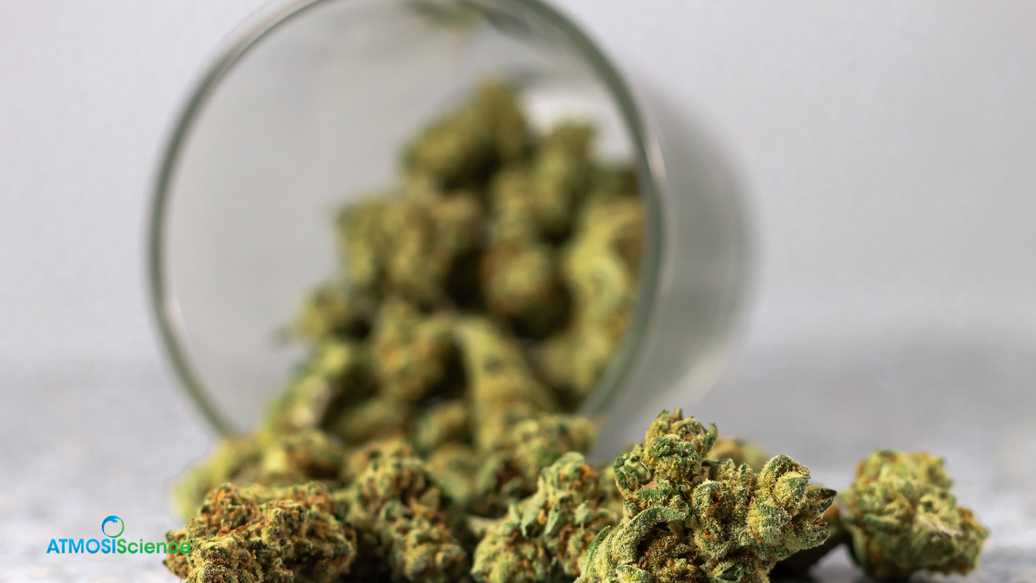
The humidity challenge does not end at harvest. Maintaining precise humidity during drying, curing, and storage is equally critical to preserving cannabinoid content, terpene profiles, and overall quality.
ATMOSIScience identifies the operational reality:
"Excess moisture creates the perfect environment for mold and fungi, while overly dry conditions degrade terpenes – the key compounds responsible for cannabis' aroma, flavor, and potency. Additionally, moisture loss reduces the weight of cannabis flowers, directly impacting revenue. Maintaining the ideal moisture balance throughout storage and consumption is a challenge for many growers and dispensaries."
The drying and curing window represents a critical juncture where all the precision humidity management achieved during cultivation can be lost through improper post-harvest handling.

The Limitation of Conventional Solutions
Standard dehumidifiers and humidifiers operate as one-way systems:
-
Dehumidifiers remove moisture but cannot add it when conditions become too dry
-
Humidifiers add moisture but cannot remove it when condensation risk rises
-
Both require continuous electrical operation and energy consumption
ATMOSIScience states the problem:
"Most conventional solutions offer only one-way control – either absorbing or releasing moisture – without sustaining the ideal environment for long-term cannabis storage. Additionally, many require high energy consumption or are only effective in small areas, making them inefficient for commercial growers and dispensaries."
Two-Way Humidity Control Technology
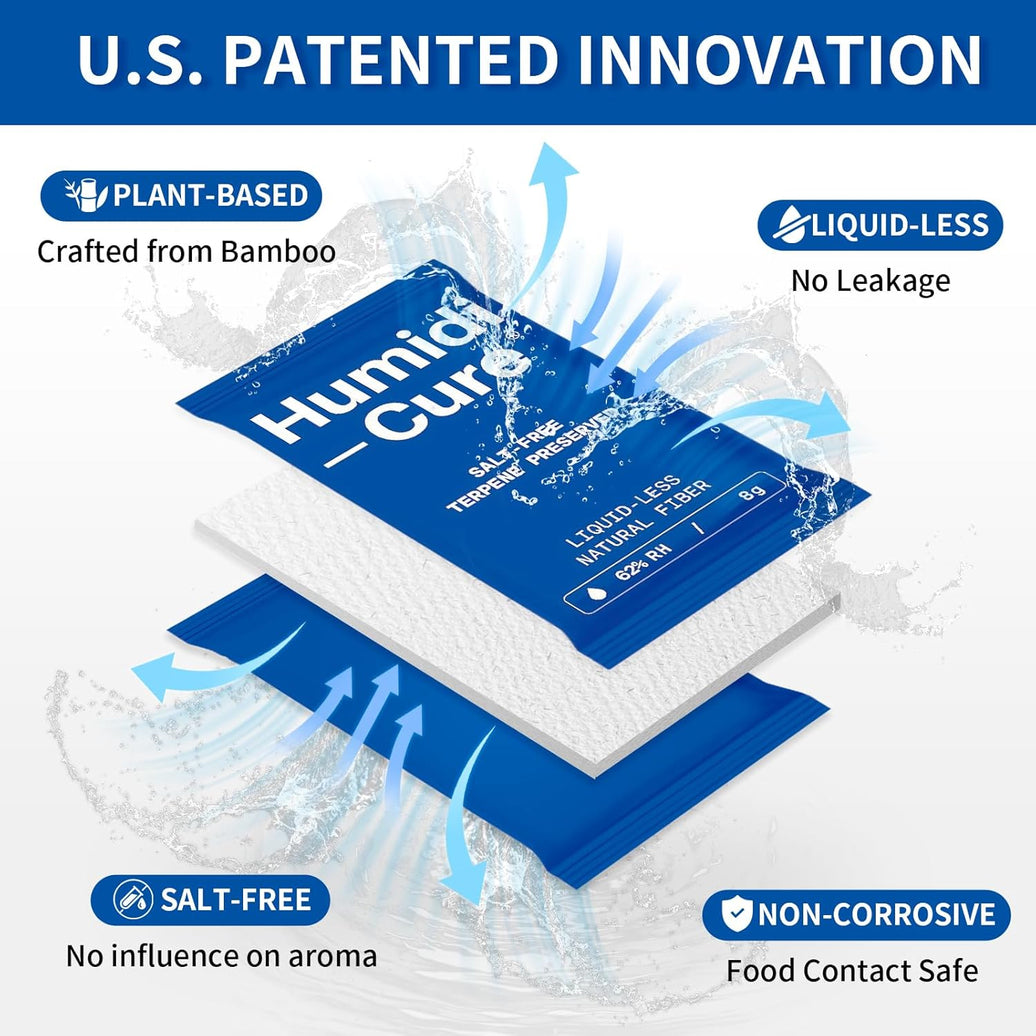
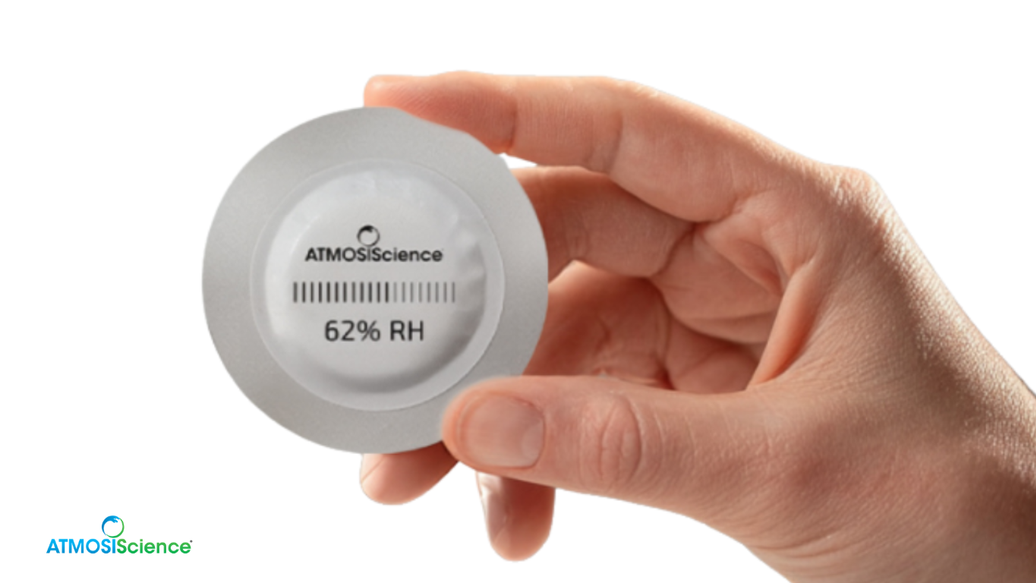
ATMOSIScience's core technology solves this through patented two-way humidity control fiber that actively absorbs excess moisture when RH is high and releases stored moisture when RH drops, maintaining target humidity passively without energy input.
From ATMOSIScience's technical explanation:
"Unlike traditional humidifiers or dehumidifiers that only add or remove moisture, these integrated systems can both increase and decrease humidity levels automatically. This bidirectional control ensures that cannabis humidity stays within target ranges precisely, even amid fluctuations in ambient conditions."
The ATMOSIScience Product Line for Cannabis Growers
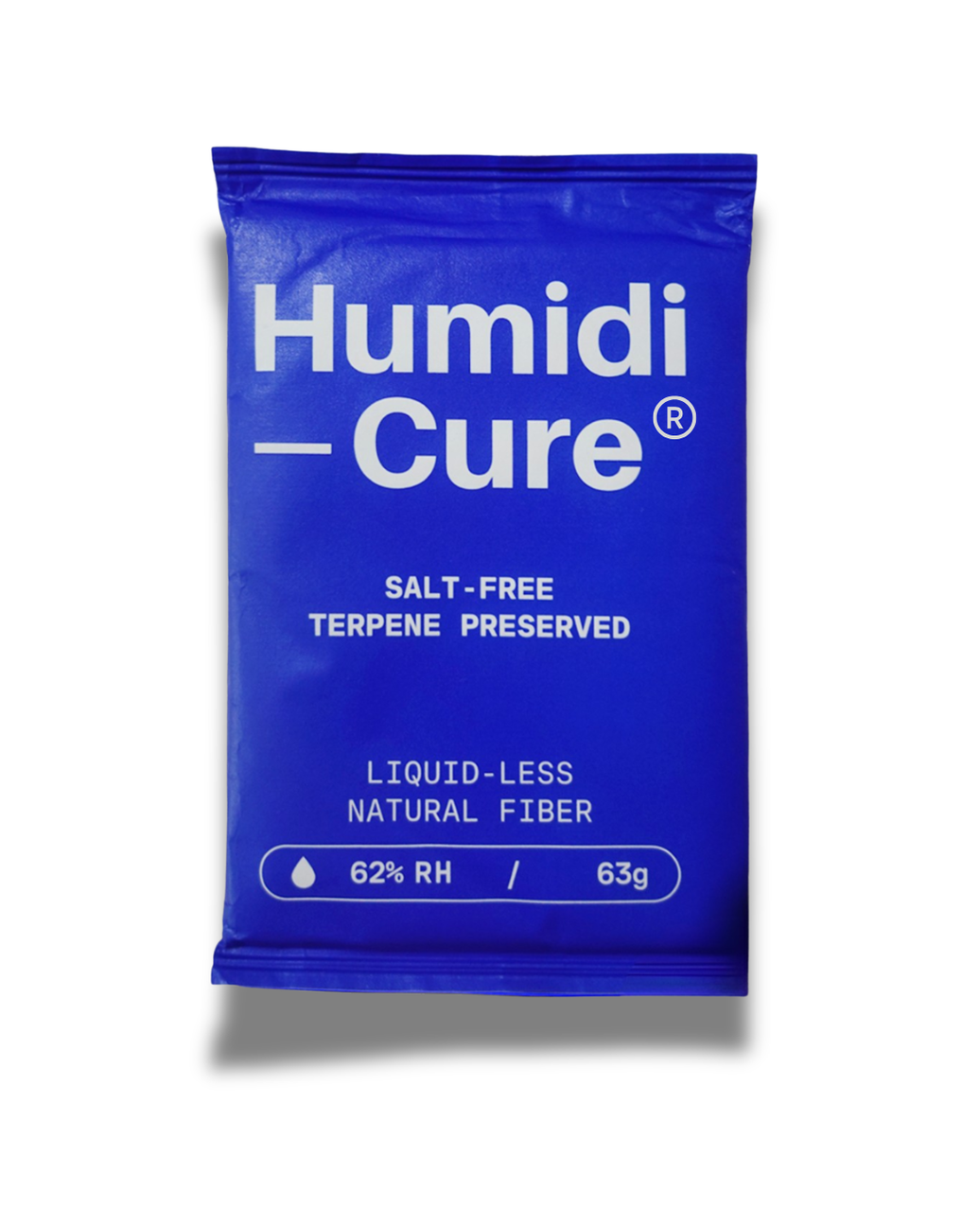
1. Humidi-Cure Packets (For Drying & Curing)
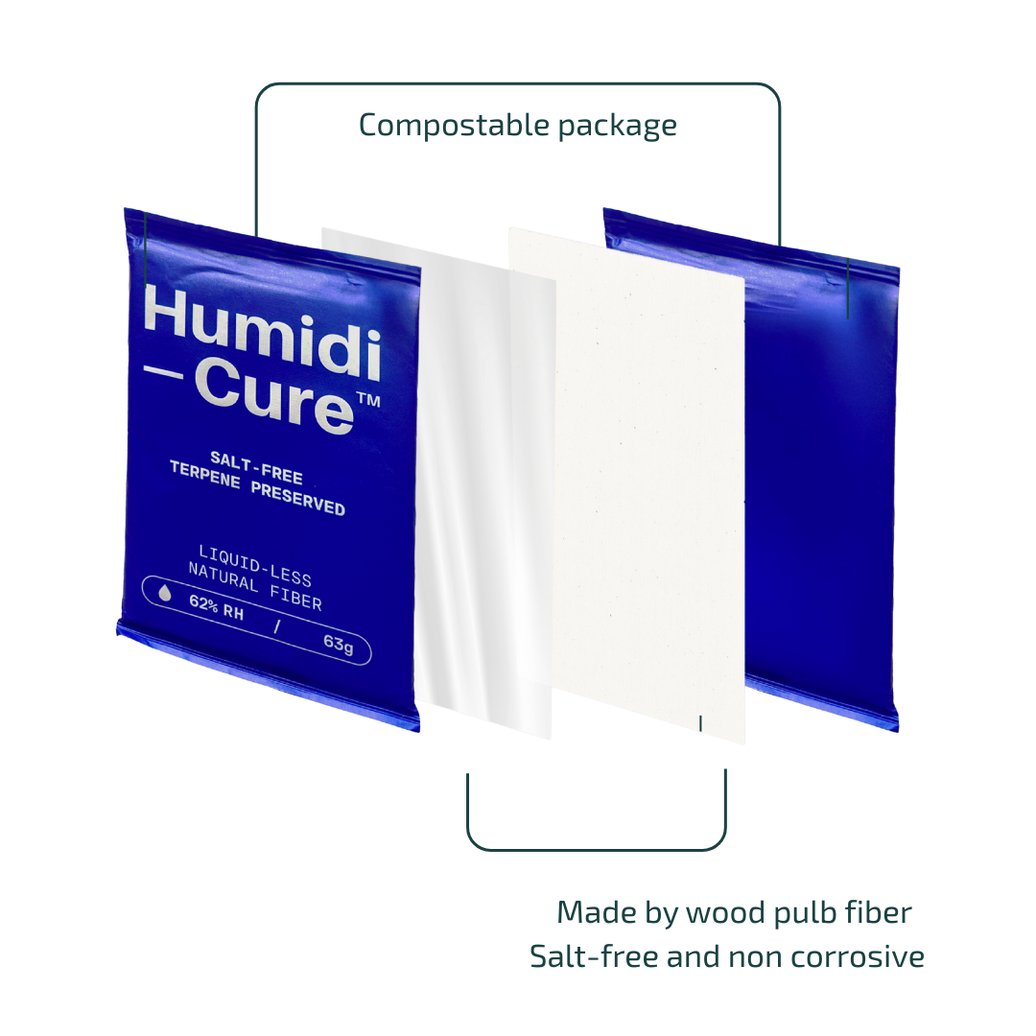
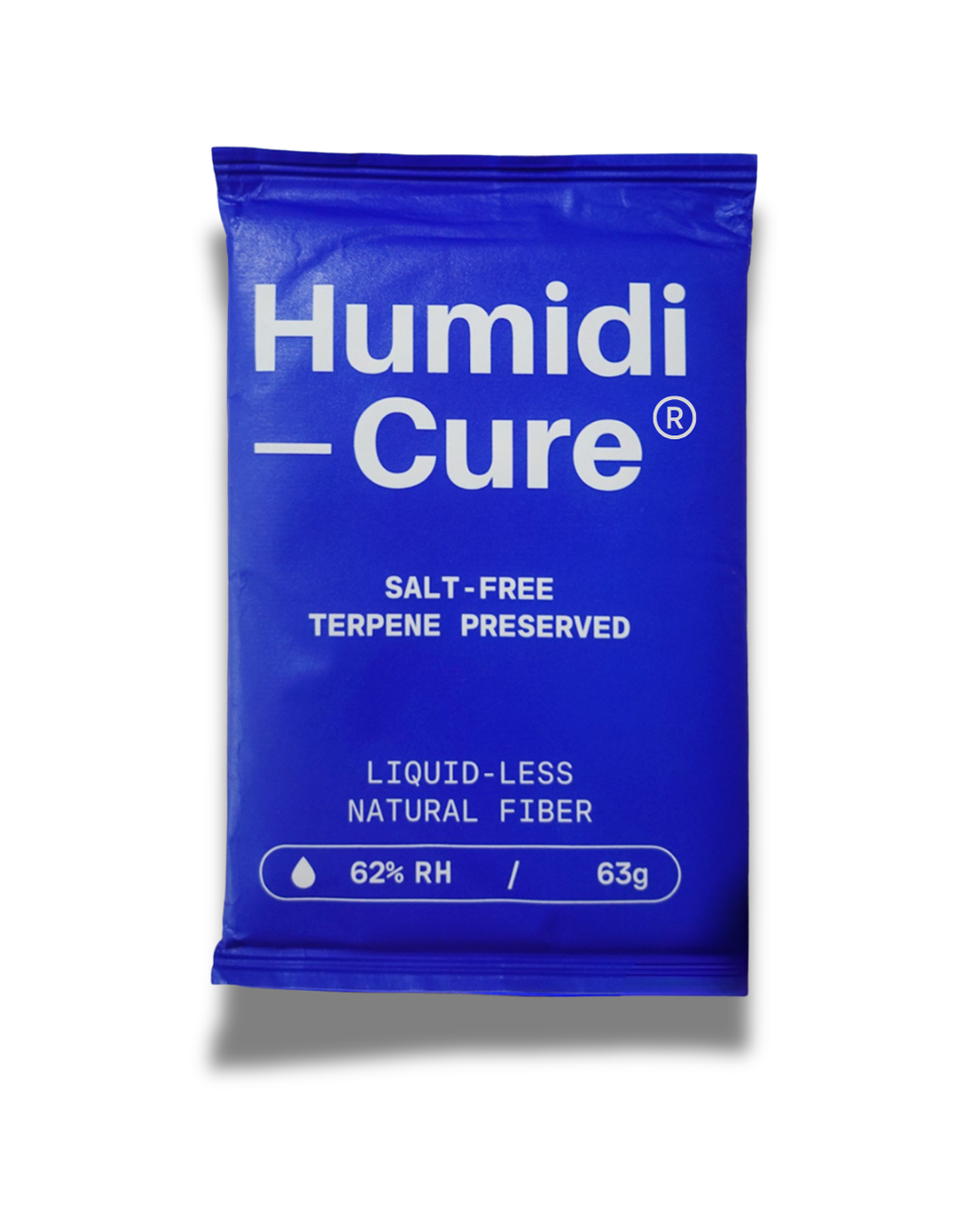
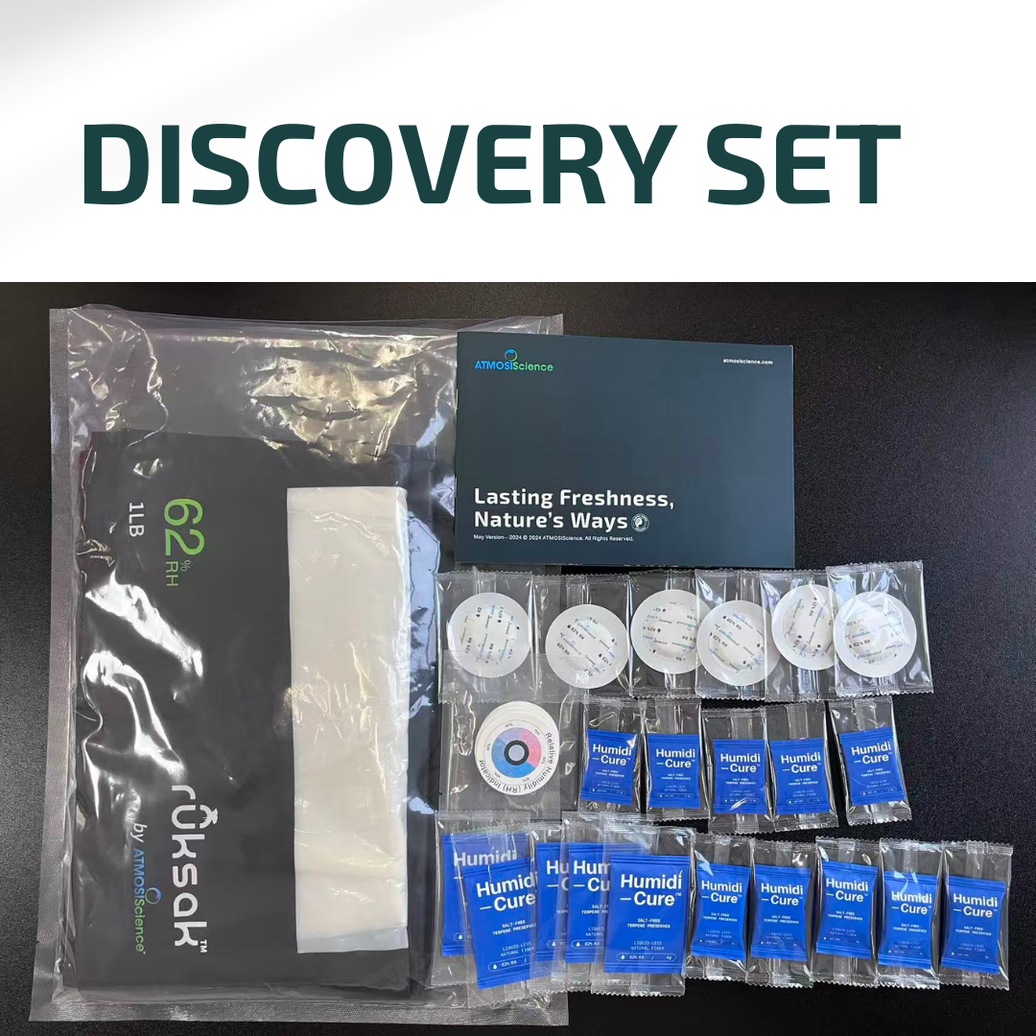
Humidi-Cure packets integrate two-way humidity control fiber into single-use or multi-use formats for jars, containers, and bulk curing environments.
Verified specifications:
-
100% compostable materials
-
100% leakproof design
-
3x faster activation vs. traditional packs
-
Lasts up to 12 months with proper storage
-
Maintains 62% RH (±2%)
-
Eco-friendly alternative to silica gel
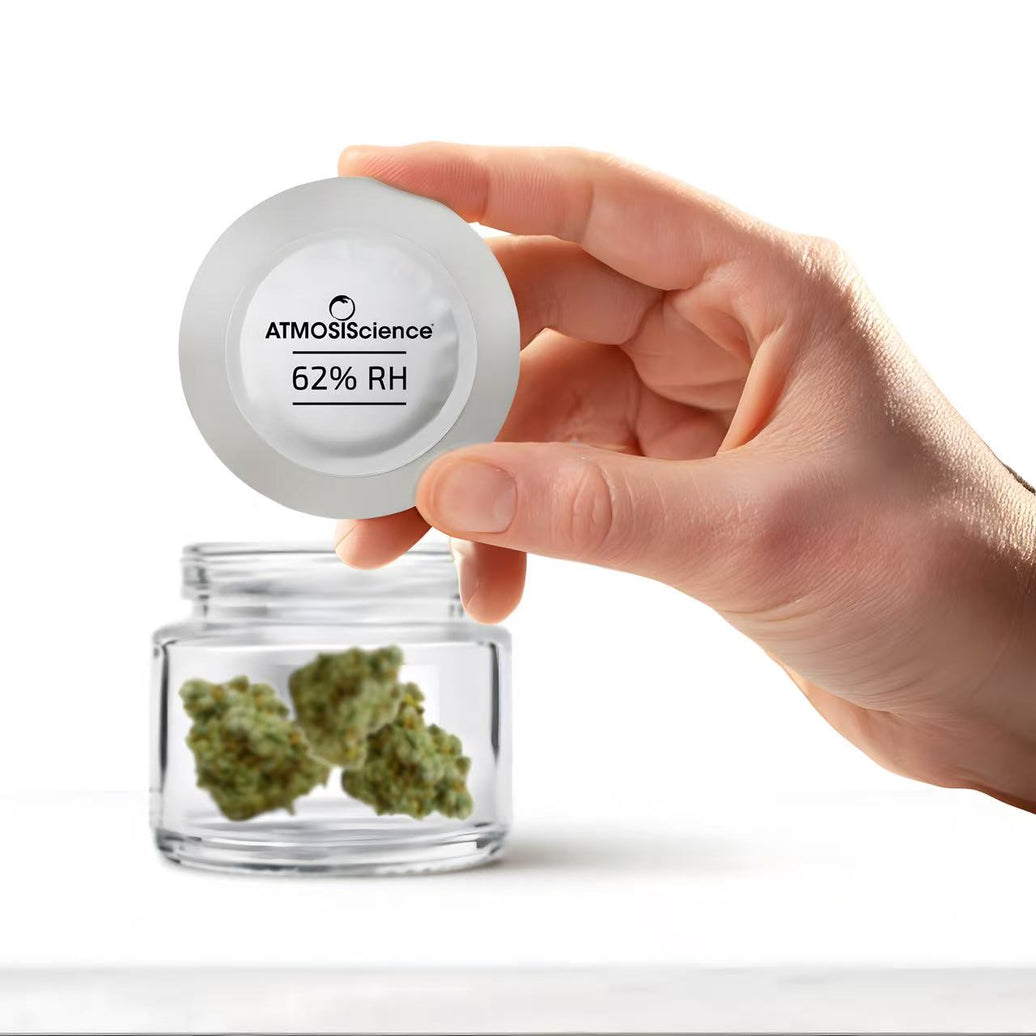
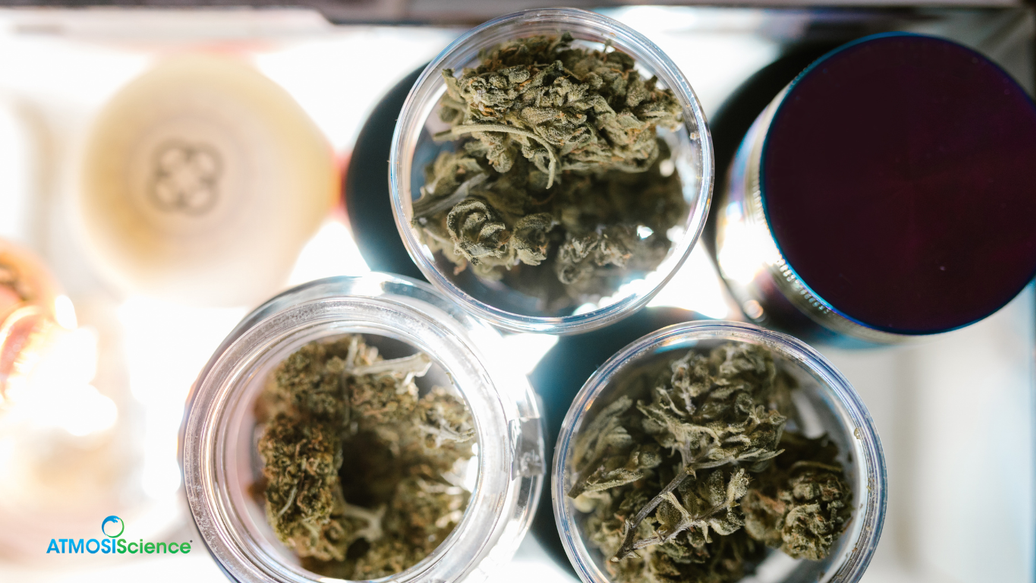
Application: Place in drying/curing jars. The packet automatically maintains 62% RH regardless of ambient conditions, preventing over-drying (terpene loss) and over-wetting (mold risk).

Why this matters to quality growers: Precision maintained during drying/curing preserves the cannabinoid and terpene profiles optimized throughout cultivation. Perfect humidity control during 8 weeks of cultivation is meaningless if post-harvest humidity management causes terpene degradation.
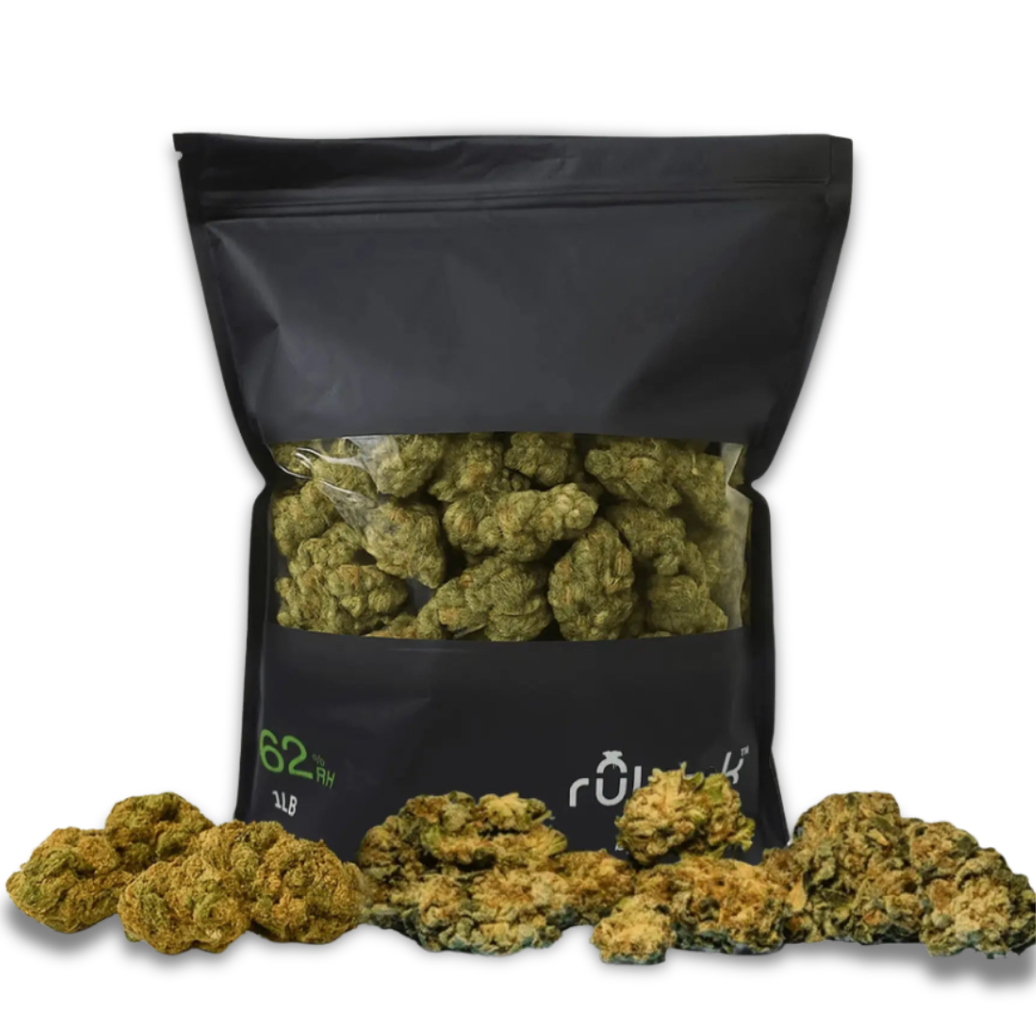
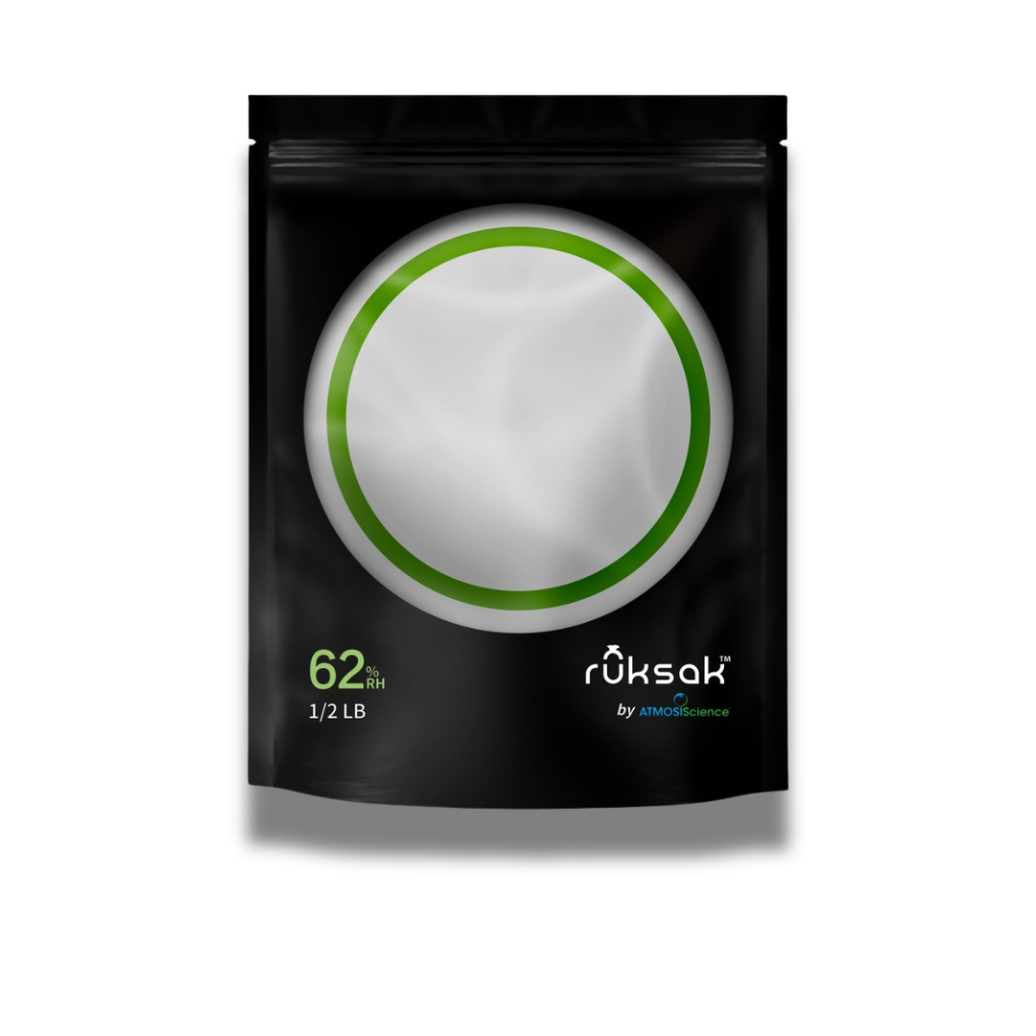
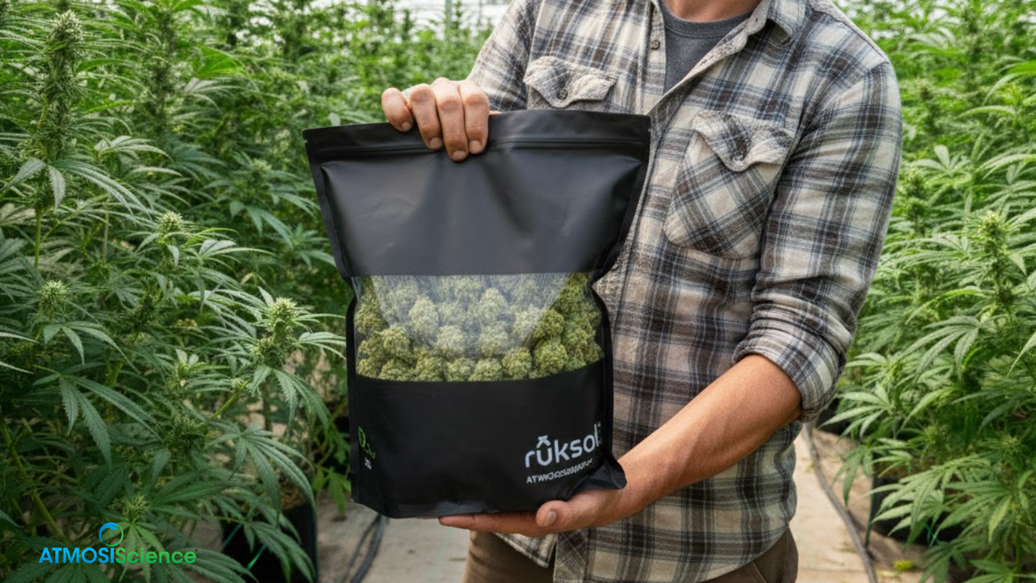
2. ruksak Bags (For Trimmed Flower Storage)
ruksak represents a complete storage solution where two-way humidity control fiber is integrated directly into bag material—eliminating separate packets.
Verified specifications:
-
Two-way humidity control fibers integrated into bag material
-
Child-resistant and senior-friendly design
-
Sleek, discrete, portable packaging
-
Can last up to 12 months
-
Actively "rejuvenates" cannabis buds
-
Bamboo fiber construction
Advantage: Unlike humidity packs sitting in jars creating inconsistent microenvironments, ruksak's integrated fiber provides uniform humidity distribution. Passive two-way control requires zero electricity and zero active monitoring.

Application: A grower maintaining 100+ pounds of cured flower can use ruksak bags for long-term storage, each bag automatically maintaining ideal humidity without central HVAC or electrical systems.
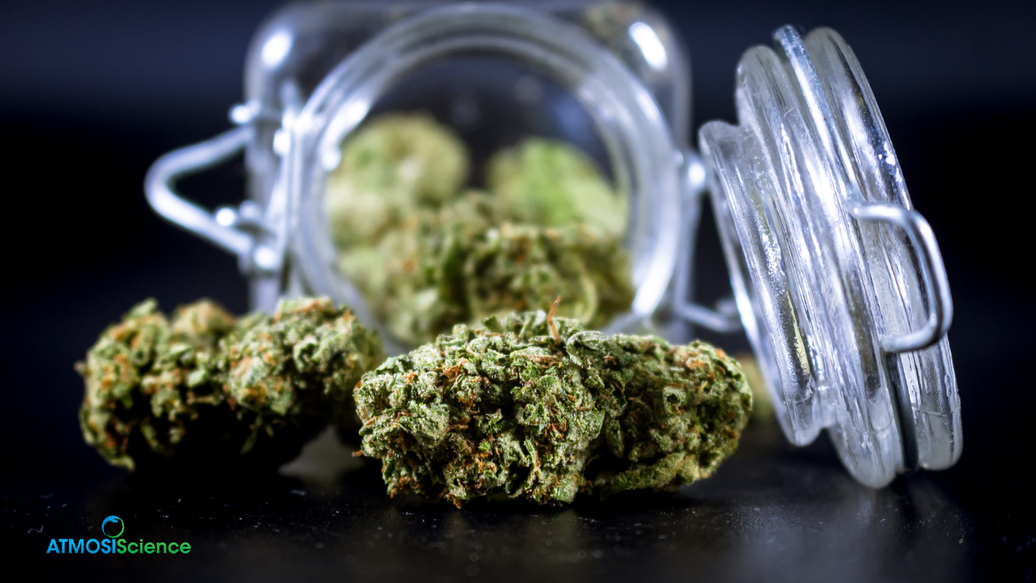
3. HumidiShield™ Powered Jars (For Consumer/Collector Storage)
HumidiShield integrate two-way humidity control directly into airtight glass containers.
Verified specifications:
-
Built-in two-way moisture control fiber
-
Automatically maintains 62% RH
-
No separate packets needed
-
Airtight, waterproof, lightproof, odor-proof
-
6-month service life
-
Child-resistant design
Purpose: Bridges cultivation/dispensary operations and end-consumer storage. Consumers purchasing flower can store it in HumidiShield jars where humidity is automatically maintained, preserving terpene and cannabinoid integrity over weeks or months.
Why relevant to quality-focused growers: Your cultivation expertise only delivers value if the final product is properly preserved. HumidiShield provides the consumer-side technology that preserves what you created.
4. Humidi-Cure Plus (For Bulk Bin Storage)
For large-scale operations storing flower in bulk bins during processing or inventory management, Humidi-Cure Plus is a scaled-up technology for larger containers.
Application: Cannabis processors or dispensary networks with 500+ lbs in active inventory can deploy Humidi-Cure Plus in bulk storage bins, maintaining consistent 62% RH passively across entire inventory.

Integration with Cultivation Strategy
A quality-focused grower invests in perfect dehumidification and humidity control during cultivation (as detailed in Parts 1-7). However, perfect cultivation is only half the story.
ATMOSIScience articulates the integrated vision:
"From seed to consumption, we provide the right humidity control solutions for every step in producing and safeguarding your precious herbs."
A complete cannabis operation requires:
-
Active cultivation-phase dehumidification: Removing 100-500 pints/day during flowering
-
Passive post-harvest preservation: Maintaining 62% RH automatically throughout drying, curing, and storage
These solutions operate in different domains:
-
Active systems solve the water vapor load problem during live plant growth
-
Passive systems solve the moisture migration problem during dried product storage
Both are essential. A grower with perfect cultivation humidity but improper post-harvest storage loses 20-30% of product value to degradation.
Energy Efficiency and Economics
A quality-focused grower cannot afford to invest tens of thousands in commercial dehumidification, HVAC systems, and environmental controls during cultivation, then use inadequate post-harvest humidity management.
ATMOSIScience products provide:
-
Zero electricity consumption: Passive two-way fibers; no compressors, fans, or pumps
-
No active monitoring: Fibers automatically regulate based on ambient humidity
-
Scalability: Same technology works from single-jar curing through commercial bulk storage
-
Compliance support: Maintaining 62% RH ±2% supports regulatory compliance for moisture/mold testing
THE COMPLETE VISION FOR QUALITY-FOCUSED GROWERS
The Two Domains of Humidity Control
Cannabis humidity management spans two critical domains:
1. Active Management During Cultivation (Parts 1-7)
Requires understanding VPD, calculating transpiration loads, selecting appropriate dehumidification technology, and maintaining precise environmental control through flowering to prevent botrytis and optimize yields.
Key principles:
-
VPD optimization over isolated RH targets
-
Dew point buffer maintenance (T−DP ≥6-8°C)
-
Late-flower RH <45% as non-negotiable
-
Microclimate elimination through airflow
-
Leaf temperature measurement for true VPD
-
Multiple smaller dehumidifiers over single large unit
2. Passive Preservation During Post-Harvest (Part 8)
Requires maintaining precise humidity from drying through consumer consumption to prevent terpene degradation and mold contamination.
Key principles:
-
Drying at 50-55% RH (10-14 days)
-
Curing at 62% RH (2-4 weeks)
-
Long-term storage at 62% RH ±2%
-
Passive two-way humidity control (ATMOSIScience products)
-
Zero-electricity maintenance systems
-
Uniform humidity distribution (no microclimates)
Why Both Matter Equally
The cultivation expertise detailed throughout this article—understanding dew point buffer, managing microclimates, optimizing for late-flower conditions—is rendered meaningless if the final product degrades through improper post-harvest storage.
Similarly, perfect post-harvest humidity control cannot recover poor-quality buds from humidity-mismanaged cultivation.
Success requires excellence in both domains.
The Quality Grower's Complete Strategy
During Cultivation:
Vegetative Phase:
-
1-2x commercial dehumidifiers (50-100 PPD) for backup
-
Fogging system for humidification
-
Environmental controller for real-time monitoring
-
2+ oscillating fans per 200 sq ft
Flowering Phase:
-
2x150-225 PPD dehumidifiers maintaining <45% RH in late flower
-
Automated environmental control (temperature, RH, VPD tracking)
-
Strategic fan placement for microclimate elimination
-
Leaf temperature monitoring via infrared thermometer
-
Dew point buffer maintenance (T−DP ≥6-8°C)
During Post-Harvest:
Drying (10-14 days): Separate drying room with Humidi-Cure packets maintaining 50-55% RH
Curing (2-4 weeks): Sealed jars with Humidi-Cure packets maintaining 62% RH ±2%
Long-term Storage: ruksak bags or HumidiShield jars passively maintaining 62% RH
Retail Distribution: HumidiShield jars preserving quality through consumer purchase
The Integrated Approach
This complete strategy—active dehumidification during cultivation + passive two-way control post-harvest—optimizes:
-
Capital expenditure: HVAC and dehumidification infrastructure needed only during growth, not storage
-
Final product quality: Humidity-preserved cannabinoid and terpene profiles from cultivation through consumption
-
Regulatory compliance: Precise RH maintenance throughout supply chain
-
Competitive advantage: Premium-quality flower commanded premium pricing
-
Operational reliability: Redundant systems and backup capacity prevent single-point failures
Final Perspective for Quality-Focused Growers
Cannabis cultivation at scale is fundamentally a humidity management business. Every decision—from genetics selection to light spectrum to watering frequency—ultimately impacts water vapor management and dew point control.
Growers who master humidity achieve:
✓ Complete elimination of botrytis and mold losses
✓ 10-20% yield improvements through optimal VPD
✓ Superior bud density, color, and terpene preservation
✓ Regulatory compliance without chemical interventions
✓ Premium product quality commanding premium pricing
✓ Repeatable, predictable results cycle after cycle
Growers who fail at humidity lose crops to mold, experience yield penalties, produce inferior quality, and incur regulatory violations.
There is no middle ground. Humidity control is non-negotiable for quality cannabis production.
This deep dive has provided the scientific foundation (VPD, dew point, transpiration), practical targets (stage-specific RH ranges), operational procedures (nighttime management), equipment selection (dehumidification technologies), and post-harvest preservation (ATMOSIScience solutions) to master humidity control from seed to consumer.
The question is not whether humidity control matters. The question is whether you're willing to implement the discipline required to execute it perfectly.
Quality growers answer that question with precision, consistency, and obsessive attention to detail.
REFERENCES
Greenhouse Grower, "Ways to Calculate Water Use and Transpiration Rates for Indoor Cannabis Cultivation," 2022-01-13
Floraflex, "Water Use and Transpiration Rates For Indoor Cannabis," 2022-02-28
Ripper Seeds, "Vapour Pressure Deficit (VPD) in Cannabis Cultivation," 2025-05-27
Advanced Nutrients, "Using a VPD Cannabis Chart to Optimize Plant Performance," 2024-11-22
Royal Brinkman, "Humidity Control in Cannabis Cultivation – It's All About the Dew Point," 2021-11-20
Green Avenger Seeds, "Dew Point vs. Bud Rot: A Grower's Guide to Nighttime Safety," 2025-09-23
DryGair, "Preventing Bud Rot – Essential Tips for Cannabis Producers," 2024-12-07
Quest Climate, "Dehumidification 101 for Cannabis Growers," 2025-03-30
Dimlex Lighting, "Vapor Pressure Deficit - The Ultimate Guide," 2022-04-26
Reddit, "Discussion: VPD and Infrared Thermometer Accuracy," 2025-02-05
AC Infinity, "VPD Thermometer, Handheld Environmental Monitor," 2026-01-11
Royal Brinkman, "Humidity Control in Cannabis Cultivation," Knowledge Center
MariaJane420 Taiwan, "ATMOSIScience - HumidiShield™ 50ml Black Humidity Control Jar," 2025-04-16