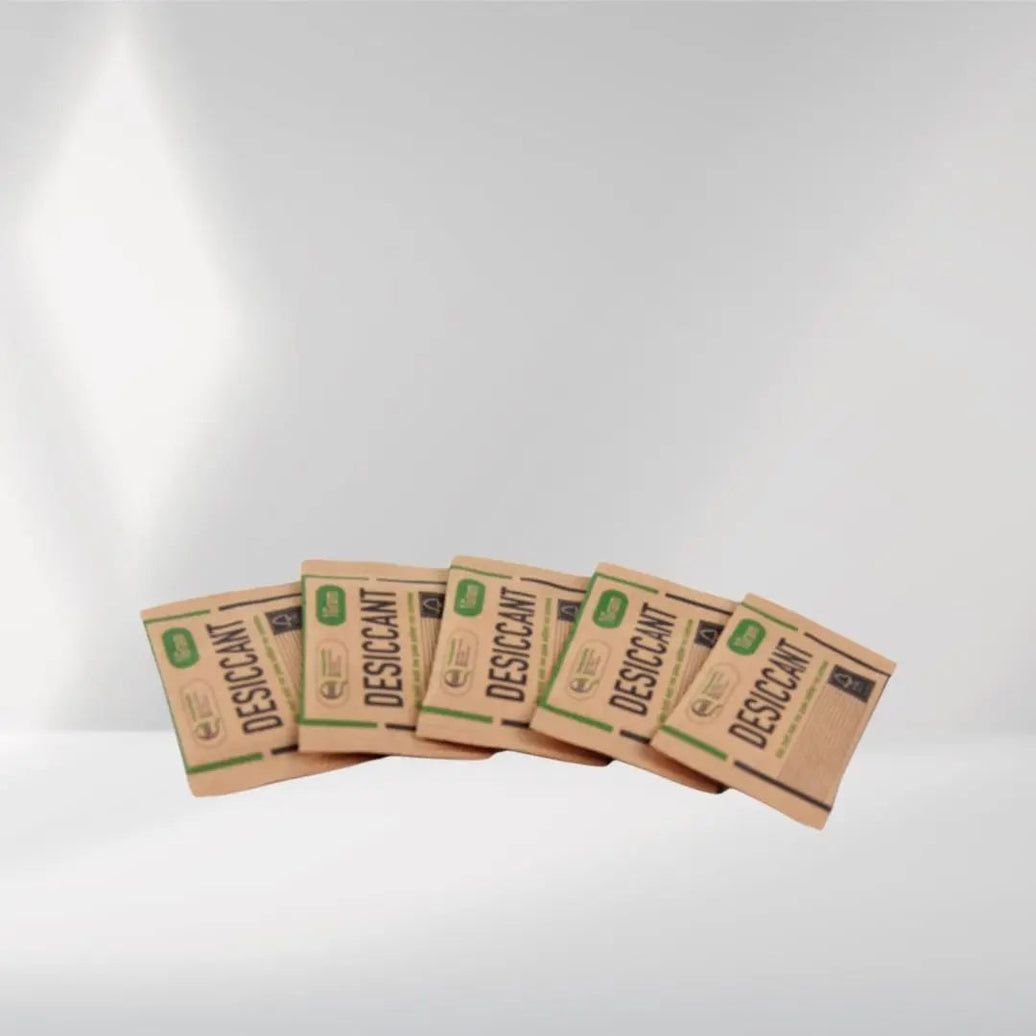
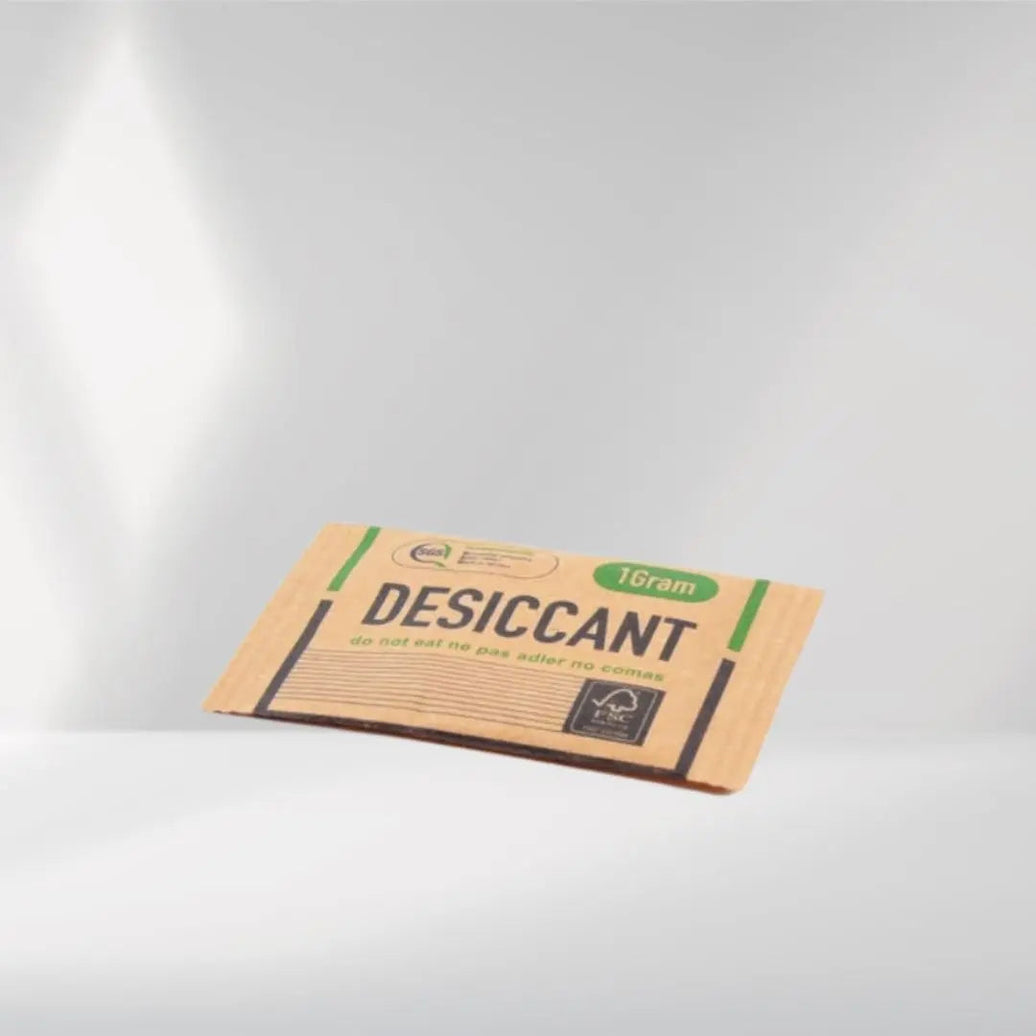
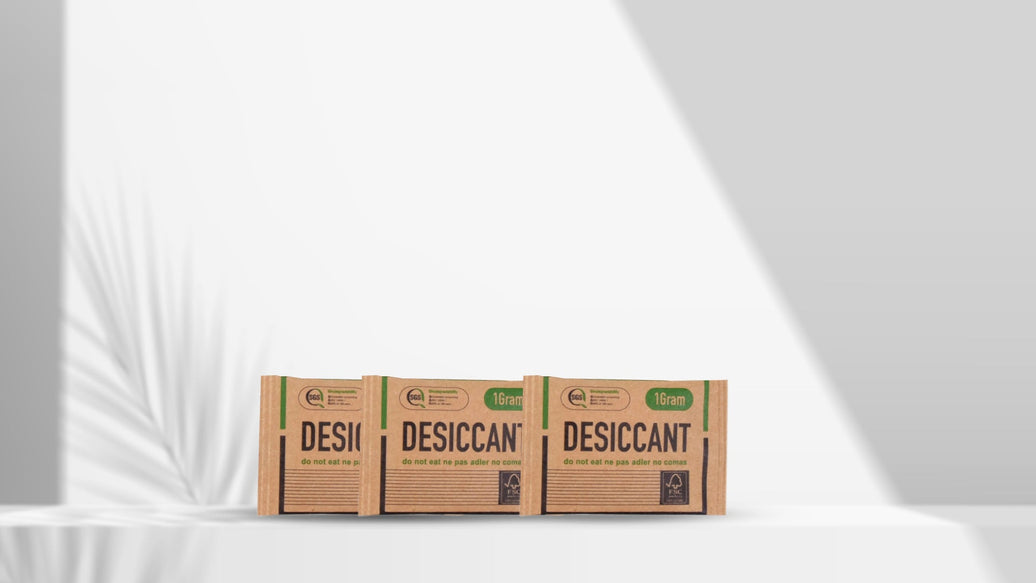
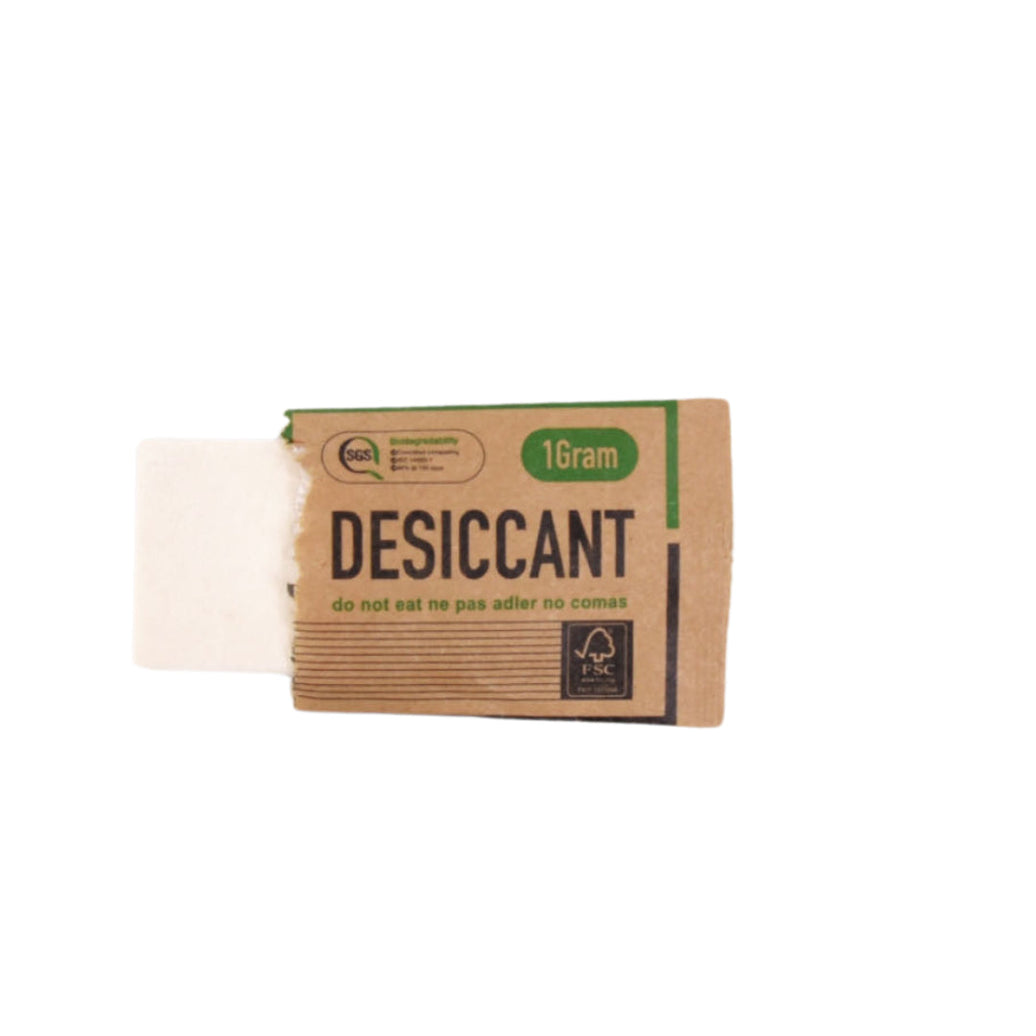
One enquiry we get several times a year arrives as a single line: interested in single-use desiccants for use with cleaning products. No format, no chemistry, no target humidity. That is the whole brief.
This is the answer we would have given if the message had gone on. It is a decision guide for anyone putting a desiccant into a non-food chemical pack: what moisture does to each product format, why a blend's critical humidity is not that of its worst ingredient, which desiccants make a chemical pack worse, and what belongs on the spec sheet.
The short answer: There is no published desiccant standard written for household chemical packs — the only applicable one is MIL-D-3464E, which defines capacity at 20% and 40% RH, and that dry-side regime, not the usual 80% RH headline, is where your product actually lives.
Related: Fiber desiccant · Fiber technology
Start by naming the gap
Food-contact desiccant compliance is thoroughly documented: 21 CFR Parts 170–199 for the framework, amorphous silica gel GRAS under §182.90, synthetic zeolites and molecular sieves under §177.1520, and a direct-versus-indirect contact distinction that tells you whether the wrapper as well as the fill must be food-safe.
The household-chemical side has nothing equivalent — no threshold humidity, no material list, no test protocol written for the application. That absence is itself the finding: you cannot look this up, so you must reason from first principles about what moisture does to your chemistry. The one applicable published standard is MIL-D-3464E, a military packaging specification, not a food-based one.
What moisture does, by product format
| Format | Primary moisture failure | Why it matters |
|---|---|---|
| Powdered laundry / dish detergent | Caking, then bricking | Four mechanisms, one irreversible |
| Sodium percarbonate / oxygen bleach | Decomposition, active oxygen loss | Self-catalysing — the reaction makes water |
| Effervescent cleaning tablets | Premature reaction, bloating, cracking | Trace water starts it; the reaction makes more |
| Enzymatic detergents | Loss of enzyme activity | Scales with the square of adsorbed moisture |
| Anhydrous concentrate refill tablets | Softening, binder failure, dose drift | The product concept depends on staying anhydrous |
Caking is not one process. The peer-reviewed mechanisms are:
- Liquid bridging by capillary condensation.
- Glass transition — sorbed moisture acts as a plasticiser and lowers it.
- Solid bridging — particles dissolve at contact points and recrystallise into rigid necks. This is what makes bricking irreversible: dry the powder again and the bridges stay.
- Mechanical consolidation under stacking load.
In spray-dried detergent, higher moisture gives lower bulk porosity but higher compressibility and cake strength — moisture does not only make caking more likely, it makes the cake harder.
Deliquescence lowering: your worst ingredient is not your threshold
Every soluble salt has a deliquescence RH — the humidity above which it spontaneously dissolves in the water it has adsorbed. Most people reach for the figure belonging to the worst single ingredient. That figure is wrong, and wrong in the unsafe direction. In a mixture, the blend's deliquescence RH is lower than that of any single component.
| Salt system | Measured deliquescence RH |
|---|---|
| (NH₄)₂SO₄ – Na₂SO₄ | 76.29% |
| NaCl alone | 75.29% (±0.12) |
| NaCl – Na₂SO₄ | 74.39% |
| NaNO₃ – Na₂SO₄ | 73.19% |
| NaCl – NaNO₃ | 67.07% |
| NaCl – Na₂SO₄ – NaNO₃ | 66.61% |
Sodium chloride alone holds to 75.29% RH; add sodium sulfate and sodium nitrate and the same chloride goes wet at 66.61% — nearly nine points lower, and below every two-salt pair above. A detergent formulation is a multi-salt system by definition, so you cannot predict its critical RH from a table of pure compounds. It has to be measured on the actual formulation.
Note what is not published: no detergent-specific caking RH threshold exists. The only published thresholds are adjacent — dairy and lactose powders below 33% RH to prevent severe caking, sugar silos at risk above 80% RH with guidance to hold below 75%. Useful as bracketing; not a spec.
Self-catalysing failures: percarbonate and effervescents
Sodium percarbonate decomposes as 2Na₂CO₃·3H₂O₂ → 2Na₂CO₃ + 3H₂O + 1.5 O₂ + heat. Read the right-hand side: decomposition produces water, and water is one of its own destabilisers. Once ingress starts, the reaction feeds itself. Above 50 °C it accelerates, with potential self-heating to 110 °C. The named destabilisers are water, transition metals and their salts, organic materials, acids, bases, reducing agents and dirt.
Here is the honest part. There is no published RH at which sodium percarbonate begins to decompose. Nobody should quote you one. The industry does not manage this with a critical humidity — it manages it with particle coating and an accelerated stability test: 35 °C at 80% RH for eight weeks, acceptance at less than 20% active oxygen loss.
Effervescent tablets do the same by another route: an organic acid and a bicarbonate need only trace water to start reacting, and the reaction generates more. There is no stable partial state.
The effervescent control numbers, and where they come from
The published control figures for effervescent manufacture come from the pharmaceutical literature. They transfer to cleaning effervescents because the chemistry is identical, not because anyone wrote a cleaning-industry standard.
| Control point | Published specification |
|---|---|
| Production and compression area | Below 20% RH, at a consistent 21 °C |
| Controlled storage | 25 °C at 25% RH |
| Equipment surfaces and process air | RH ≤30%, all surfaces dry |
| Finished tablet water content | 0.5% or less |
That same literature lists desiccant inside the packaging, and silica gel incorporated into the tube cap, as standard practice — alongside foil, laminated films, individual foil wrapping, hermetic containers and sealing immediately after compression. Note where the desiccant sits: in the normal control set, not as an extra bolted on after a stability study goes badly.
Enzymes and the square law
Detergent enzyme stability turns on hydration state, not on a humidity number. Below monolayer hydration, stability is significantly conserved. At multilayer hydration — demonstrated at 100% RH — activity fell 80% in one week. The mechanism is conformational change, not proteolysis or aggregation: the enzyme is not digested, it is unfolded.
The business case is in the dose–response: inactivation depends on the square of the moisture adsorbed, so halving adsorbed moisture cuts the inactivation rate roughly fourfold. Most protective measures return linearly; this one does not. No specific water-activity target is published, so frame the objective as staying on the monolayer side rather than hitting a number.
Now combine the failure modes. In an oxygen-bleach enzymatic detergent, one moisture ingress does three things: it drives percarbonate decomposition; the decomposition releases water, which drives enzyme inactivation; and the released peroxide also attacks the enzyme. One moisture failure, three effects, and the middle one is a feedback loop.
Choosing the desiccant for a chemical pack
| Desiccant | Capacity | On warming | Fit for a chemical pack |
|---|---|---|---|
| Calcium chloride, unbound | Up to 300% of own weight | Deliquesces | Becomes a corrosive liquid gel with leak risk; needs roughly 4× the packaging material of clay |
| Silica gel | ~35% | Readily desorbs | Efficient below 25 °C; gives water back as the pack warms |
| Clay | 30–40% | Readily desorbs | Same objection, lower capacity |
| Molecular sieve | 700–800 m² internal surface area | Does not readily desorb | Holds at temperature — the advantage where a pack gets hot |
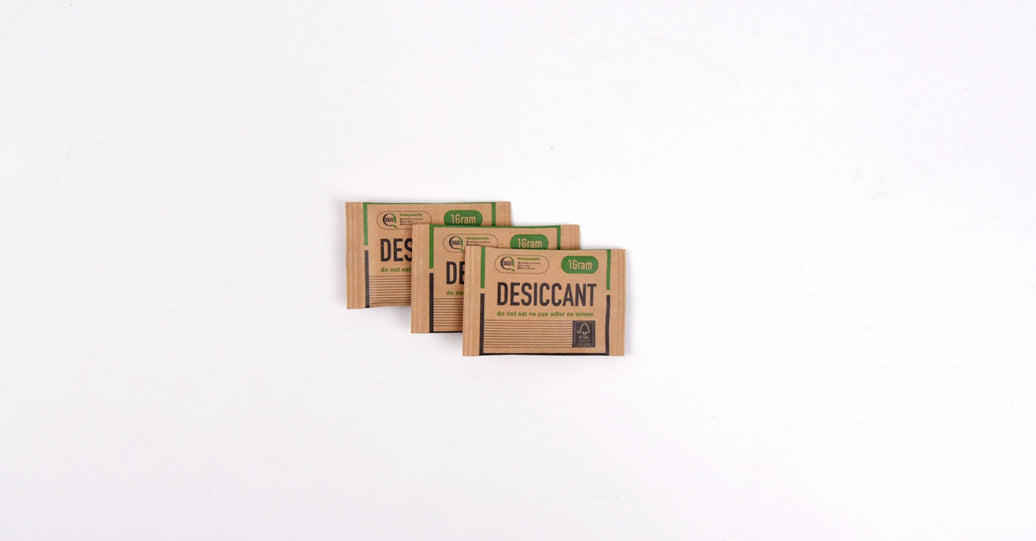
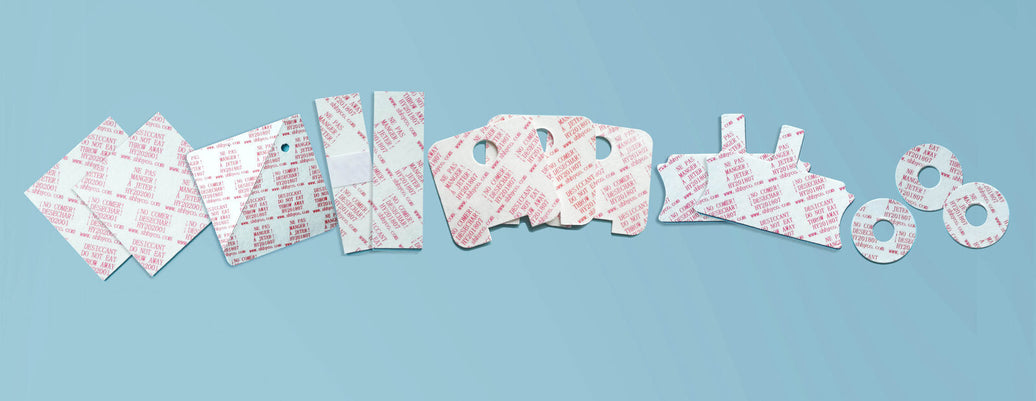
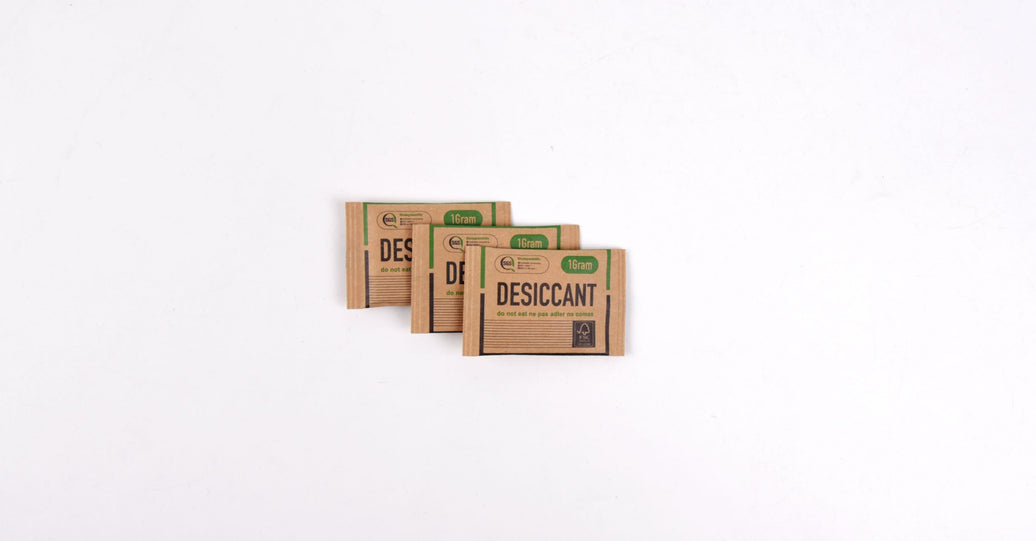
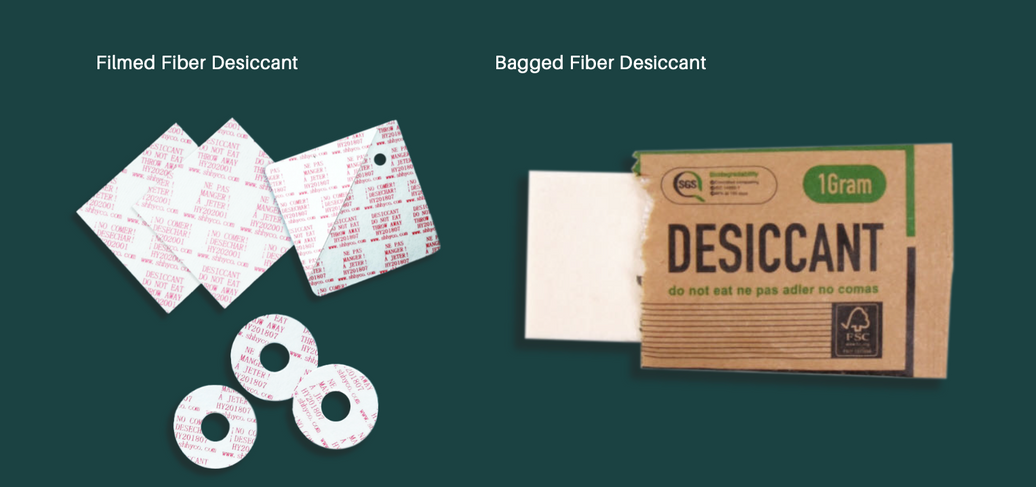
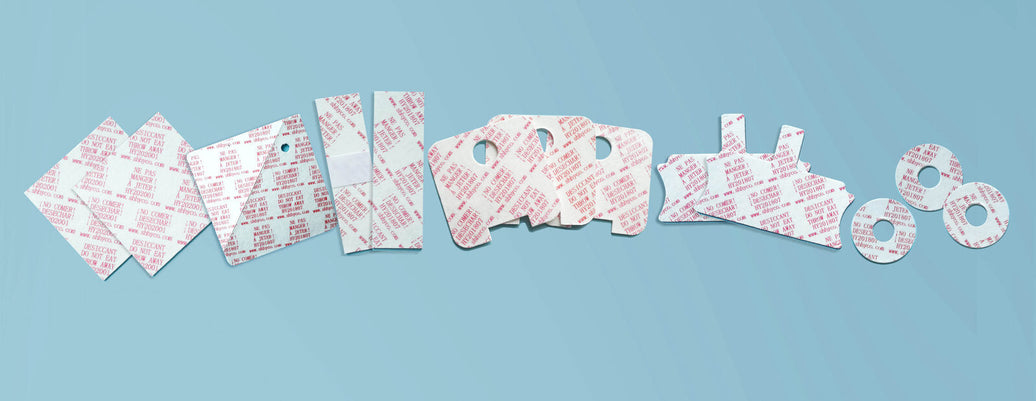
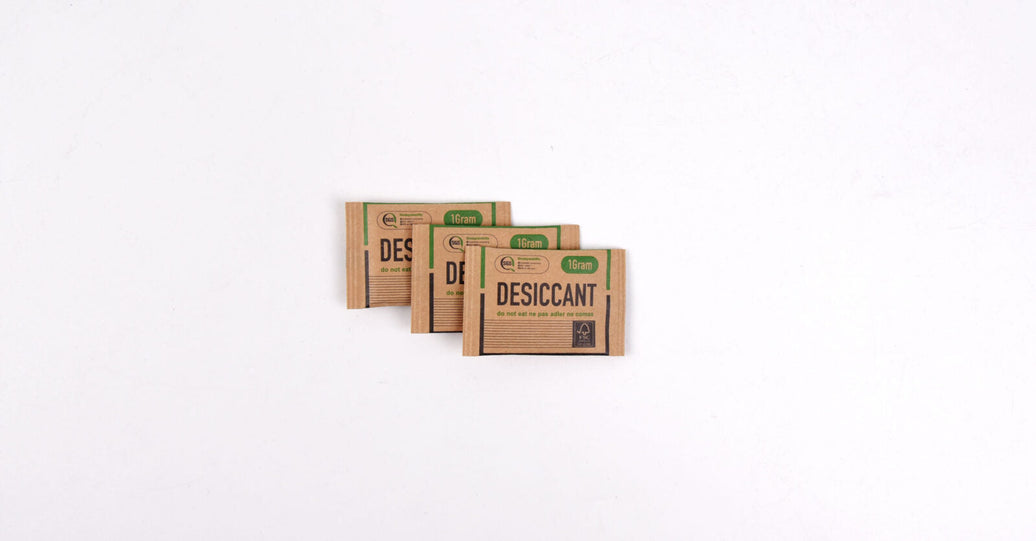
| Plant fibre, bound matrix | >100% bagged; >70% at 25 °C / RH 90 as a filmed sheet | Composition bound in the matrix | Non-dusting sheet, freely die-cuttable, can be bonded into the closure |
A brine leak into a percarbonate or effervescent product is not a mess — it is a formulation failure, because water and salts are both named destabilisers. But the desorption point deserves the sharper emphasis, because it is most often missed: a percarbonate product that self-heats above 50 °C, whose failure mode is moisture-driven, is the worst possible home for a desiccant that gives water back when it warms. In a hot container that desiccant is not neutral — it is a reservoir releasing water into a reaction water accelerates. One further exclusion: blue indicating silica gel contains cobalt chloride, a REACH substance of very high concern, and has no place in a consumer chemical pack.
Dust, immersion, and the dry-side regime
MIL-D-3464E was never written for household chemistry, but three of its provisions map onto a chemical pack better than anything else in print. Type II, non-dusting, at 0.5 mg or less. Desiccant fines in a powder are an unidentified foreign particle in a product the consumer measures by eye; on a tablet surface they are a visible defect and a possible nucleation site. Type III, water-immersion resistant, matters wherever a pack is opened wet or stored in a laundry room.
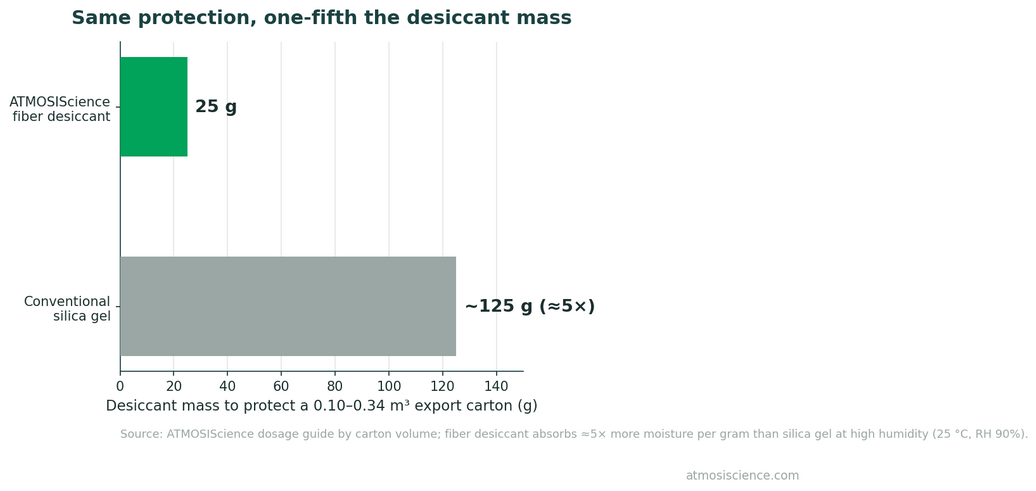
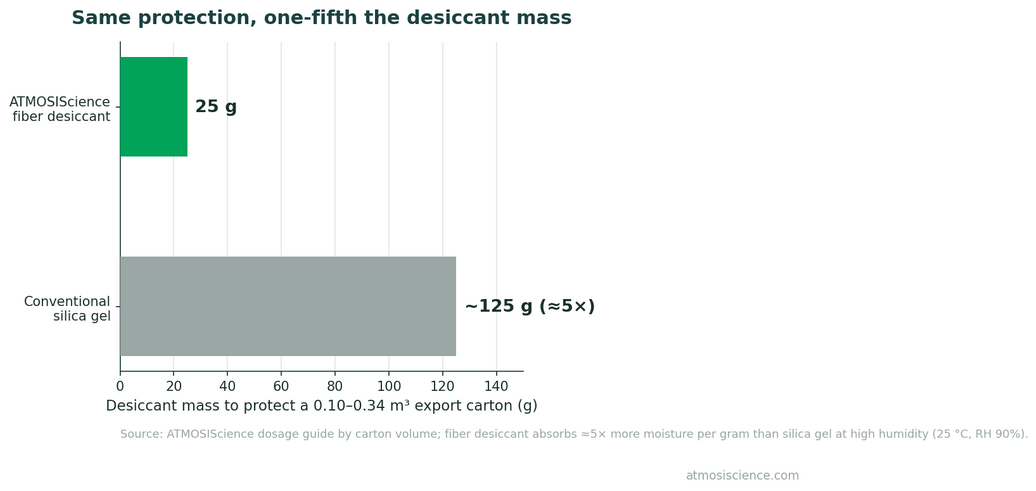
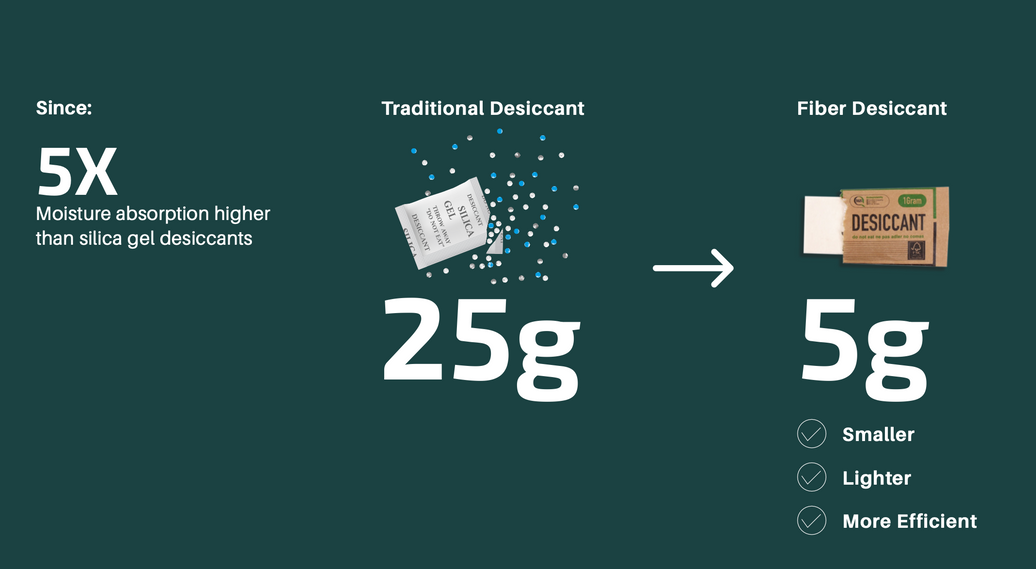
Third, and least discussed: MIL-D-3464E defines a desiccant unit by capacity at 20% and 40% RH — not less than 3.00 g of water at 20% RH and 6.00 g at 40% RH, both at 25 °C. That is the dry-side regime an effervescent or percarbonate pack operates in; a desiccant qualified only at 80% RH was measured in the wrong regime, and its headline number flatters it. On that basis, one desiccant unit is 18 g of fibre, 30 g of silica gel or 35 g of clay.
Dose confusion, and the labelling that is not optional
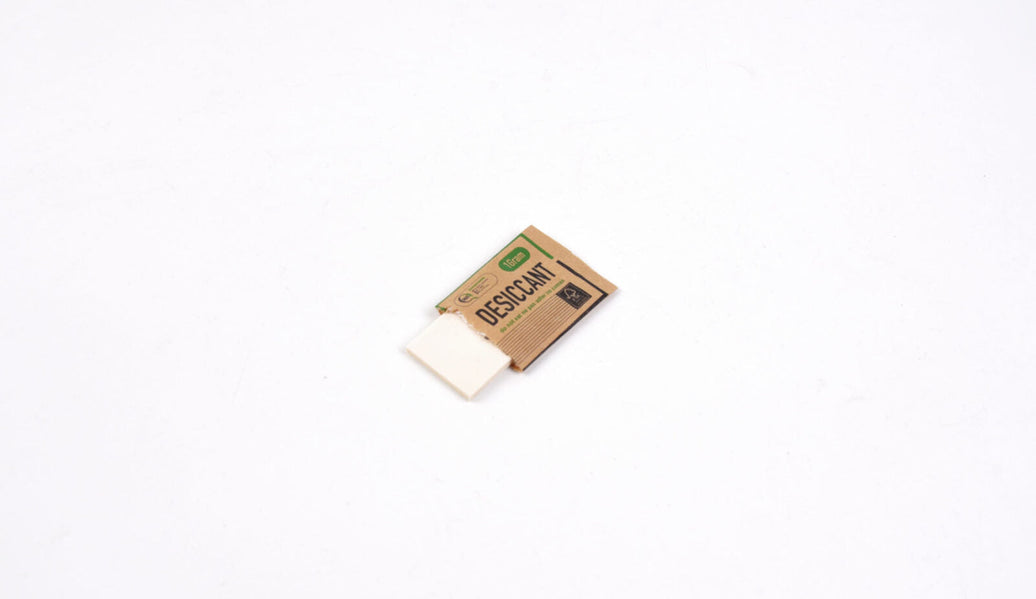
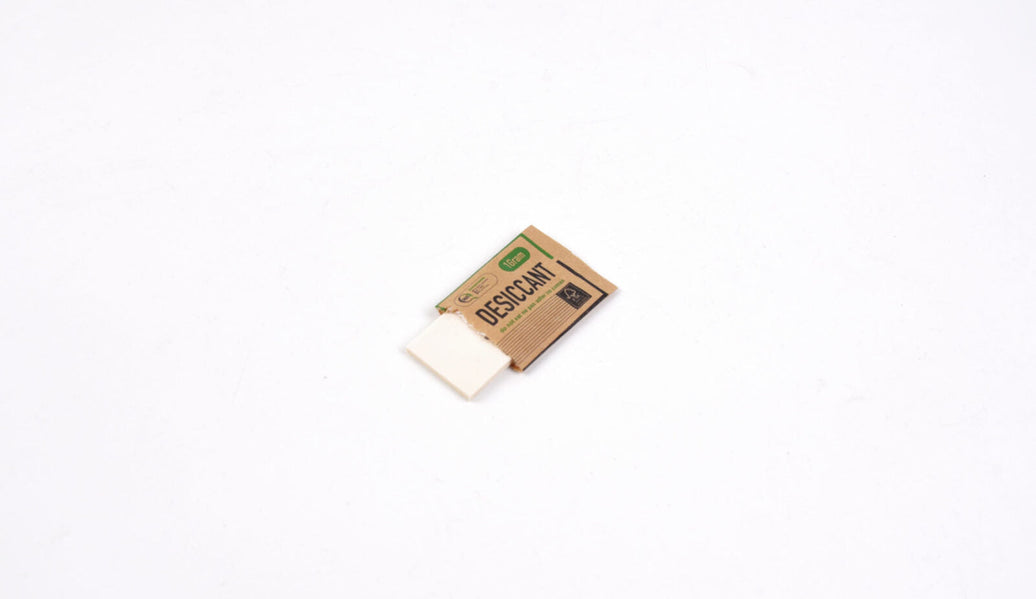
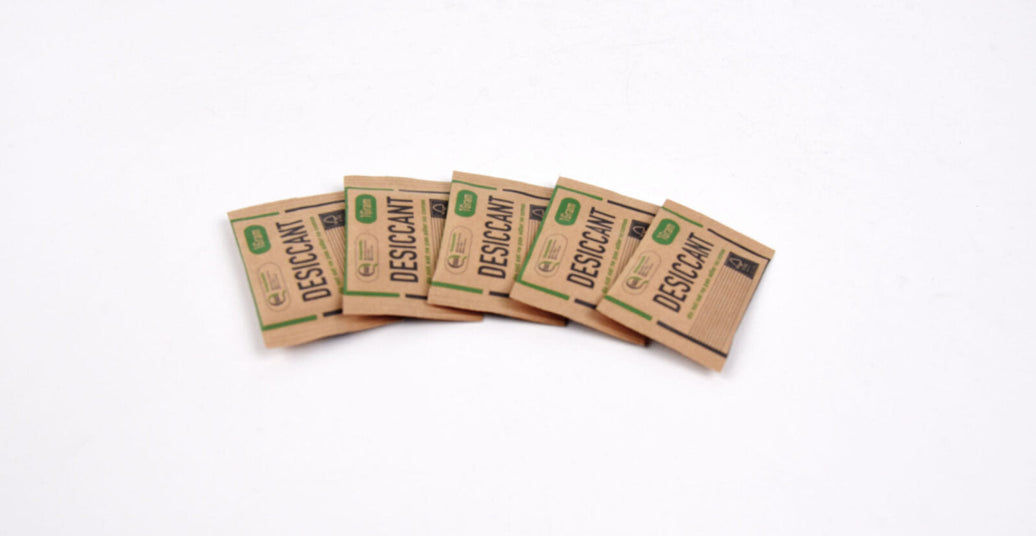
What follows is a design argument, not a cited fact, and we say so plainly: we found no published data on it. But it follows from use. A white sachet loose in a tub where every other white object is a unit dose the user is meant to pick up is a materially higher confusion risk than the same sachet in a shoebox — in a shoebox nothing else is meant to be handled, and in a detergent tub everything is.
The mitigation is design, not warning text: make the desiccant visually and dimensionally unlike the dose, or integrate it into the closure so it is never loose in the pack. A die-cut sheet bonded into a cap is not picked up by mistake, because it is not a discrete object in the hand. That also helps in the US — under California SB 54 a packaging component is counted individually when detachable, and the de minimis carve-out requires the component not be independent or detachable.
"Do Not Eat" marking is mandatory, including on clear or unprinted packets, with lot coding and traceability in batch records. Two end-of-life points are worth budgeting for: hazardous chemicals adsorbed into a desiccant can create a disposal obligation for the spent part, and a desiccant in a fragranced or solvent-containing pack will scavenge more than water, affecting both fragrance retention and end-of-life handling. We could not find permeability data for sachet substrates against volatile chemicals; if that matters to your formulation, it is a test to commission, not a datasheet to request.
The spec checklist
- Capacity stated at 20% and 40% RH, not only 80%. Ask for the isotherm.
- Non-dusting form — MIL-D-3464E Type II, 0.5 mg or less.
- No deliquescence in the delivered form. Nothing that can become a liquid inside the pack.
- Low desorption on warming, especially for percarbonate, peroxide and effervescent products.
- Integrated rather than loose wherever the format allows — bonded, die-cut, or built into the closure.
- Marked and lot-coded, including on clear packets.
- Critical RH measured on your actual formulation, never inferred from its worst single salt.
Sizing then follows from the pack, not the desiccant: capacity divided by ingress across the shelf life, which needs your water-vapour transmission rate and the standard it was measured to. We work through that arithmetic in our sizing calculation, and compare fibre with silica gel in fibre desiccant vs silica gel.
This article is general information, not legal advice. Verify current obligations against your own products and counsel.
Frequently asked questions
Does a desiccant in a cleaning product need to be food-grade?
Not as a matter of law — a household cleaner is not food, so the 21 CFR food-contact citations do not automatically apply. Many buyers specify food-safe materials anyway, because it removes a class of questions and the same converting line often runs food packs.
What humidity should I hold a powdered detergent below?
No detergent-specific threshold is published. Measure the deliquescence RH of your own formulation, because a multi-salt blend goes wet below any of its single components. For bracketing only: dairy and lactose powders below 33% RH, sugar below 75%.
Can I just use calcium chloride? It has the highest capacity.
Unbound, it deliquesces to a corrosive liquid gel, carries leak risk, and needs about four times the packaging material of clay. In a percarbonate or effervescent pack a brine leak introduces two named destabilisers at once. Capacity is the wrong first criterion.
How many months will a desiccant hold my pack?
Not answerable from the desiccant alone. Service life is capacity divided by ingress, and ingress is a property of your pack — its water-vapour transmission rate, measured to a stated standard such as ASTM F1249, E96 or D7709, under stated conditions. Anyone quoting months without your WVTR is guessing.
Tell us the chemistry, not just the pack size
The useful first message names the chemistry — percarbonate, enzyme, effervescent, anhydrous concentrate — the pack format and closure, and the shelf life you must hold. Send it to info@atmosiscience.com and we will return a sizing calculation and the formats that fit, or say plainly if our platform is not the right answer. Formats are on our fiber desiccant page.
Related reading: Fibre desiccant vs silica gel, compared on a standards basis · Desiccant sizing: the JEDEC calculation and the isotherm
Tell us the product, not just the part number
Send us what you are packing, the pack format and the humidity or shelf-life target. We will come back with a sizing calculation, the matching format and the certificate pack.