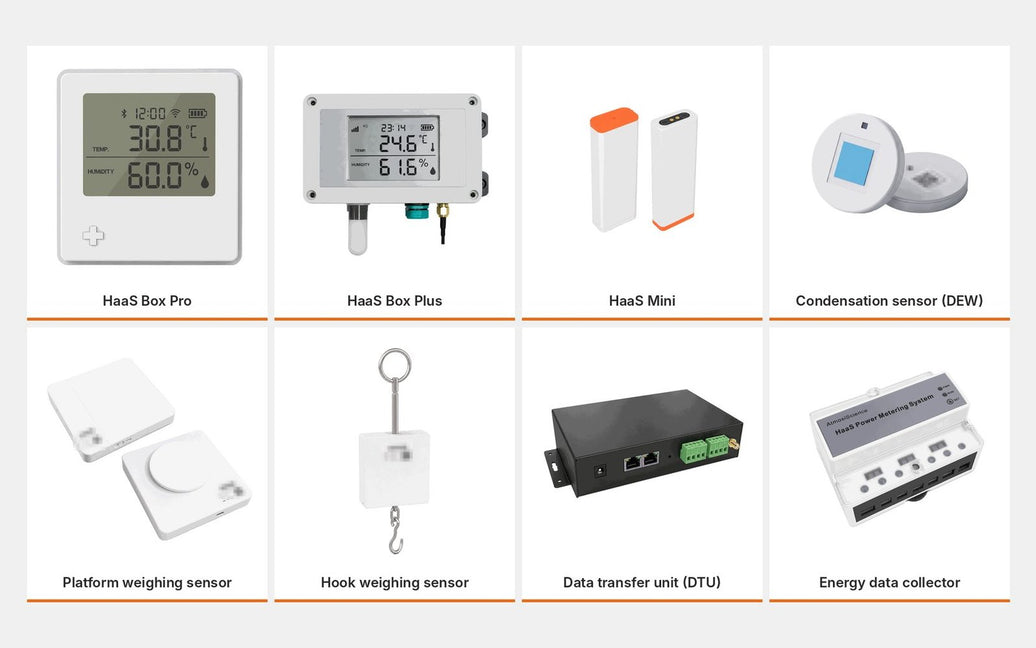
Part 3 of 5 in our HaaS series. Part 2 covered the sensors.
Quick answer: HaasLink is the cloud platform behind HaaS. It connects devices of any brand, stores and analyzes their data, sends alarms as soon as a device reports a reading past a threshold, and drives equipment such as air conditioners and dehumidifiers automatically. You see it all on a web console, a mobile app or a WeChat mini program.

Sensors only matter if someone acts on what they say. HaasLink is where that happens. We develop and operate it ourselves as a one-stop, fully managed IoT service: connectivity, storage, analytics, visualization, alerts and feedback, without writing a line of code.
It connects more than our own sensors
HaasLink is an open platform. There are no brand restrictions on device access, and both the device-side protocols and the APIs are open, with a subscription service for real-time data. It accepts:
- Automation products: PLCs, variable frequency drives, HMIs
- Acquisition and control equipment: analog and digital I/O modules, relay modules
- Instruments and sensors: pressure, flow, temperature, level and weight
Underneath, it speaks TCP and UDP, with application protocols including TCPJSON, MQTT, CoAP and Modbus RTU/TCP. Every protocol is load-balanced for multi-level disaster recovery, and protocol tags and scripts can parse non-standard formats too.

What you can see
The monitoring web app shows every device on your account:
- Real-time monitoring: connection status (connected, disconnected, heartbeat, disabled), live values, switch states, and the option to send values back down to a device.
- Historical query: trend curves, data lists you can export to Excel, and statistics such as maximum, minimum, average, cumulative values and differences.
- Location tracking: live position, historical trajectory and adjustable playback, useful for mobile loggers on the road.
Alarms that reach the right person
An early-warning trigger does two things. It pushes an alarm message, and it can forward the data to a control device so equipment on site responds. Alarm channels include WeChat, SMS, voice call and email, and the system also supports power-outage alarms. Triggers fire the moment a device reports, so you hear about a problem as early as possible.

Linkage control: let the data run the equipment
HaasLink can switch water pumps, valves, air conditioners, ventilators and other appliances as temperature and humidity change. You pick from four strategies:
- LLM-powered intelligent linkage
- Logic threshold control
- Scheduled linkage
- Manual linkage
This is the piece that ties monitoring back to energy. Materials hold the baseline, so powered equipment runs for less time.
Scheduled tasks and cross-protocol relay
A scheduled task forwards device data on a time rule. It can send fixed values or data from other sensors, and it can relay data between devices that speak different protocols. For example, a sensor reports over Modbus, the platform parses and repackages the data, and a device gateway receives it over MQTT.
The data center view
The HaaS data center dashboard brings three analyses together:
- Temperature and humidity statistics across the space
- Dynamic deviation analysis against your target temperature and humidity
- Energy consumption share for each piece of mechanical and electrical equipment
On your phone
- WeChat mini program: the Enterprise Edition supports the customer's own registered mini program account, with the code published by HaasLink.
- Android and iOS app: switches between Chinese and English, suited to overseas customers. The Enterprise Edition offers a white-label app.
Built to be trusted
The system runs independently. Data is stored in more than one way, resumable transmission helps keep it authentic and secure, and the platform includes automatic backup plus account and permission management. Backup power supplies, linkage controllers and alarm units round out the setup, and we offer custom development on request.
Next in the series: HaaSMind: AI Models for Shelf Life, Condensation and Moisture Diffusion
Frequently asked questions
Can HaasLink read sensors from other brands?
Yes. Device access has no brand restriction, and DTUs and edge gateways bring existing equipment online.
How are alarms sent?
By WeChat, SMS, voice call and email, plus power-outage alarms.
Is there an English app?
Yes. The Android and iOS app switches between Chinese and English.
Want to see which alarms and controls your site needs?
Tell us about your site and the equipment that runs it.
Prefer email? info@atmosiscience.com