Part 2 of 5 in our HaaS series. Start with Part 1.
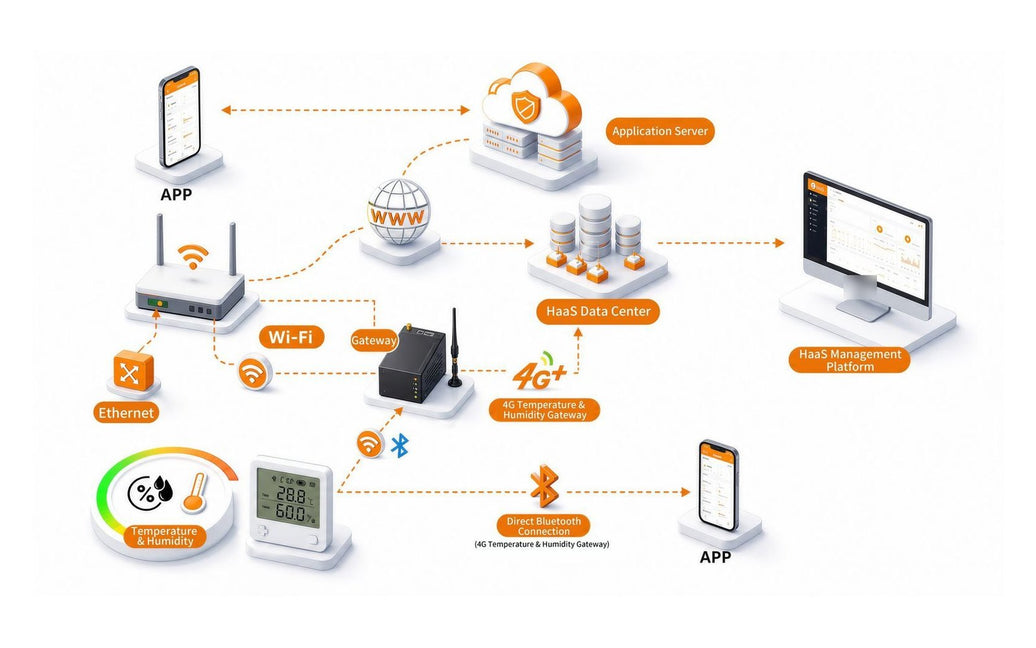
Quick answer: HaaS uses four kinds of smart terminals: temperature and humidity loggers, condensation sensors that also read surface temperature, weighing sensors that track humidity-conditioning materials by weight, and energy data collectors. Gateways and a DTU move the data to the cloud.

We call smart terminals the "nerve endings" of the system. They're where every data point starts and where control actions end. They do three jobs: capture environmental data in real time, trigger equipment from preset rules, and run data cleansing and logic operations locally, which reduces cloud bandwidth load and improves response speed and stability.
Same accuracy across the range
Every temperature and humidity terminal below shares the same core accuracy:
- Temperature: ±0.2 °C
- Humidity: 0 to 100% RH range, with accuracy of ±1.0% RH (20 to 60% RH), ±1.5% RH (below 20% and 60 to 90% RH) and ±2.0% RH (90 to 100% RH)
Temperature and humidity loggers
| Model | Best for | Range | Power and life | Notable |
|---|---|---|---|---|
| HaaS Box Pro | Indoor spaces (indoor standard series) | -10 to 60 °C | 2 × AA; over 3 months on Wi-Fi, over 8 months on Bluetooth | Swiss Sensirion sensor, full-range compensation calibration, screen, live curves on your phone |
| HaaS Box Plus | Logistics, warehousing, field work | -10 to 60 °C | Built-in 5,000 mAh battery, 1 year | IP65 waterproof, 4G, external sensor, movement trajectory |
| HaaS Mini | Compact spaces | -10 to 60 °C | Built-in 200 mAh battery, 1 year | IP65, magnetic charging, 260,000 records |

Condensation sensors
The HaaS condensation sensor (model family DEW) reads three things at once: air temperature, humidity and surface temperature. From those three readings, condensation inside a space can be calculated directly, in real time. Its main uses are electrical cabinets, energy storage and automotive, and it's designed for enclosed cavities.

| Version | Temperature range | Power and life | Size |
|---|---|---|---|
| Round high-temperature | -10 to 105 °C | Built-in 200 mAh, 1 year | 33 mm diameter × 6.5 mm |
| External-battery high-temperature | -10 to 105 °C | 800 mAh external battery, 18 months at 1-minute sampling | 17 × 28 × 3.5 mm |
| Rechargeable (ambient) | -10 to 60 °C | 150 mAh, 10 months, over 30 charge cycles | 30 × 38 × 6.8 mm |
All three are IP65, store 260,000 records, use a surface temperature probe plus a temperature and humidity probe behind a waterproof breathable membrane, and mount with double-sided tape. Data goes straight to a phone or through a gateway.
Weighing sensors: watch the material work
HaaS weighing sensors log the weight of humidity-conditioning materials over time, with temperature and humidity built in. We use them to monitor how much moisture a material absorbs and releases, so you can see the material doing its job instead of guessing.
| Version | Capacity | Accuracy | Use |
|---|---|---|---|
| Platform | 20 g to 1 kg | ±0.02 g at 20 g; ±0.5 g at 1 kg | Lab-grade monitoring of absorption and release |
| Hook | 1 kg and 5 kg | ±0.5 g at 1 kg; ±1 g at 5 kg | Long-term online monitoring of large humidity-conditioning assemblies and hanging industrial materials |
Both are rated for 10 months of standby time on a single full charge of a 1,200 mAh lithium battery, with more than 30 charge cycles.
Getting data off site: gateway and DTU
- HaaS Data Gateway: Ethernet, Wi-Fi and (on the 4G version) 4G. It connects up to 32 Wi-Fi devices and 50 Bluetooth devices, covers about 300 m² of open area and reports every 30 minutes.
- DTU (data transfer unit): an edge-side data hub with Ethernet, 4G or Wi-Fi, MQTT, TCP, HTTP and UDP, Modbus RTU and up to 255 RS485 channels. It's how existing sensors join the cloud. Power draw is under 3 W.
Measuring the energy side
The Energy Data Collector connects to electricity, water, gas and other meters and acquires and processes consumption data in real time. It handles AC 5 to 500 V, 10, 50 or 100 A, three-phase three-wire or four-wire wiring, and sends data over Wi-Fi every 30 minutes. That's what lets the system show how much power your dehumidifiers and air conditioners actually use.
Closing the loop: linkage controllers
The linkage-control layer drives air conditioners, dehumidifiers, humidifiers and circulation fans automatically. Controllers include the infrared linkage controller (one per air-conditioning unit), the RS485 infrared linkage controller and remote linkage switches.
Which terminal do you need?
| If you're protecting... | Start with |
|---|---|
| A room, lab or storeroom | HaaS Box Pro (the indoor standard series), plus a gateway |
| A small, compact space | HaaS Mini |
| Goods in transit or a damp site | HaaS Box Plus (waterproof, 4G) |
| Electronics in a sealed enclosure | A condensation sensor |
| A humidity-conditioning material you want to verify | A platform or hook weighing sensor |
| Energy use of climate equipment | An energy data collector |
Protecting electronics from condensation already? Our anti-condensation page shows our anti-condensation packs.
Next in the series: From Sensor to Dashboard: the HaasLink Platform
Frequently asked questions
How accurate are HaaS humidity sensors?
±1.0% RH between 20 and 60% RH, ±1.5% RH below 20% and from 60 to 90%, and ±2.0% RH from 90 to 100%. Temperature is ±0.2 °C.
Can a sensor measure condensation directly?
The DEW sensor reads air temperature, humidity and surface temperature, and condensation is calculated from those three readings.
Do I need a gateway?
Not always. Terminals can report directly to a mobile device or through a gateway. The gateway acquires, stores and reports data from terminals and weighing sensors in real time for remote management.
Not sure which mix fits your site?
Send us the space, the size and what you're storing.
Prefer email? info@atmosiscience.com