Part 5 of 5 in our HaaS series. Part 4 covered the AI models.
Quick answer: We run projects through a seven-step cooperation process, from raising the problem to establishing a standard. You get four deliverables: a humidity control benchmark report, a parameter library, a shelf-life support package and a selection guide. Acceptance is judged on five KPIs.

You've seen the materials, the sensors, the platform and the models. Here's how they come together on a real project, and what lands on your desk at the end.
The seven-step process
Our cooperation process has seven steps, and every step, from requirements communication to final delivery, is evidence-based, auditable and traceable:
- Raise the problem
- Organize the requirements
- Design the plan
- Run the trials
- Fit the model
- Finalize the material
- Establish the standard
The four deliverables
| Deliverable | What's inside |
|---|---|
| Humidity control benchmark report | RH-time curves, saturation behavior, and a one-way vs two-way material comparison |
| Parameter library | k_e, K_m and water activity set points, plus acceleration factor indications |
| Shelf-life support package | Equivalent-time interpretation and correlation with your product's functional data |
| Selection guide | Material type, dosage, package sealing and cost margin |
How success is measured
We judge acceptance on five KPIs:
- Time spent inside the RH target window
- Maximum deviation
- Saturation risk
- Mass balance
- Product fit and economics
How a deployment runs on site
- Test preparation: on-site survey and assessment, then the test plan.
- Device preparation: choose the devices and test their functions.
- On-site deployment preparation: issue deployment drawings.
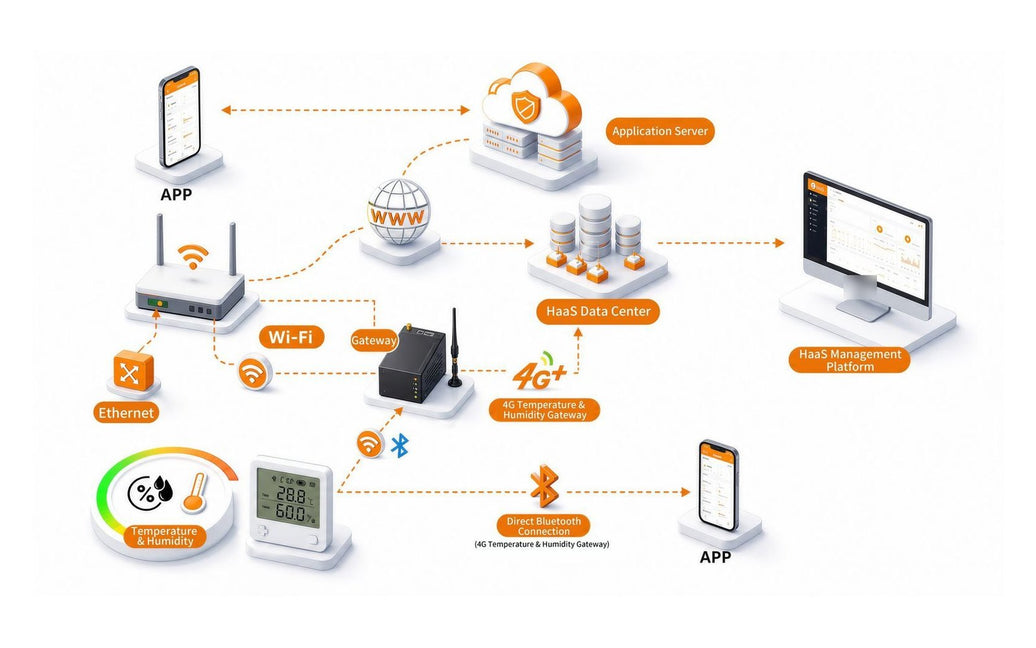
- On-site deployment: install to the drawings, commission devices, add them in the HaaS App.
- Data association: configure scenarios and devices on the management platform, then run functional tests.

Our deployment principles for test scenarios:
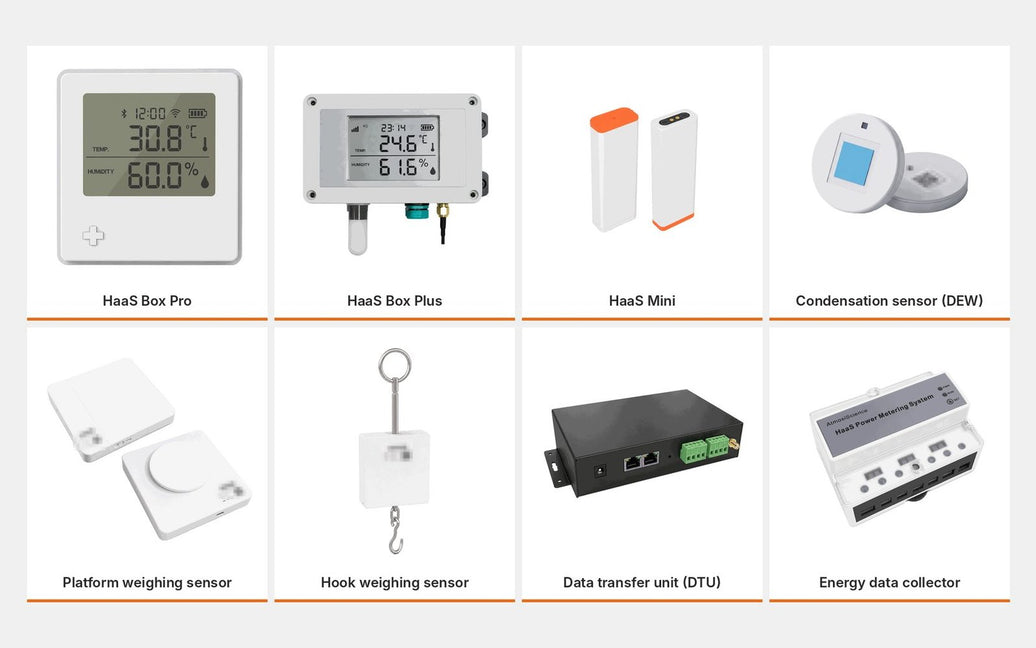
- One temperature and humidity terminal every 6 to 8 m.
- Ceilings over 4 m get two levels of terminals, upper and lower.
- One energy data collector per piece of mechanical and electrical equipment.
- One infrared linkage controller per air conditioner.
- One gateway per 400 m².
The minimum system is five temperature and humidity terminals, one gateway, two energy data collectors (dehumidifier and humidifier) and one infrared linkage controller for the air conditioner.
Example 1: simulating a long-haul shipment in a climate room
Our climate room test system is about 20 m² with a 3 m ceiling and a temperature range of -20 to 60 °C. One terminal goes on each wall at 1.5 m height, using the waterproof HaaS Box Plus, with a wired gateway (HaaS_GT-PHY) uploading every 10 minutes to ensure data completeness. The test then plays out a shipment in three stages:


| Stage | Conditions | What it simulates |
|---|---|---|
| 1. Initial moisture exposure (24 h) | 26 °C at 83% RH, rising to 90% RH in the last 2 hours; 5 mL/m² water mist sprayed on the sample; a damp substrate inserted between the middle layers | Cargo caught in light rain, with moisture-affected packaging |
| 2. Long-haul gradient (72 h) | 26 °C to 18 °C and 83% to 50% RH, then 18 °C to 8 °C and 50% to 35% RH, then an 8 to 15 °C day-night cycle with RH swinging from 35% to 70% | Traveling north from Guangdong, then cold and dry near Shandong, then port day-night swings |
| 3. High humidity before unloading (48 h) | 10 °C ±2 °C at a constant 94% RH | Conditions that accelerate mold on moisture-affected cargo |
Example 2: anti-condensation in a shipping container
For flour transport, we test in a container scaled to 1:3 of a standard 20-ft unit. A standard protection group (kraft paper fixed with adhesive tape, then covered with PE film) runs against a differential protection group, and door gaps are sealed so outside moisture doesn't skew results. Sensors sit in four layers (top surface, side face, the middle of the stack and near the floor), each with one temperature and humidity sensor plus two or three thermocouples, all feeding one HaaS DTU.

What our materials have delivered
These two benchmark cases are results of our humidity-conditioning materials themselves, not HaaS monitoring projects. The conditions matter, so we've kept them.
- 5G base stations. Anti-condensation packs in outdoor AAU/RRU units and integrated cabinets retained at least 80% of performance after hot-cold shock, with an expansion rate of 10% or less and a 10-year effective life. That life figure holds under the agreed use and operating conditions, with no more than 20% performance decay over 10 years.
- Museum storeroom retrofit. Passive humidity-conditioning boards delivered more than 50% overall power saving, 4.4% humidity fluctuation and 0% formaldehyde. Those figures come from a sealed collection storeroom of a national first-class museum, under agreed use conditions and door-opening frequency.


Ready to start?
Every project starts with step one: the problem you're trying to solve. Tell us what you're protecting, where it's stored or shipped, and what "good" looks like for you.
Want the materials side first? Start with anti-condensation or fiber desiccant.
Frequently asked questions
What do I receive at the end?
A humidity control benchmark report, a parameter library, a shelf-life support package and a selection guide.
How is the project judged?
Against our five acceptance KPIs: time in the RH target window, maximum deviation, saturation risk, mass balance, and product fit and economics.
How long does monitoring run?
For packaging validation, we run 30 days of dynamic monitoring, which produces an auditable data package.
Start with step one
Tell us the problem you're trying to solve.
Prefer email? info@atmosiscience.com