In the cannabis industry, finishing a pre-roll is more than a cosmetic decision. The Twist finish and the Dutch Crown finish directly influence ignition, burn uniformity, consistency across batches, consumer perception, and shelf stability. But the variable that determines whether either finish performs well is humidity — specifically water activity (Aw) and relative humidity (RH) throughout grinding, packing, finishing, and storage. ATMOSIScience specializes in scientific humidity control technologies built on water-activity stabilization. Understanding how these principles interact with Twist and Dutch Crown finishing reveals why moisture management has become the defining factor in modern pre-roll manufacturing.
What the Twist Finish Really Is — And Its Moisture Sensitivity
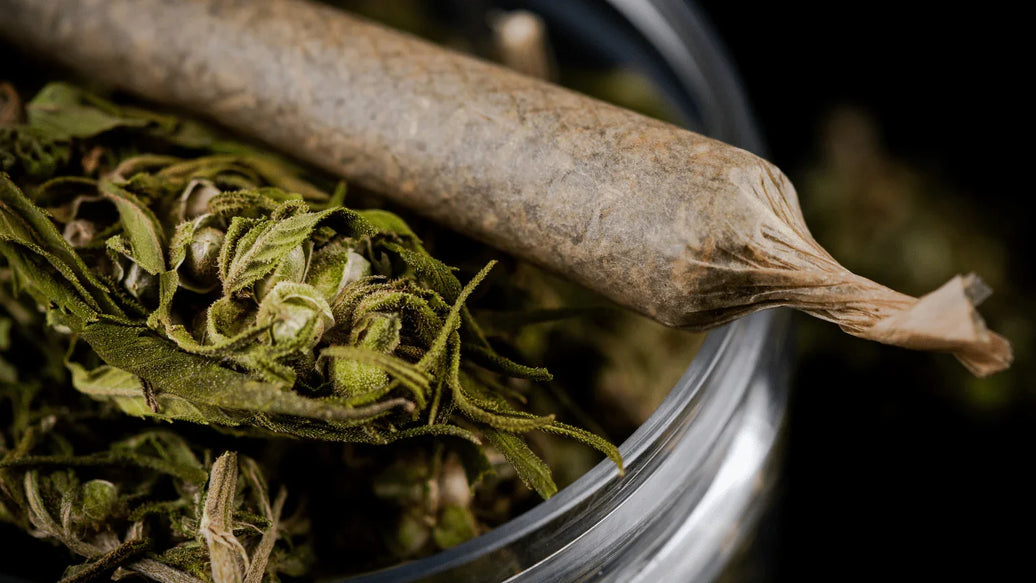
A Twist finish is created by gathering excess paper at the cone tip and rotating it into a tight spiral. It is simple, fast, and requires no specialized tools. But Twist closures are vulnerable to humidity variations because the cannabis inside must maintain enough internal structure to support a clean twist without tearing the paper or displacing plant material. When water activity is too low, cannabis becomes brittle and powdery, causing inconsistent pack density, loose spirals, and fragile tips. When water activity is too high, the flower becomes sticky and compresses unevenly, making the twist messy, difficult to form, and prone to restricted airflow. Because the twist point creates a narrow ignition surface, any imbalance in moisture also makes the pre-roll harder to light evenly. Canoeing — uneven side-burning — increases dramatically when RH fluctuates during production or storage. Twist finishing works best only when the flower maintains a stable water activity and the surrounding microenvironment remains controlled.

Understanding the Dutch Crown Finish — A Premium Fold Requiring Consistency
The Dutch Crown finish folds the paper down into a clean, flat-top “crown” rather than twisting it. This technique produces a smoother ignition surface and typically burns more uniformly. Achieving a proper Dutch Crown requires cannabis with consistent moisture content, stable water activity, and predictable compressibility. When humidity is well controlled, the material packs evenly, the paper folds cleanly, and each crown looks identical across a batch — a visual signal of quality, precision, and brand professionalism. When humidity fluctuates, Dutch Crowns fail: paper tears, folds loosen, compaction becomes uneven, and the final surface loses its uniformity. Because Dutch Crowns rely on geometry rather than a twisted closure, they expose humidity inconsistencies more visibly than Twist finishes. Manufacturers who adopt Dutch Crowns typically do so for premium positioning, but the finish only performs as intended when moisture is managed with scientific accuracy.
Why Humidity Control Matters More Than the Finish Itself
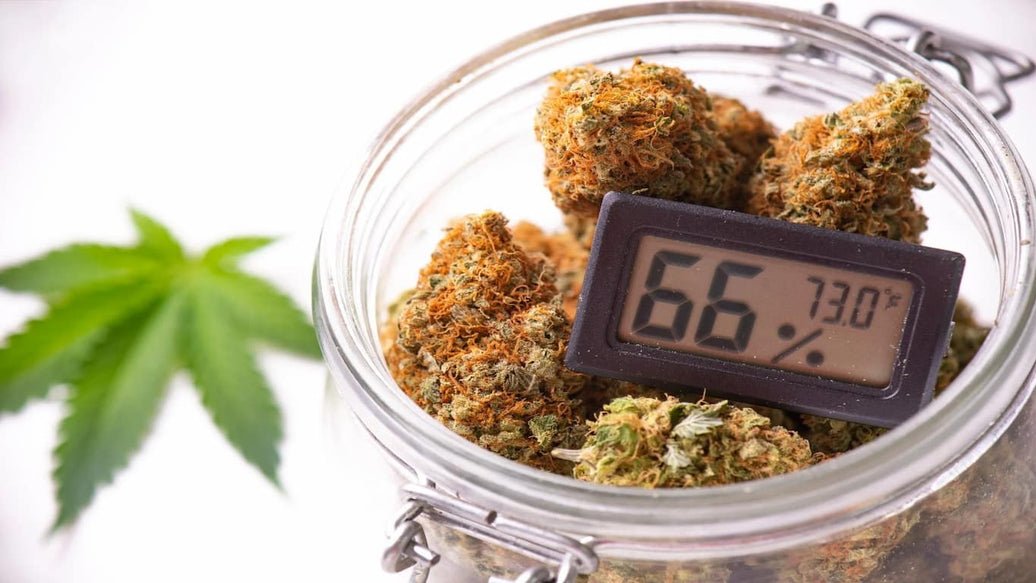
Both Twist and Dutch Crown finishes succeed or fail based on humidity control. The cannabis industry uses moisture content for grinding and packing decisions, but water activity (Aw) is the scientific variable that dictates safety, combustion quality, terpene retention, and microbial viability. Water activity determines how moisture behaves inside the cannabis matrix — not just how much water exists, but how available it is. If Aw is too low, cannabis loses structural integrity, aroma, and smoothness. If Aw is too high, microbial risk increases and cannabinoid/terpene delivery drops sharply during combustion. The optimal water activity target for pre-roll smokability is approximately 0.65 Aw, producing the highest cannabinoid and terpene release while minimizing irritation. Maintaining Aw near this target requires more than a humidity pack — it requires a materials-based and sensor-driven control approach.
How ATMOSIScience’s Technology Supports Twist and Dutch Crown Production
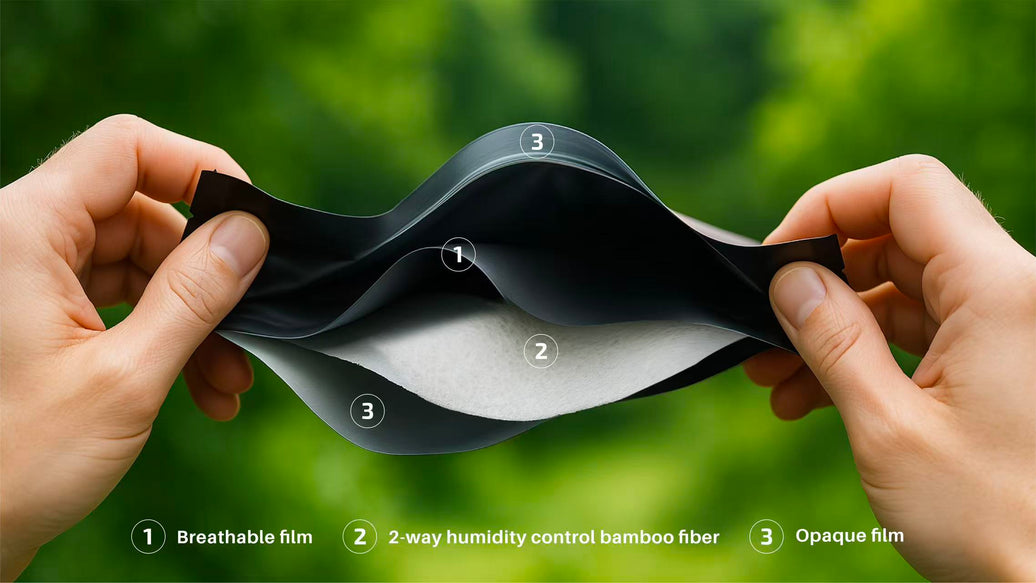
ATMOSIScience’s two-way humidity control materials are built on water activity stabilization, a scientific mechanism detailed in the company’s technical files. Instead of relying on salts or liquid-based solutions, ATMOSIScience uses composite fibers and porous mineral substrates infused with hydrophilic polymer groups. These materials hold a stable internal water activity value. When the surrounding environment becomes too humid, they absorb moisture; when too dry, they release moisture. This two-way balancing behavior keeps the local microenvironment within a tight RH range, enabling: predictable pack density, consistent grind behavior across multi-day production runs, reduced brittleness or stickiness during Twist finishing, clean and uniform folds during Dutch Crown finishing, lower canoeing rates due to stabilized moisture distribution, and long-term preservation of cannabinoids and terpenes. Unlike single-use humidity packets, ATMOSIScience technologies are non-corrosive, salt-free, liquid-free, and designed for precision control rather than broad correction. Their sheet-like configuration and high surface area allow rapid moisture buffering inside pre-roll storage boxes, production trays, curing rooms, or sealed packaging environments. This stabilizes the cannabis before, during, and after finishing.
The Science: Water Activity, Relative Humidity, and Combustion Performance
Research and industry validation consistently show that cannabis with stabilized water activity offers superior combustion characteristics. At ~0.65 Aw, cannabinoids aerosolize efficiently, terpenes volatilize optimally without degrading, and combustion remains smooth with minimal throat irritation. If Aw drifts below 0.45, the smoke becomes harsher, the burn rate accelerates, and twist tips become fragile. If Aw rises above 0.75, microbial growth risk increases and burn performance suffers, even when the flower appears “fresh.” ATMOSIScience humidity control materials are engineered to bring the surrounding RH into equilibrium with the Aw target, preventing these swings and ensuring that both Twist and Dutch Crown finishes behave predictably throughout lighting and consumption.
Why Dutch Crown Finishes Benefit Most from ATMOSIScience Stabilization
The Dutch Crown finish is often positioned as premium because of its burn consistency and aesthetic refinement. But this advantage only emerges when humidity remains stable during production. Dutch Crown equipment — manual or automated — relies on precise cannabis firmness, which itself depends on equilibrium relative humidity. With ATMOSIScience stabilization in production rooms and pre-roll storage zones, cannabis maintains uniform moisture structure, enabling highly consistent folding geometry, reduced reject rates, and visually uniform crowns across thousands of units. This environmental stability is also critical for maintaining brand consistency across multiple facilities or seasonal shifts.
Why Twist Finishes Still Require Scientific Humidity Stabilization
The Twist finish may appear less demanding, but it is actually more sensitive to inconsistent humidity. The narrow ignition point and spiral shape amplify the effects of moisture imbalance in the tip. Stabilized humidity through ATMOSIScience materials ensures that Twist tips remain firm but pliable, allowing operators to produce clean, tight spirals that light evenly. By controlling Aw throughout grinding, packing, and storage, Twist-finished pre-rolls burn more uniformly and exhibit reduced canoeing.
Integrated Pre-Roll Production Workflow Using ATMOSIScience Humidity Control
A modern cannabis facility can integrate ATMOSIScience solutions at each stage: drying and curing rooms equipped with ATMOSIScience mineral-composite humidity boards to stabilize Aw; grinding and staging areas protected with fiber-based humidity stabilizers that maintain consistent processing conditions; pre-roll finishing rooms (Twist or Dutch Crown) stabilized to prevent day-to-day variation in cannabis firmness; conditioning and holding rooms using ATMOSIScience sheets to maintain uniform RH while pre-rolls equilibrate; sealed packaging incorporating ATMOSIScience fiber inserts to preserve Aw throughout shelf life. This vertically integrated approach ensures that every environmental stage supports combustion quality, preservation chemistry, and finishing precision.
Conclusion: Twist and Dutch Crown Finishes Perform Best Under Scientific Humidity Control
The cannabis industry often debates whether the Twist or Dutch Crown finish is “better,” but the real differentiator is atmospheric stability. Both finishes rely on moisture-dependent mechanical behavior — Twist requires elasticity without brittleness, and Dutch Crown requires firmness with pliable folding characteristics. Without precise humidity control, both finishing styles suffer. ATMOSIScience’s water-activity–based humidity control materials provide the scientific consistency needed to support both techniques. By stabilizing the microenvironment before, during, and after production, ATMOSIScience enables manufacturers to deliver smoother burns, cleaner finishes, longer shelf life, and more reliable consumer experiences — regardless of whether the pre-roll ends in a Twist or a Dutch Crown.