A growing list of US states either require or incentivize cannabis packaging that is recyclable, reusable, or compostable. The market has responded with everything from "ocean-friendly" claims with no certification to fully BPI-certified compostable packs at premium prices. For a brand manager or packaging buyer, the real question is not whether to go compostable — it is which spec, what cost, what RH control, and what switching workload. This guide answers those four questions.
The four buyer questions
| Question | Short answer |
|---|---|
| Which certification matters? | BPI for North America. TUV OK Compost (Industrial / Home) for global brands. Anything without one of those is marketing language, not compliance. |
| What does state law actually require? | Most states require child-resistant + opaque + tamper-evident. A handful (CA, NY, CO) layer on extended producer responsibility (EPR) for plastic packaging — compostable can earn fee reductions. |
| Does compostable hurt RH control? | Only if the compostable layer replaces the moisture barrier without compensation. The fix is a hybrid: barrier mylar (or recyclable equivalent) + compostable internal humidity sachet. |
| What is the all-in cost vs conventional? | Typically 15–35% cost premium per unit at low volumes, narrowing to 5–15% premium at OEM volumes once the supply chain stabilizes. [VERIFY current pricing] |
What "compostable" actually means
Compostable is a regulated term. To use it on packaging in the US without legal risk, the spec must meet ASTM D6400 (industrial composting) or ASTM D6868 (compostable coatings on substrates), and ideally carry the BPI (Biodegradable Products Institute) certification mark.
There are three categories worth distinguishing:
- Industrially compostable — breaks down within 180 days under industrial composting conditions (60°C, controlled moisture, microbial inoculum). Most certified-compostable cannabis packaging falls here.
- Home compostable — breaks down under backyard compost conditions. Stricter spec; only some materials qualify.
- Biodegradable (uncertified) — vague, often misleading. Without an ASTM-spec test result, this term is increasingly flagged in greenwashing enforcement.
Buyers should reject "biodegradable" claims that lack an ASTM number and a third-party cert.
State-level regulatory snapshot (US, 2026)
Cannabis packaging regulation lives at three layers: (1) cannabis-specific child-resistance rules from each state's regulator, (2) general extended producer responsibility (EPR) laws that apply to all packaging, and (3) federal Truth-in-Labeling enforcement (FTC) on environmental claims.
| State | Cannabis-specific packaging rule | EPR / sustainability angle |
|---|---|---|
| California | Child-resistant, opaque, tamper-evident (BCC §40417) | SB 54 — EPR for plastic packaging from 2027 [VERIFY] |
| New York | Child-resistant + tamper-evident (OCM Pt. 124) | NY Packaging Reduction Act passed 2024 [VERIFY] |
| Oregon | Child-resistant + opaque (OLCC) | EPR for packaging began 2025 [VERIFY] |
| Colorado | Child-resistant + opaque + tamper-evident (CDPHE) | EPR program in build-out [VERIFY] |
| Massachusetts | Child-resistant + opaque + tamper-evident (CCC) | No active EPR yet [VERIFY] |
The pattern: cannabis packaging rules are mostly about safety. The push toward compostable is being driven separately by EPR and brand differentiation.
The RH-control trade-off
The biggest technical risk of switching to compostable packaging is losing the moisture barrier that protects flower weight, terpenes, and shelf-life. A fully compostable pouch made of PLA or cellulose film typically has a higher water vapor transmission rate (WVTR) than mylar, which means the pack loses water faster — straight back into the cure-room weight-loss math brands are trying to solve.
Two viable paths:
Path A — Hybrid pack: mylar barrier + compostable sachet
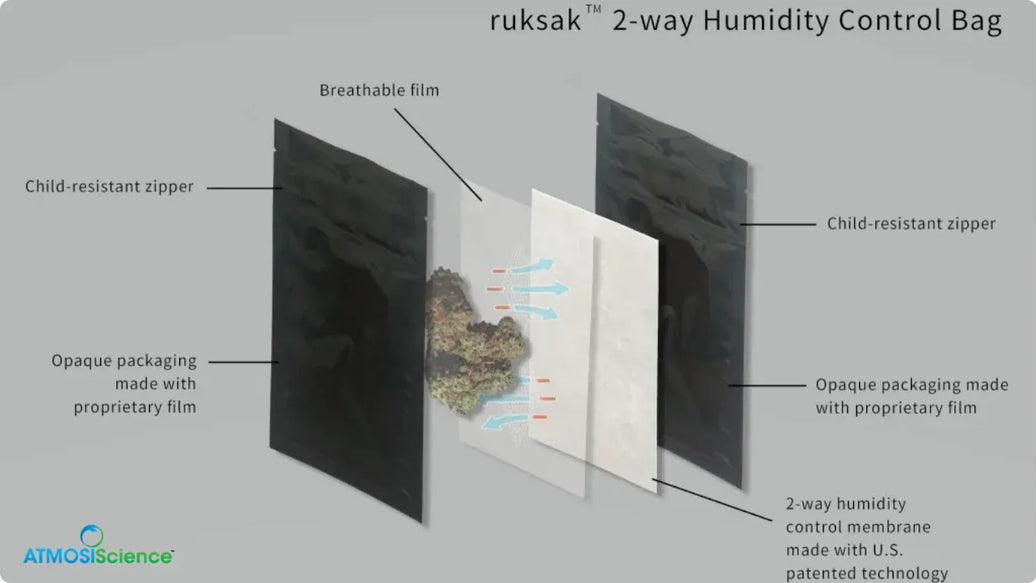
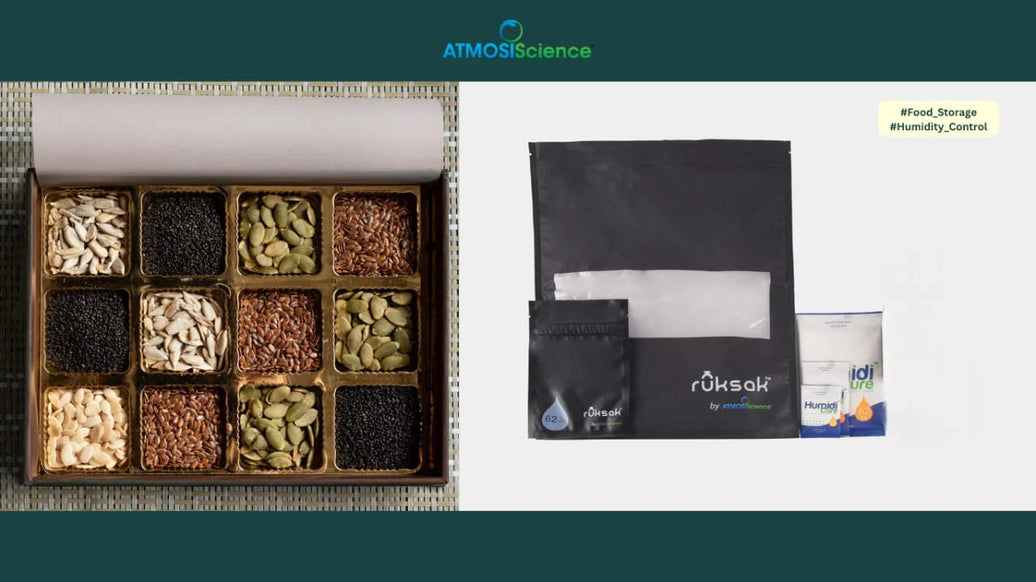
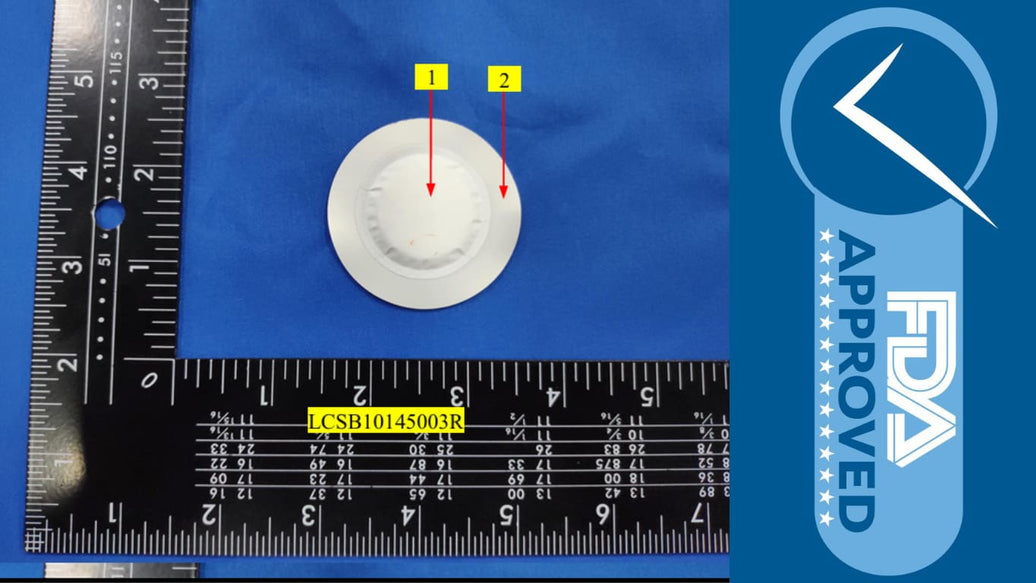
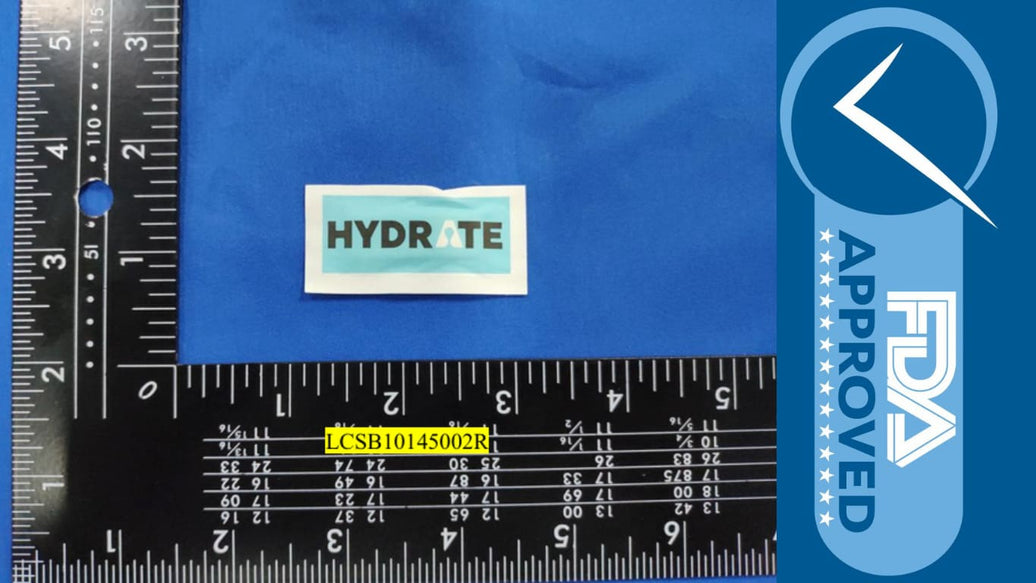
Keep the proven moisture barrier (mylar pouch) and replace only the internal humidity pack with a certified-compostable two-way humidity sachet. This is how ruksak® is built: the matte-black mylar pouch holds the moisture barrier; the bamboo-fiber humidity sachet inside is BPI-compostable. The brand earns the compostable claim on the functional component without sacrificing flower protection.
ATMOSIScience offers ruksak in stocked sizes (7 g through 1 lb) and runs custom-printed OEM versions for licensed brands. Order ruksak as a stocked option →
Path B — Fully compostable pack with engineered RH control
For brands committed to a fully compostable exterior, the pack needs a compostable-certified film with WVTR equivalent to mylar, plus an internal humidity sachet with enough capacity to compensate for any residual barrier loss. ATMOSIScience supports custom OEM runs for this spec.
Cost framing
Conventional mylar pouch with conventional humidity pack: typically $0.20–$0.45 per unit at OEM volumes. Hybrid (Path A): typically $0.25–$0.55 per unit. Fully compostable (Path B): typically $0.45–$0.90 per unit. [VERIFY current numbers]
Per-unit math is misleading without the brand's volume and SKU mix. Compostable cost premiums shrink fast above 50,000 unit annual volumes.
Brand and marketing case
Compostable packaging is a real differentiator for premium and craft brands targeting sustainability-conscious consumers. Three things to confirm before claiming it on the label:
- The cert number is on file. Marketing teams should be able to produce the BPI cert PDF on request.
- Disposal guidance is on the pack. "Industrially compostable — check local facilities" prevents customer confusion and FTC exposure.
- The recyclable / non-recyclable parts are separated. A pouch with a mylar exterior and compostable sachet should call out which part goes where.
ATMOSIScience supplies the BPI cert documentation for the ruksak humidity sachet on request.
Switching cost — what changes for the brand
| Workload | Time | Owner |
|---|---|---|
| Sample test on 1 batch | 2 weeks | Pack-out lead |
| RH headspace measurement | 90 days | Cultivation manager |
| Updated pack art (cert mark, disposal guidance) | 4 weeks | Brand designer + legal |
| Updated state filing (if pack art changes) | 4–8 weeks | Compliance |
| First production run | 6–10 weeks | Procurement |
| Total project | 3–4 months | Cross-functional |
What to ask a packaging supplier
- BPI cert number for any compostable component.
- ASTM spec number (D6400 / D6868) the material meets.
- Water vapor transmission rate (g/m²/day) of the pack film.
- Pack RH set point and tolerance (e.g., 62% ± 2%).
- Capacity rating of the internal sachet vs the pack headspace.
- MOQ, lead time, print spec, child-resistant closure spec.
- Disposal label requirement compliance (FTC Green Guides).
A supplier that cannot answer these in writing should not be on the short list.
FAQ
What does BPI certification mean for cannabis packaging? BPI certifies that a material breaks down under industrial composting conditions to ASTM D6400 or D6868.
Is ruksak compostable? The internal humidity sachet inside ruksak is BPI-certified compostable. The mylar pouch exterior is recyclable through specific film-recycle programs.
Does compostable packaging change how my flower stores? Only if the moisture barrier is weakened. Hybrid packs preserve the barrier and gain the compostable claim on the functional component.
How much more does compostable packaging cost? At OEM volumes, hybrid compostable adds roughly 5–25% per unit vs conventional. Fully compostable adds roughly 30–80% per unit. Both narrow as annual volume grows. [VERIFY current numbers]
Do California / New York require compostable packaging? No. They require child-resistant, opaque, tamper-evident packaging. EPR laws create financial incentives for compostable across all categories.
Can I get ruksak co-branded with my logo? Yes — ATMOSIScience offers OEM custom runs of ruksak with brand printing, custom sizes, and custom RH set points. Request a custom OEM compostable packaging quote →
Bottom line
For most licensed cannabis brands moving to compostable packaging in 2026, the lowest-risk path is the hybrid: keep the moisture barrier that protects flower weight, swap the internal humidity pack for a BPI-certified compostable sachet.
Request a custom OEM compostable packaging quote →
Sources
- Biodegradable Products Institute (BPI), certification standard reference. https://bpiworld.org [VERIFY]
- FTC Green Guides — 16 CFR Part 260. [VERIFY revision]
- CA SB 54. [VERIFY 2026 status]
- NY Packaging Reduction Act. [VERIFY status]
- ASTM D6400 / D6868. [VERIFY citation]
- ATMOSIScience BPI cert documentation. Internal:
_marketing/_context/ASI Certifications/Compostable/.